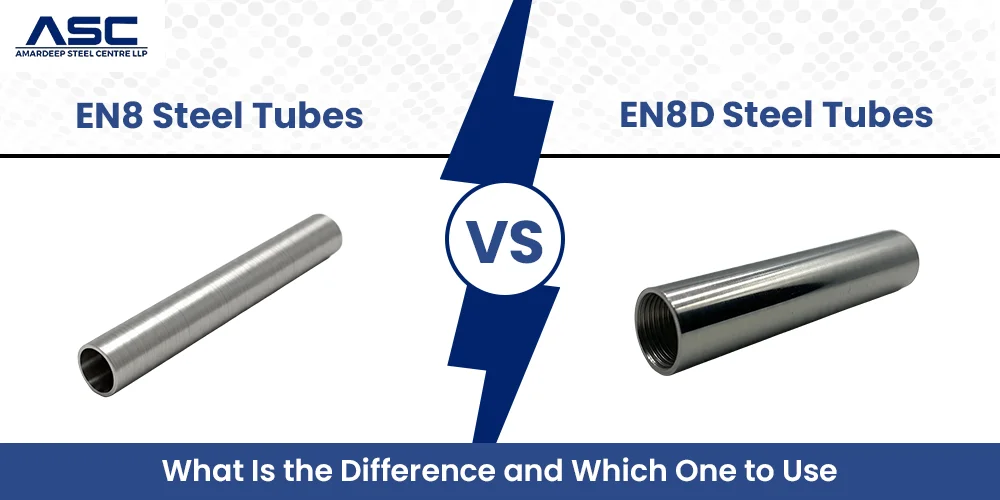
EN8 and EN8D steel tubes are medium-carbon steel products used for components requiring strength, machinability, and wear resistance. The difference is that ordering for EN8 is typically by the mechanical properties of the material (EN8 080M40) and is typically by chemical composition under the relevant BS 970 ordering designation (EN8D 080A42). These two are suitable for machining shafts, sleeves, bushes, spacers and many other engineering components; however, none of these can be regarded as free-cutting steel.Choose EN8 when the drawing needs a guaranteed tensile band. Choose EN8D if you require precision of chemical control and size drawn. The following paper gives a comparison of properties of EN8D, its composition, machinability, equivalent BS 970, and automotive applications.
Both grades are medium carbon steels from the old British standard BS 970, and on paper they look almost the same. The practical difference is in what the standard promises you. EN8 comes with mechanical values for stated conditions. EN8D comes with a tighter chemical analysis and no guaranteed mechanical values.
|
Factor |
EN8 (080M40) |
EN8D (080A42) |
|
BS 970 Designation Letter |
M: Ordered to mechanical properties |
A: Ordered to chemical composition |
|
Carbon Content |
0.36–0.44% |
0.40–0.45% |
|
Manganese Content |
0.60–1.00% |
0.70–0.90% |
|
Guaranteed Property |
Tensile strength in stated condition (R, S, T, or U) |
Chemical analysis (no guaranteed mechanical values) |
|
Commonly Supplied As |
Hot rolled, normalised, or heat-treated bar and tube |
Bright drawn, peeled, or ground bar and hollow bar |
|
Free-Cutting Variant? |
No (EN8M is the free-machining variant) |
No (EN8DM is the free-machining variant) |
|
Nearest EN 10083-2 Grade |
C40 / C45 |
C45 / C45E |
BS 970 describes a steel with a six-character code, and each part tells you something. Take 080A42 (EN8D) and 080M40 (EN8):
So 080M40 (EN8) is a steel you buy for its strength in a stated condition, and 080A42 (EN8D) is a steel you buy for its chemistry. That single letter explains most of the differences in the sections below.
What BS 970 is today. BS 970 has been superseded in Europe by the BS EN 10083 series, so it is best described as BS 970 (withdrawn, still used in trade). Drawings, enquiries and stockists still use EN8 and EN8D every day, which is why we list the nearest EN 10083-2 grades in the equivalent-grade table below.
EN8D Composition Compared With EN8
|
Element |
EN8 (080M40) |
EN8D (080A42) |
|
Carbon (C) |
0.36–0.44 |
0.40–0.45 |
|
Silicon (Si) |
0.10–0.40 |
0.10–0.40 |
|
Manganese (Mn) |
0.60–1.00 |
0.70–0.90 |
|
Phosphorus (P), max |
0.050 |
0.050 |
|
Sulphur (S), max |
0.050 |
0.050 |
|
EN8 Condition (BS 970) |
Tensile Strength (MPa) |
Where EN8D Stands |
|
R |
550–700 |
No guaranteed value; depends on bar condition and size |
|
S |
625–775 |
As above |
|
T |
700–850 |
As above |
|
U |
775–925 |
As above |
|
BS 970 Grade |
EN 10083-2 |
AISI / SAE |
Other |
|
EN8 (080M40) |
C40 / C45 |
1040–1045 |
Werkstoff 1.0511 / 1.0503 |
|
EN8D (080A42) |
C45 / C45E |
1045 (1042–1045) |
S45C (JIS) |
Both grades respond to the same heat treatments. Section size limits how deeply they harden, so check the core strength of thick parts rather than assuming the surface result.
|
Process |
Typical Range |
Note |
|
Annealing |
680–720 °C, slow furnace cool |
Softens for heavy machining |
|
Normalising |
830–860 °C, air cool |
Refines grain and evens out properties |
|
Hardening |
820–860 °C, oil or water quench |
Section size limits through-hardening; check core strength |
|
Tempering |
550–660 °C |
Sets final strength; soak time depends on section |
|
Welding |
Preheat is normally needed; a typical range for this carbon content is 150–250 °C, set by a qualified welding procedure |
Medium carbon content raises cracking risk; follow a qualified procedure |
|
Induction hardening |
Suitable, subject to geometry and required case depth |
Both grades; confirm with the heat treater |
EN8 and EN8D have almost the same chemistry and end up in similar parts, because both give medium strength with good fatigue behaviour once hardened and tempered.
|
Application |
Usually Specified |
Why |
|
Drive and transmission shafts |
EN8 or EN8D |
Strength after heat treatment; EN8D bright stock arrives straight and sized |
|
Axle parts, spindles, studs, pins |
EN8 or EN8D |
Medium strength with good fatigue behaviour once tempered |
|
Sleeves, bushes, spacers (tube form) |
EN8D hollow bar / CDS tube |
Consistent drawn stock cuts with little waste |
|
Gears, couplings, keys |
EN8 |
Normalised or Q / R condition with a stated tensile band |
|
Hydraulic and machinery components |
EN8D drawn stock |
Tight size reduces stock removal |
|
Your Requirement |
Choose |
Check First |
|
Drawing says EN8 or 080M40 |
EN8 in the stated condition |
No swap without design approval |
|
Drawing says EN8D or 080A42 |
EN8D; confirm bright, peeled or ground |
Delivery condition and tolerance |
|
Need a guaranteed tensile band |
EN8 in R, S, T or U condition |
Ruling section and condition letter |
|
Need consistent drawn size and finish |
EN8D |
Straightness and OD tolerance |
|
Fast machining is the priority |
EN8M / EN8DM (where drawing allows) |
Impact toughness, sulphur level |
|
Large section, high core strength |
Move to alloy steel (EN19 / EN24, 4140 / 4340) |
Hardenability and section size |
When neither EN8 nor EN8D is enough
For large sections, high core strength or heavy shock loading, medium carbon steel runs out of hardenability. The usual step up is alloy steel such as EN19 (AISI 4140) or EN24 (AISI 4340). See our 4140 alloy tubing, AISI 4340 tubes and alloy steel tubes, or read alloy steel vs carbon steel for a plain comparison. For everyday medium carbon needs, browse our carbon steel pipes and tubes.
EN8 is specified by mechanical properties, while EN8D is specified by chemical composition. Their typical supply conditions may also differ.
Not necessarily. Strength depends on the delivery condition, heat treatment and section size.
No. EN8D is not a free-cutting steel grade. EN8DM and EN8M are free-machining variants with increased sulphur content.
080A42 is a British steel designation associated with a medium-carbon engineering steel. Its designation should be interpreted using the applicable British standard rather than assuming that each number directly represents a specific alloying element or percentage.
C45E and SAE 1042-1045 may be considered as potential alternatives, depending on the required chemical composition, mechanical properties and applicable standards. They are not exact equivalents, so the material specification should be checked before substitution.
EN8D is a bar designation. Buyers typically require hollow bar with EN8D chemistry or mechanical tubing in a suitable grade, such as C45E or ASTM A519 Grade 1045, subject to the required dimensions and material properties.
Yes. EN8D can be heat treated, but welding requires suitable procedures and may require preheating to reduce the risk of cracking. The appropriate procedure depends on the material composition, section thickness and welding conditions.
Choose EN8 when the drawing requires a guaranteed tensile-strength range in a specified supply condition. Choose EN8D when controlled chemical composition and consistent material characteristics are the priority. Confirm whether the drawing also requires guaranteed mechanical properties before selecting EN8D.
Stainless Steel Metal Fabrication is a very specialised process and is very different from carbon steel, as it has a very different metallurgical behaviour.