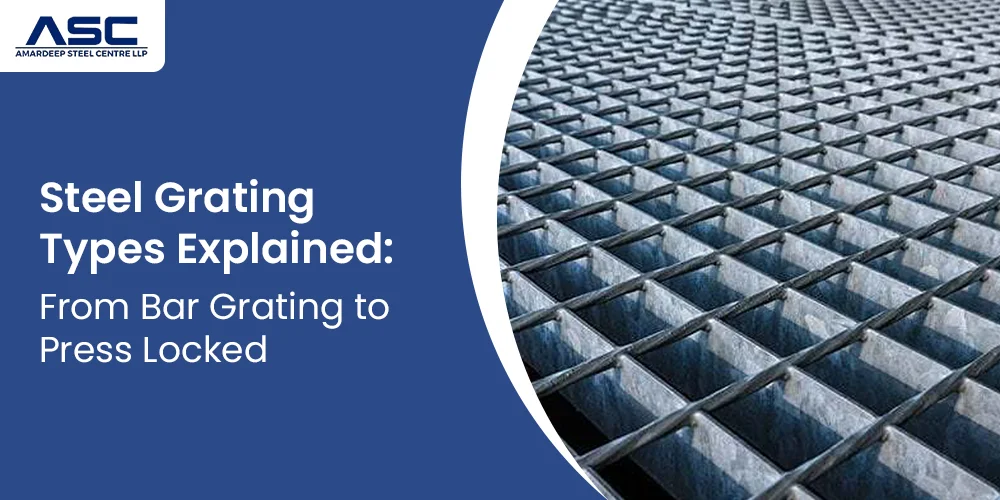
The difference between steel grating types depends on how the crossbars are attached to the load carrying bars, either through welding, press lock, swage lock, riveting and dovetail construction method. The method used determines the load bearing ability, surface and cost of production of the panels. Expanded metal, plank and compound grating are used for lighter applications or closed surfaces.
Steel grating is an open grid system of load-carrying bars interconnected with cross bars in order to create a load-carrying and well-ventilated system. Steel grating is used for supporting loads such as people, tools, and equipment while providing the passage of air, light, water, and any other loose materials due to their perforation. Such properties allow its application in industrial floor systems, walkway systems, stair treads, drainage systems, and trench cover systems. Main parts of steel grating are load-bearing bars and cross bars. The bearing bars support the major part of applied loads while cross bars define spacing between bars.
|
Type |
How Cross Bars Are Fixed |
Load Capacity |
Surface |
Typical Use |
|
Welded (forge-welded) |
Welded to the bearing bars at every intersection |
Highest |
Rigid, robust |
Industrial platforms, heavy walkways |
|
Press-locked |
Cross bars pressed into notched bearing bars |
Light to medium |
Neat, uniform |
Architectural and commercial flooring |
|
Swage-locked |
Cross bars passed through punched holes and deformed |
Light to medium |
Smooth |
Walkways, light platforms |
|
Riveted |
Rivets |
Light |
Mechanically fastened |
Aluminium or stainless light-duty panels |
|
Dovetail |
Cross bars dovetailed into notches |
Light |
Small openings |
Pedestrian areas |
Bar grating is the type of grating based on the way the cross bars are connected to the bearing bars. All methods are mechanical joints with hot dip galvanized (if stated) as a separate joint coating process.
At each corner, cross bars are welded to the bearing bars and the panel is therefore a single rigid grid. Hence, it provides high strength and it is the most chosen option for the heavy loadings and walkways in the industrial platforms. In corrosive environments, or when exposed to the outside air, welded panels are typically galvanized after they are welded.
Pressure locked (press locked) grating is essentially press locked, the bearing bars have notches and the cross bars are pressed into the notches, which is basically a cold deformation joint so that the joint is locked. The outcome is a neat, even appearance and it's suitable for larger bar spacings. It is suitable for architectural, decorative and light to medium duty applications.
Swage locked grating is punched with holes in the bearing bars. Cross bars go through the holes and are swaged, or physically hammered, to hold the holes in place. It is a cold joint that is not welded. Panels have smooth upper surface and joint is not prone to loosen, suitable for walkways and light to medium duty use.
The bearing bars are fitted with cross bars that are then riveted on. This method is normally used on aluminium or stainless steel panels where welding could be difficult or cause damage to the corrosion protective surface. It is used in light-weight and corrosive applications.
The ends of the cross bars are dovetailed into notches in the bearing bars. This creates tight, small openings and a close fit and is used for pedestrian use and when narrow openings are required.
For heavy loads, use welded panels if you are needing a rigid panel. If appearance and wider bar spacing are more important than load, then pressed locked or swage locked are common options. Double check method and load table with supplier.
Bar grating can be supplied with a plain (smooth) top edge or a serrated one. Serrated grating has teeth or notches cut along the top of the bearing bars to improve grip. I-bar grating is a bearing bar profile with a wider top flange, sometimes used for a flatter walking surface. Choose serrated wherever the surface can become wet, oily or icy.
|
Feature |
Plain (Smooth) Bar |
Serrated Bar |
|
Top edge of bearing bar |
Flat, smooth |
Notched or teeth cut along the top |
|
Slip resistance |
Standard |
Better in wet, oily or icy conditions |
|
Comfort for foot traffic |
Smoother |
Slightly rougher |
|
Typical use |
Dry indoor walkways, public areas |
Oil and gas, food processing, outdoor and wet platforms, stair treads |
|
Cost |
Lower |
Slightly higher (extra machining) |
Material choice depends on the environment more than the load. Carbon steel is the default, and stainless steel grating is chosen when zinc coating is not enough. For help with the metals themselves, see carbon steel vs stainless steel, 304 vs 316 stainless steel and aluminium vs stainless steel.
|
Material |
Corrosion Resistance |
Strength / Weight |
Best For |
Watch Out |
|
Carbon steel, hot-dip galvanized |
Good with zinc coating (ASTM A123, or EN ISO 1461 outside the US) |
High strength, heavier |
General industrial platforms |
Coating damage at cuts; galvanizing can distort wide-spaced grating |
|
Stainless steel 304 |
Very good in most environments |
High strength |
Food, pharma, mild chemicals |
Cost; chlorides |
|
Stainless steel 316 |
Better in chlorides and marine |
High strength |
Marine, offshore, chemical |
Higher cost |
|
Aluminium |
Good, no rust |
Light, lower strength |
Where weight matters |
Lower load capacity |
|
Fibreglass (FRP) |
Excellent chemical resistance |
Light, non-conductive |
Chemical plants, electrical areas |
Not steel; lower stiffness and fire/UV limits |
Cut ends and drilled holes in galvanized grating expose bare steel, so touch them up with a zinc-rich coating after fabrication.
Fibreglass grating (also called fiberglass or FRP grating) is a non-metal alternative made from glass fibre in a resin matrix. It is not steel, but buyers often compare the two.
|
Factor |
Steel Grating |
Fibreglass (FRP) Grating |
|
Strength and stiffness |
Higher |
Lower stiffness; more deflection at the same span |
|
Chemical resistance |
Depends on coating or grade |
Excellent in many chemicals |
|
Weight |
Heavier |
Light and easy to handle |
|
Electrical conductivity |
Conductive |
Non-conductive |
|
Fire and UV |
Better fire performance |
Resin limits; UV stabilisation needed |
|
Typical use |
Heavy-duty industrial platforms |
Chemical plants, electrical areas |
Choose steel for heavy loads and higher temperatures. Choose FRP where chemical attack or electrical safety outweighs stiffness.
Work through these points before asking for a quote.
Not sure which bar size and pitch to specify? Send the span, load and finish to our technical team and we will point you to the right load table.
The main types are welded, press-locked, swage-locked, riveted and dovetail bar grating, plus expanded metal and plank grating. Compound grating adds a chequered plate top.
Serrated grating has notched bearing bars for better slip resistance, while plain grating has smooth, flat bearing bars.
Press-locked grating is used for industrial walkways, platforms, stair treads and architectural flooring where a uniform appearance is preferred.
Stainless steel, particularly Grade 316, is suitable for many corrosive environments. FRP grating may also be appropriate depending on the chemicals and operating conditions.
Swage-locked grating secures cross bars through punched holes by mechanically deforming them, while press-locked grating uses pressure to fit cross bars into notched bearing bars.
Bearing bars are commonly spaced at about 30 mm (1 3/16 in) or 40 mm centres, with cross bars at about 100 mm (4 in) centres. Spacing, bar size and span together determine load capacity, so always consult the manufacturer's load tables for the required loading conditions.
Stainless Steel Metal Fabrication is a very specialised process and is very different from carbon steel, as it has a very different metallurgical behaviour.