ASTM A335 P91 Seamless Pipes
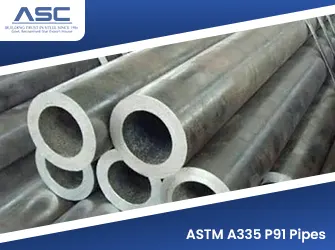
We are a leading stockist and exporter of ASTM A335 P91 Pipe | ASME SA335 P91 alloy steel seamless pipes, available in ready stock for power plant, refinery, and high-temperature applications.
- Sizes: ½" NB to 24" NB
- Wall Thickness: SCH 40 to SCH 160, XXS
- Mill Test Certificate (EN 10204 3.1)
- Third Party Inspection: SGS / BV / TUV
- Cut-to-Length Service Available
- Worldwide Shipping
- Bulk Stock Available for Immediate Dispatch
What is ASTM A335 P91 Pipe?
ASTM A335 P91 / ASME SA335 P91 is a seamless, high temperature and high pressure service, ferritic alloy steel pipe. It is a chrome-moly (Cr-Mo) steel and is uniquely designed to serve the purpose of use where it is necessary to have an excellent creep resistance, oxidation resistance, and thermal stability in the long-term.
The alloy is about 8.00-9.50 percent chromium and 0.85-1.05 percent molybdenum and controlled contents of vanadium and additional strengthening elements. This well balanced alloy produces increased high temperature strength coupled with increased scaling and corrosion resistance to high temperature environments.
ASTM A335 P91 is considered a Creep Strength Enhanced Ferritic (CSEF) steel. It is fabricated by controlled heat treatment in form of normalizing at about 1050 °C, air cooling and tempering at about 760 °C. The metallurgical process is used to stabilize the microstructure and provide undeniable creep strength and long-term survival in cyclic thermal stress.
Having a minimum tensile strength of 585 Mpa and yield strength of 415 Mpa, P91 has much better mechanical performance than the conventional carbon steels and previous grades of chrome-moly P9 and P22. Its superior toughness, weldability and high-temperature deformation are some of the reasons why it is the material of choice in critical service conditions.
ASTM A335 P91 pipes are widely used in Power generation plants, Ultra-supercritical boilers, High-pressure steam lines, Oil & gas processing units, Refineries and petrochemical facilities. Because of its superior metallurgical stability and high-temperature reliability, P91 has become the industry standard for advanced thermal power and heavy industrial applications.
ASTM A335 P91 Chemical Composition
Carbon - 0.08% - 0.12%
Manganese - 0.30% - 0.60%
Phosphorus, max - 0.020%
Sulfur, max - 0.010%
Silicon, max – 0.20% - 0.50%
Chromium - 8.00% - 9.50%
Molybdenum - 0.85% - 1.05%
Vanadium: 0.18% - 0.25%
Nitrogen: 0.030% - 0.070%
Nickel: 0.40% Max
Aluminum: 0.02% Max
Columbium: 0.06% - 0.10%
Titanium: 0.01% Max
Zirconium: 0.01% Max
Mechanical Properties of ASTM A335 P91 Pipes
Tensile Strength: 85,000 psi (585 MPa) minimum
Yield Strength (0.2% offset): 60,000 psi (415 MPa) minimum
Elongation in 2 inches (50 mm): 20% minimum
Hardness: 250 HBW / 25 HRC (maximum)
ASME SA335 P91 Pipe Equivalent Materials
ASME: SA335 P91
EN (European Norm): EN 10216-2 (often grade X10CrMoVNb9-1 or 1.4903)
DIN (German): Approximately 1.4903 (X10CrMoVNb9-1)
Dimensional Tolerances of ASTM A335 P91 Pipes
Outside Diameter (OD) Tolerance
OD 6 mm to 40 mm: ±0.40 mm
OD 40 mm to 100 mm: ±0.79 mm
OD 100 mm to 200 mm: +1.59 mm / –0.79 mm
OD 200 mm to 300 mm: +2.38 mm / –0.79 mm
OD above 300 mm (12 inches): ±1% of the specified OD in the purchase order
Wall Thickness Tolerance
DN 6 to DN 65: +20% / –12.5%
Above DN 65 (t/D ≤ 5%): +22.5% / –12.5%
Above DN 65 (t/D > 5%): +22.5% / –12.5%
Where:
t = Specified wall thickness
D = Specified outside diameter
SA 335 P91 Pipe Applications
ASTM A335 / SA335 P91 are pipes that are used in high-pressure and high-temperature service environs. The material can be bent, flanged (vanstoning), and fused welded, which means that it is very adaptable to the involvement of complex fabrication and installation needs.
P91 finds extensive application in power generation and petrochemical industries where there are conditions of steam, fluids and gases transportation under extreme temperature and pressure. It has a high creep strength and thermal stability, which means that it can be used over long periods without deformation and structural collapse.
P91 has an outstanding strength to weight ratio, which allows it to support thin wall thickness when compared to the traditional chrome-moly grades. This is a beneficial aspect especially in combined cycle power plants as well as the Heat Recovery Steam Generators (HRSG) where thermal efficiency, coil location and optimization in heat transfer are important design considerations.
Common Applications of SA335 P91 Pipe:
- Thermal and nuclear power generation plants
- Combined cycle power plants
- Heat Recovery Steam Generators (HRSG)
- Superheaters and reheaters
- High-pressure steam pipelines
- Petrochemical and refinery units
- Gas processing facilities
- Industrial heaters
- Oilfield and offshore services
ASME SA335 P91 Pipe Welding Procedure
Welding ASTM A335 P91 pipes requires careful control of preheating, inter-pass temperatures, and post-weld heat treatment to preserve the material's microstructure and mechanical properties. Failure to follow proper procedures can lead to catastrophic failures.
For thick-walled pipes, modern induction heating systems are recommended, as they provide uniform heating of the inner and outer diameters, maintain consistent inter-pass temperatures, and are safer for workers. This method is especially effective for complex fittings such as weldolets and tees.
Electrode composition must match the parent material, as elements like nickel and manganese though present in small amounts significantly influence critical temperatures, heat treatment, and cooling rates.
Proper preheating is essential to remove moisture and reduce hydrogen-induced stress corrosion cracking. Post-weld heat treatment should be completed as soon as possible to avoid exposure to moisture and ensure all joints meet hydrostatic testing requirements.
Testing & Inspection of ASTM A335 P91 Pipes
- Tensile Tests
- Flattening Test
- Hardness Test – Maximum hardness shall not exceed:
- 250 HBW
- 265 HV30
- 25 HRC
- Bend Test
- Hydrostatic Test
- Non-Destructive Examination (NDT)
All inspection results are documented and provided with Mill Test Certificates (MTC) as per EN 10204 3.1 / 3.2 upon request.
Heat Treatment of ASTM A335 P91 Pipes
ASTM A335 P91 pipes are supplied in the heat-treated condition to achieve the required mechanical strength and creep resistance. The material is heat treated either by a normalize and temper process or by quench and temper. Normalizing is carried out at a temperature range of 1900–1975°F (1040–1080°C), followed by controlled cooling. This is then followed by subcritical annealing or tempering at a temperature range of 1350–1470°F (730–800°C).
This controlled heat treatment refines the microstructure, enhances creep strength, and ensures long-term stability under high-temperature and high-pressure service conditions.
Available Stock Range of ASTM A335 P91
Outside Diameter: ½" to 24"
Wall Thickness: SCH 40, SCH 80, SCH 160, XXS
Length: Random / Fixed Length
Ends: Plain End / Beveled End
Contact for Latest SA 335 P91 Pipe Price Per Kg
Looking for ASTM A335 P91 seamless pipes in urgent quantity?
We maintain bulk ready stock for power plant shutdown projects and refinery maintenance.
FAQ’s About ASTM A335 P91 Alloy Steel Seamless Pipes
What is the difference between P91 and P22?
The main difference between P91 and P22 is their strength and high-temperature performance. P91 contains about 9% chromium and offers much higher creep strength, better heat resistance, and longer service life in high-pressure steam systems. It is used in advanced power plants and ultra-supercritical applications. P22 contains around 2.25% chromium and is suitable for moderate temperature and pressure conditions, such as conventional boilers and pressure vessels.