Hastelloy fasteners refer to bolts, studs and nuts fabricated using nickel-based alloys that can resist extreme levels of corrosion in difficult industrial settings. The fasteners are selected due to their ability to resist pitting, crevice corrosion and chloride induced stress corrosion cracking, especially in instances where ordinary 304 and 316 stainless steels are unable to provide sufficient levels of protection against corrosion. There are different grades that have varying properties depending on the process fluids, concentrations and temperatures involved. For example, C276 is the ideal choice for most aggressive chemical conditions whereas C22 is suitable for resistant oxidizing acids. B2, on the other hand, is good for reducing conditions with hydrochloric acid, based on operating conditions.
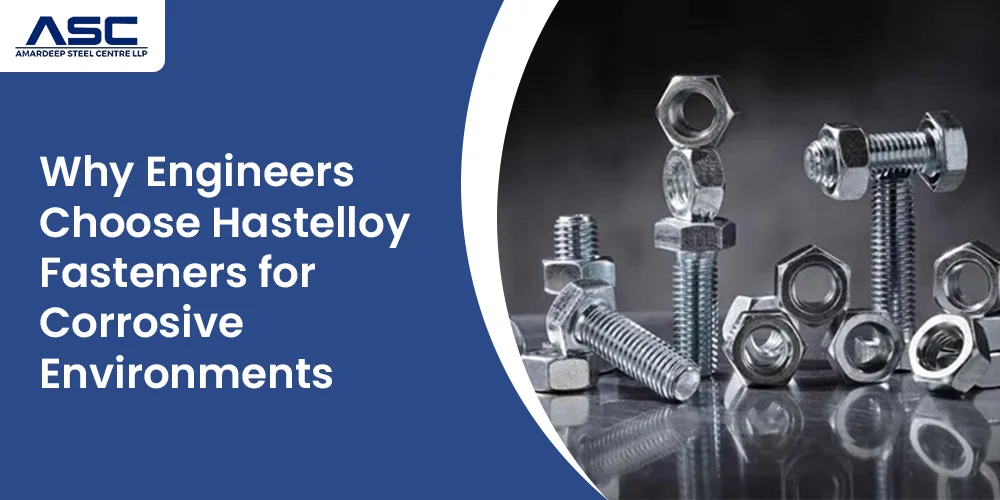
Hastelloy fasteners are hex bolts, stud bolts, nuts, washers, socket screws and threaded rods machined or forged from a Hastelloy bar. Haynes International is a registered trademark of Hastelloy, which is also being marketed as Alloy C-276 (UNS N10276), Alloy C-22 (UNS N06022) and Alloy B-2 (UNS N10665).Common applications are the hex bolts, stud bolts, nuts, washers, socket screws and threaded rods. hey are typically produced by suitable alloy stock that is machined or forged. Amardeep Steel offers Hastelloy fasteners and other Hastelloy products for industrial applications.
The fastener, which is likely the first part to fail, creates crevices such as the threads or flange faces where corrosive liquid can collect in a corrosion resistant system. The bolts that attach the flanges to a vessel or pipe are the weakest link in the chain of the vessel or pipe. Hastelloy bolts are specified for engineers when the existing stainless steel fasteners are not able to offer the necessary corrosion resistance or reliability.
Both grades 304 and 316 stainless steel are not very resistant to localized corrosion in specific chloride-rich and acidic environments. Hastelloy C276 is a material containing approximately 16% molybdenum, whereas C22 is a material made up of approximately 21% chromium with a high molybdenum content. These are alloying elements that enhance the resistance to pitting and crevice corrosion in numerous high corrosive chemical applications.
Austenitic stainless steel bolts are susceptible to sudden failure due to chloride induced stress corrosion cracking especially in warm chloride environments subject to tensile stress. High nickel alloys like Hastelloy C276 and C22 are more resistant to this type of cracking and are good choices for challenging chemical processing applications. This is, of course, the actual performance which depends on the alloy grade and service conditions.
Depending on the alloy, product form and operating conditions, allowable limits can be used at elevated temperatures for Hastelloy fasteners without loss of useful mechanical properties. The maximum design temperature should be determined by consulting the allowable-stress tables in ASME Section II, Part D, as well as manufacturer's datasheet for the corresponding grade and product form.
In general, hastelloy bolts are found to be more expensive than the standard stainless steel bolts. Incorporating corrosion replacement can, however, lead to equipment shutdowns, labour and extra maintenance. Overall, the use of an appropriate Hastelloy grade can improve the lifespan and life cycle costs of the bolted joint in aggressive service.
A leaking-flange can be a serious safety risk if the process involves corrosive acids, toxic chemicals or hazardous fluids. Choosing the right fasteners that have the proper corrosion resistance will keep joints intact and minimize the possibility of leaks. Appropriate bolting dimensions, preload, gasket compatibility and bolting procedures must also be selected as part of the correct material selection.
The benefits are dependent on the service conditions. Depending on the environment, 316 stainless steel might also be satisfactory in less corrosive conditions at a lower cost. If the process medium, operating temperature or effects of joint failure call for the versatility of a nickel-based alloy, then Hastelloy is appropriate.
Three grades cover most Hastelloy bolts; B3 is the modern alternative to B2. C276 is the all-rounder, C22 handles oxidizing and mixed media better, and B2 is specialised for hydrochloric acid. Typical specification limits are below. Verify them against the current ASTM B574 / B335 editions and your mill test certificates before ordering.
|
Element |
C276 (UNS N10276) |
C22 (UNS N06022) |
B2 (UNS N10665) |
|
Nickel (Ni) |
Balance |
Balance |
Balance |
|
Chromium (Cr) |
14.5 – 16.5 |
20.0 – 22.5 |
1.0 max |
|
Molybdenum (Mo) |
15.0 – 17.0 |
12.5 – 14.5 |
26.0 – 30.0 |
|
Iron (Fe) |
4.0 – 7.0 |
2.0 – 6.0 |
2.0 max |
|
Tungsten (W) |
3.0 – 4.5 |
2.5 – 3.5 |
— |
|
Cobalt (Co) |
2.5 max |
2.5 max |
1.0 max |
|
Carbon (C) |
0.01 max |
0.015 max |
0.02 max |
|
Silicon (Si) |
0.08 max |
0.08 max |
0.10 max |
|
Manganese (Mn) |
1.0 max |
0.50 max |
1.0 max |
|
Vanadium (V) |
0.35 max |
0.35 max |
— |
|
Phosphorus / Sulphur |
0.04 / 0.03 max |
0.02 / 0.02 max |
0.04 / 0.03 max |
|
Property |
C276 |
C22 |
B2 |
|
Tensile strength, min |
690 MPa (100 ksi) |
690 MPa (100 ksi) |
760 MPa (110 ksi) |
|
Yield strength 0.2%, min |
283 MPa (41 ksi) |
310 MPa (45 ksi) |
350 MPa (51 ksi) |
|
Elongation, min |
40% |
45% |
40% |
|
Density |
8.89 g/cm³ |
8.69 g/cm³ |
9.22 g/cm³ |
|
Melting range |
1325 – 1370°C |
1357 – 1399°C |
1330 – 1380°C |
|
Material specs (bar / forging) |
ASTM B574, B564 |
ASTM B574, B564 |
ASTM B335, B564 |
|
Grade |
UNS |
Werkstoff Nr. |
Common Name |
|
Hastelloy C276 |
N10276 |
2.4819 |
Alloy C-276 |
|
Hastelloy C22 |
N06022 |
2.4602 |
Alloy C-22 |
|
Hastelloy B2 |
N10665 |
2.4617 |
Alloy B-2 |
How to Select the Right Hastelloy Fasteners
Choosing a suitable fastener involves more than identifying a corrosion-resistant alloy. The chemical environment, mechanical load, connection design and applicable standards must all be considered together.
Chemical exposure: Identify the process fluid, its concentration, impurities and any cleaning chemicals. Corrosion resistance varies between Hastelloy grades, so confirm compatibility with the actual service conditions.
Operating temperature: Establish both normal and maximum temperatures, including temperature fluctuations. Verify that the selected grade retains the required mechanical properties throughout the operating range.
Mechanical loading: Determine the tensile load, preload, vibration and fatigue requirements. Check the specified strength properties and ensure that the fastener can withstand the design loads without unacceptable deformation or failure.
Joint and dimensional requirements: Confirm the bolt or stud diameter, thread form, length, nut compatibility and required surface finish. Also consider galvanic corrosion, galling and the compatibility of mating materials.
Different Hastelloy grades are designed for different combinations of corrosion resistance, temperature capability and mechanical performance. The following comparison provides a starting point for material selection.
|
Grade |
Key Characteristic |
Typical Application Areas |
|
Hastelloy C276 |
Broad resistance to many aggressive oxidizing and reducing environments |
Chemical processing, pollution control equipment, and process piping |
|
Hastelloy C22 |
Strong resistance to a wide range of oxidizing and reducing corrosive media |
Chemical plants, scrubbers, and industrial process equipment |
|
Hastelloy B2 |
Excellent resistance to hydrochloric acid under suitable reducing conditions |
Acid processing and chemical equipment |
|
Hastelloy B3 |
Improved structural stability and resistance to hydrochloric acid in suitable reducing environments |
Hydrochloric acid handling and chemical processing |
Important: These grades are not interchangeable. For example, B2 and B3 are primarily intended for reducing environments and may perform poorly in oxidizing conditions. Confirm the alloy's compatibility with the process fluid before finalizing the material.
|
Medium |
C276 |
C22 |
B2 / B3 |
|
Hydrochloric acid |
Good at lower concentration and temperature |
Limited; B2 / B3 preferred |
Excellent at all concentrations, reducing conditions only |
|
Sulphuric acid |
Good in dilute to moderate strength |
Good |
Good in pure, air-free acid; avoid oxidisers |
|
Nitric acid |
Not preferred |
Good |
Do not use |
|
Wet chlorine, hypochlorite, bleach plant |
Good |
Excellent |
Do not use |
|
Ferric or cupric chlorides, mixed oxidising acids |
Good |
Good to excellent |
Do not use |
|
Seawater and brines |
Excellent |
Excellent |
Not applicable |
If the Hastelloy fastener is specified, verify the specific alloy type, material specification, mechanical properties, size and tolerances of the threads. Give the composition and concentration of the process fluid, operating temperature and exposure scenarios to assist in determining corrosion compatibility. Include material test reports, inspection and traceability requirements, and appropriate tightening procedures, lubrication and galling prevention measures. Review material compatibility of bolts and nuts; verify project specific ASTM, ASME or other specifications.
Hastelloy fasteners applications cluster where aggressive chemistry meets a joint that cannot be allowed to leak.
Hastelloy fasteners price depends on raw material cost and manufacturing route, so any single figure goes out of date quickly. The main drivers are:
If you are comparing grades for a specific medium and temperature, our technical team can review the service with you. See our Hastelloy fasteners range for available sizes and forms.
Give the supplier these details so the quote matches the job.
They resist pitting, crevice corrosion and stress-corrosion cracking in acids and chlorides where stainless steel bolts can fail, and they retain useful strength at elevated temperatures. This can reduce leakage risks and unplanned shutdowns in aggressive service.
C276 offers broad resistance to acids, chlorides and mixed chemical environments. C22 provides strong resistance to oxidising media and mixed environments. B2 is particularly suited to reducing environments involving hydrochloric acid and is generally unsuitable where oxidising agents are present.
In many strong-acid and chloride environments, Hastelloy bolts offer better corrosion resistance than 316 stainless steel. In milder service, 316 may be adequate and more economical. The choice depends on the process medium and the consequences of joint failure.
Some nickel alloys may be suitable under defined conditions covered by ISO 15156 / NACE MR0175. Confirm the specific alloy, hardness limits, environmental conditions and applicable requirements before selecting fasteners for sour service.
Yes. Nickel-based alloy fasteners can experience galling during tightening. Appropriate lubrication, compatible thread materials, correct thread tolerances and controlled installation procedures can help reduce the risk.
Applicable material specifications may include ASTM B574 for nickel-molybdenum-chromium alloy bars and ASTM B564 for nickel-alloy forgings, depending on the product form and grade. Thread dimensions must meet the specified dimensional standard, and EN 10204 Type 3.1 inspection certificates may be required.
The price depends on nickel and molybdenum market prices, alloy grade, fastener dimensions, machining method, order quantity and certification or inspection requirements.
Yes, in many applications. A relatively small, more noble Hastelloy bolt in a much larger carbon steel flange generally presents a lower galvanic corrosion risk than the reverse combination. However, the electrolyte, exposure conditions and joint design must still be evaluated.
Not automatically. Alloy 625 offers high strength and good chloride corrosion resistance, while Hastelloy C276 and C22 can provide broader resistance to particular aggressive acid environments. The appropriate fastener depends on the process medium, temperature, mechanical requirements and exposure conditions.
Stainless Steel Metal Fabrication is a very specialised process and is very different from carbon steel, as it has a very different metallurgical behaviour.