
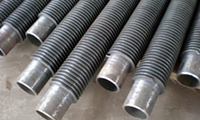
Wire Wound Fin Tubes Manufacturer In India
Wire wound fin tubes are a specialised category of heat exchanger fin tubes built for intense thermal duties. These components feature loop wire matrices helically wound around a central base tube. The unique wire fin construction dramatically expands external surface area while continuously breaking air boundary layers. Compared to standard finned tubing, wire-wound designs deliver exceptional thermal efficiency, superior vibration resistance, and reduced total weight, making them ideal for compact air-cooled exchangers, compressor coolers, and waste heat recovery units.
Amardeep Steel Centre manufactures premium-grade wire-wound finned tubing to order, drawing on a wide base tube portfolio that spans carbon steel pipes and tubes, alloy steel pipes and tubes, stainless steel, and copper alloy grades. If your project actually needs a wound and crimped fin strip rather than a wire matrix, our finned tubes range covers that construction specifically.
Every tube undergoes rigorous quality checks and hydro testing to ensure reliable operations in high-pressure industrial systems.
Technical Data
Wire Wound Finned Tubes Specifications
| Specification | Technical Detail |
|---|---|
Base Tube Material | Carbon steel, stainless steel 304 and 316, alloy steel, copper alloys |
Applicable Standards | ASTM A106 Grade B,ASTM A179,ASTM A213, ASTM A269 |
Base Tube Outer Diameter | 12.7 mm to 38.1 mm |
Wall Thickness | 1.24 mm to 3.50 mm |
Fin Wire Material | Copper, aluminium, stainless steel, galvanised carbon steel |
Wire Diameter | 0.8 mm to 1.6 mm |
Fin Height | 6.0 mm to 15.0 mm |
Fin Pitch | Custom loops per inch based on thermal design |
Standard Length | Up to 12 meters, custom cut to size |
Testing Standards | Hydrostatic testing, pneumatic testing, dimensional check |
Chemical Composition of Wire Wrapped Fin Tube
| Base Material Grade | Carbon C | Manganese Mn | Phosphorus P | Sulfur S | Silicon Si | Chromium Cr | Nickel Ni |
|---|---|---|---|---|---|---|---|
ASTM A106 Grade B | 0.30 max | 0.29 to 1.06 | 0.035 max | 0.035 max | 0.10 min | 0.40 max | 0.40 max |
ASTM A179 Seamless | 0.06 to 0.18 | 0.27 to 0.63 | 0.035 max | 0.035 max | 0.25 max | Balance | Balance |
SS TP304 | 0.08 max | 2.00 max | 0.045 max | 0.030 max | 0.75 max | 18.0 to 20.0 | 8.0 to 10.5 |
SS TP316 | 0.08 max | 2.00 max | 0.045 max | 0.030 max | 0.75 max | 16.0 to 18.0 | 10.0 to 14.0 |
ASTM A213 T11 | 0.05 to 0.15 | 0.30 to 0.60 | 0.025 max | 0.025 max | 0.50 to 1.00 | 1.00 to 1.50 | Balance |
Mechanical Properties of Wire-Wound Finned Tubes
| Material Grade | Tensile Strength MPa min | Yield Strength MPa min | Elongation percentage min | Hardness max |
|---|---|---|---|---|
ASTM A106 Grade B | 415 | 240 | 30 | 137 HRB |
ASTM A179 Seamless | 325 | 180 | 35 | 72 HRB |
SS TP304 Seamless | 515 | 205 | 35 | 90 HRB |
SS TP316 Seamless | 515 | 205 | 35 | 90 HRB |
ASTM A213 T11 Alloy | 415 | 205 | 30 | 163 HBW |
Standard Dimensions and Wire Density Chart
| Base Tube OD mm | Base Tube Wall mm | Fin Height mm | Wire Loop OD mm | Fin Density loops per inch |
|---|---|---|---|---|
15.88 | 1.24 | 8.0 | 1.0 | 18 |
19.05 | 1.65 | 10.0 | 1.2 | 22 |
25.40 | 2.11 | 12.5 | 1.2 | 24 |
31.75 | 2.77 | 15.0 | 1.5 | 26 |
38.10 | 3.20 | 15.0 | 1.6 | 28 |
Common Base Tube Specification
| Material Group | Typical Grades & Standards |
|---|---|
Carbon Steel | A179, A192, SA210 Gr A1 / C, A106 Gr B, A333 Gr 3 / 6 / 8, DIN 17175 St35.8 / St45.8, EN 10216 P195 / P235 / P265, GB/T 3087 10 / 20, GB/T 5310 20G / 20MnG |
Alloy Steel | A209 T1 / T1a, A213 T2 / T5 / T9 / T11 / T12 / T22 / T91, A335 P2 / P5 / P9 / P11 / P12 / P22 / P91, EN 10216-2 13CrMo4-5, 10CrMo9-10, 15NiCuMoNb5-6-4 |
Stainless Steel | TP304 / 304L, TP316 / 316L, TP310 / 310S, TP347 / 347H |
Copper & Copper-Nickel | UNS C12200 / C14200 / C70600, CuNi 90-10, CuNi 70-30 |
Titanium | ASTM B338 Grade 2 |
Wire Finned Tubes: Typical Material Combination
| Component | Common Materials |
|---|---|
Base Tube | Carbon steel, alloy steel, stainless steel, copper, cupro-nickel, titanium, aluminium |
Fin | Carbon steel, stainless steels (304, 310, 316, 321, 409, 410), nickel 200, Inconel, copper, aluminium |
Support Rings | Carbon steel, aluminium, hot-dip galvanised steel |
Industrial Applications of Wire-Wrapped Finned Tubes
- Air-Cooled Heat Exchangers: Ideal for oil refineries and chemical plants requiring heavy air cooling capabilities.
- Waste Heat Recovery Boilers: Installed in flue gas exchangers to recover process heat efficiently.
- Compressor Gas Coolers: Used in high-pressure air compressors to drop gas temperatures between stages.
- Turbine Air Preheaters: Essential for power generation plants, maximising combustion air preheating efficiency.
See also our Heat Exchangers and Condenser Tubes pages for related process equipment.
Frequently Asked Questions
Why are copper wire wound fin tubes preferred over solid copper L-Fin tubes?
A copper wire loop configuration delivers 7% to 8% higher heat transfer performance compared to an 11 FPI copper L-Fin tube, while cutting total weight by roughly 20%. Since raw copper is cost-intensive, wire wound loops give a lighter, highly efficient alternative to solid ribbon copper fins without sacrificing thermal transfer.
How do wire-wound fin tubes compare to solid helical fins regarding pressure drop?
The continuous loop design lets air and process gases flow around the wire matrix instead of striking a solid surface. This creates localized air-side turbulence — boosting thermal transfer 2 to 3 times over smooth strip fins while keeping overall air-side pressure drop and fan power consumption significantly lower.
Can wire-wound fin tubes be combined with internal tube turbulators?
Yes. For low-velocity or viscous fluid applications inside the tube, such as lube oil or heavy hydraulic fluids, internal wire turbulators can be soldered inside the bore. Pairing internal turbulators with external wire-wound fins increases overall heat transfer rates by up to 3 to 10 times compared to plain tube bundles.
How do wire-wound fin tubes perform under mechanical vibration?
Because the wire loops are mechanically tension-wound and continuously root-soldered along the full tube length, the joint bond resists vibration levels up to 7G. This makes wire wound fin tubes well suited to heavy industrial compressor coolers and engine-mounted radiator assemblies, where standard tension-wound L-Fins can loosen over time.
What is the recommended cleaning procedure for wire wound fin tubes?
The open matrix loop design resists light particulate fouling. When cleaning is needed, low-pressure compressed air blowing, soft chemical bath soaking, or a gentle low-pressure wash-down across the wire axis is recommended. Avoid high-pressure water jetting directly perpendicular to the wire loops, as it can bend the loop profiles.
Can aluminium wire be used for manufacturing wire wound fin tubes?
Aluminium wire is generally not recommended for wire-wound fin configurations, because aluminium cannot be reliably soft-soldered or silver-soldered to steel or copper base tubes at production scale. Aluminium fins work best in extruded or G-type embedded fin configurations. For wire-wound construction, copper, stainless steel, and galvanised carbon steel wire provide the most durable bonds.
Related grade pages: ASTM A106 Grade B Carbon Steel Pipes & Tubes | ASTM A179 Tubes | ASTM A213 Seamless Tubes | ASTM A213 T11 Alloy Steel Seamless Tube | ASTM A269 Seamless Tubes
Stainless base tube options: Stainless Steel 304L Pipes & Tubes | Stainless Steel 316 Pipes & Tubes
Copper-nickel and titanium options: Copper Nickel 90-10 Pipes & Tubes | Copper Nickel 70-30 Pipe & Tube | ASTM B338 Gr2 Titanium Pipes & Tubes
Get a Quote for Wire Wound Fin Tubes
Amardeep Steel Centre supplies wire wound fin tubes with complete documentation, including EN 10204 3.1 Mill Test Certificates and third-party inspection on request. To request a quote, share your base tube material, fin wire material, dimensions, and quantity via our Enquiry page or Contact page. Our team will confirm price and availability the same working day.
Related Products
Fin tube family: Finned Tubes, G Fin Tubes, H Fin Tubes, Heat Exchangers, Condenser Tubes, Copper Finned Tubes
