
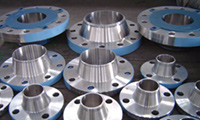
Amardeep Steel Centre is a leading industrial flanges manufacturer, supplier and exporter based in Mumbai, India, producing steel flanges and pipe flanges to ASME/ANSI B16.5, ASME B16.47, ASTM A182, DIN, BS and EN 1092-1 standards in Stainless Steel, Alloy Steel, Hastelloy, Carbon Steel, Inconel and Nickel Alloy trusted by process industries for consistent quality and full mill test certification.
We supply all types of ASME B16.5 flanges including Weld Neck Flanges, Slip-On Flanges, Blind Flanges, Socket Weld Flanges, Orifice Flanges, RTJ Flanges and Spectacle Blind Flanges. Available in Stainless Steel, Carbon Steel, Alloy Steel, Nickel Alloy, Duplex Steel, Hastelloy, Inconel and Titanium, conforming to ASTM A182, ASME B16.5, ASME B16.47, DIN, BS and EN 1092-1 standards.
What Are Flanges?
A flange is a mechanical coupling device used to connect pipes, valves, pumps and other process equipment into a complete piping system. Two flanges are bolted together with a gasket sandwiched between the mating faces, creating a pressure-tight, leak-proof seal that can be easily disassembled for maintenance, inspection or modification.
Flanges are used across virtually every process industry from oil & gas and petrochemicals to power generation, pharmaceuticals and water treatment. Their design varies by how they attach to the pipe (welded, threaded or loose), how their mating faces are finished (Raised Face, Flat Face, RTJ), and the pressure class they are rated for.
At Amardeep Steel Centre, we manufacture and supply flanges to the most demanding global specifications ASME B16.5, ASME B16.47, EN 1092-1, DIN, BS 4504 and JIS — in an extensive range of metallic alloys for high-temperature, high-pressure and corrosive service conditions.
½"–48" Size Range (NB) | 12+ Flange Types | 15+ Material Grades | 7 Pressure Classes (ASME) | 50+ Countries Served
What Are Pipe Flanges? And How Do They Work?
Pipe flanges are the most common type of flange, used to connect straight pipe runs to other pipe, valves, pumps and vessels. A typical flanged pipe connection has three parts: the pipe flange itself, a gasket, and the bolting that draws the two flange faces together. Because the joint is bolted rather than welded, pipe flanges give a piping system flexibility; sections can be unbolted for cleaning, inspection, or to swap in a valve or instrument, then reassembled without cutting or re-welding the line.
The right pipe flange for a given point in a system depends on how it attaches to the pipe (welded, slipped-on, threaded or loose on a stub end), the facing on its mating surface, and the pressure class it must hold at the operating temperature all covered below.
Shop by Flange Type
We manufacture all major flange types to ASME, DIN, EN and BS standards. Each type is suited to a specific connection method and service condition. Click any type for full dimensional data and grades.
Weld Neck Flanges (WNRF)
ASME B16.5
Long tapered hub welded to the pipe. Ideal for high-pressure, high-temperature and cyclic service. Offers excellent stress distribution and radiographic weld inspection.
View Weld Neck Flanges →Slip-On Flanges (SORF)
ASME B16.5
Slides over the pipe OD and is fillet-welded inside and outside. Lower cost than weld neck; suitable for moderate pressure and non-critical piping systems.
View Slip-On Flanges →Blind Flanges (BLRF)
ASME B16.5
Solid plate flange used to blank off or seal a pipe end, nozzle or valve opening. Must withstand full system pressure; widely used in pressure vessel and storage applications.
View Blind Flanges →Socket Weld Flanges (SWRF)
ASME B16.5
Pipe inserts into the socket and is fillet-welded externally. Used in small-bore, high-pressure lines (Class 3000 & 6000). Provides smooth bore for improved flow.
View Socket Weld Flanges →Threaded / Screwed Flanges
ASME B16.5
Internally threaded flange that screws onto an externally threaded pipe. Used where welding is not feasible — highly flammable environments or on-site modifications.
View Threaded Flanges →Orifice Flanges
ASME B16.5 / API 6A
Designed with tapped holes for pressure differential measurement. Used in pairs to house an orifice plate for flow metering in oil, gas and water systems.
View Orifice Flanges →RTJ Flanges (Ring Type Joint)
ASME B16.5 / B16.20
Groove machined into the flange face accepts a metal ring gasket (oval or octagonal). Used in subsea, wellhead, and high-pressure refinery service for superior sealing.
View RTJ Flanges →Spectacle Blind Flanges
ASME B16.48
Combination of a solid blind disc and an open ring (spacer), connected by a web. Rotated to isolate or allow flow — ideal for permanent isolation points in process piping.
View Spectacle Blinds →Reducing Flanges
ASME B16.5
Connects pipes of two different sizes in a single fitting. Eliminates the need for a separate reducer fitting, saving space and weight in compact piping layouts.
View Reducing Flanges →Groove & Tongue Flanges
ASME B16.5
Mating faces have a raised tongue and matching groove. Extremely accurate seating of the gasket; common in pumps, compressors and cryogenic service.
View G&T Flanges →Plate Flanges (Flat Face)
ASME B16.5 / DIN
Simple flat-plate design with a flat face. Used with full-face gaskets in low-pressure service and when connecting to cast iron or non-metallic equipment.
View Plate Flanges →DIN / EN 1092-1 Flanges
DIN 2501 / EN 1092-1
European standard flanges with PN pressure ratings (PN6 to PN100). Required for projects in Europe, Middle East and wherever metric/DIN specifications are specified.
View DIN Flanges →Flange Facing Types Explained
The face type determines which gasket is used and how the seal is formed. We supply all of the following:
- Raised Face (RF): a small raised ring around the bore that concentrates bolt load onto a ring-type gasket; the most common facing for ASME B16.5 flanges in general process service.
- Flat Face (FF): the mating surface is flush across the full flange face, used with a full-face gasket; specified when bolting to cast iron or non-metallic equipment that cannot tolerate the point loading of a raised face.
- Ring Type Joint (RTJ): a machined groove holds a solid metal ring gasket (oval or octagonal profile); used for high-pressure, high-temperature refinery, subsea and wellhead service where a soft gasket cannot hold the seal.
- Tongue & Groove (T&G) and Large/Small Male-Female (LMF/SMF): a raised tongue on one flange mates into a matching groove on the other, self-aligning the gasket; common on pumps, compressors and cryogenic piping.
- Lap Joint (LJ): used with a separate stub end; the flange itself is not welded to the pipe, which lets it rotate freely for bolt-hole alignment.
Facing surfaces are also finished smooth or serrated: smooth finishes are generally paired with metallic (e.g. RTJ) gaskets, while serrated finishes help soft gaskets bite in and seal at lower bolt loads.
How to Choose the Right Flange
- Pressure-temperature rating: match the ASME Class (150-2500 LBS) or DIN PN rating to the line's design pressure at its maximum operating temperature; rating drops as temperature rises.
- Dimensional standard: confirm ASME B16.5/B16.47, EN 1092-1, DIN, BS or JIS, since bolt circles, hole counts and hub dimensions differ between standards even at the same nominal size.
- Facing type: RF for general service, RTJ for high-pressure/high-temperature or subsea service, FF for cast-iron/non-metallic mating equipment, T&G/M&F for precise gasket seating.
- Attachment method: Weld Neck for high-pressure/cyclic/critical lines, Slip-On for moderate-pressure general piping, Socket Weld for small-bore high-pressure lines, Threaded where welding isn't permitted, Blind to terminate or pressure-test a line.
- Material compatibility: Carbon Steel for general/utility service, Stainless Steel for corrosive/hygienic service, Duplex/Super Duplex or Hastelloy/Inconel for chloride-rich or highly corrosive/high-temperature service, NACE-compliant materials for sour (H2S) oil & gas service.
Technical Data
Flange Specifications
Complete specification range for all flanges supplied by Amardeep Steel Centre.
| Parameter | Details |
|---|---|
| Size Range | 1/2" (15 NB) to 48" (1200 NB) · DN10 to DN5000 |
| Standards | ASME B16.5, B16.47 Series A & B, B16.48, B16.36 · BS 4504, BS 10, BS 1560 · EN 1092-1 · DIN 2501 · JIS B2220 · MSS SP44 · API 6A · GOST 12820 · AWWA C207 |
| ANSI Pressure Ratings | Class 150, 300, 400, 600, 900, 1500, 2500 LBS |
| DIN / EN Pressure Ratings | PN6, PN10, PN16, PN25, PN40, PN64, PN100 |
| JIS Pressure Ratings | 5K, 10K, 16K, 20K, 30K, 40K, 63K |
| Face Types | Raised Face (RF), Flat Face (FF), Ring Type Joint (RTJ), Lap Joint (LJ), Large Male-Female (LMF), Small Male-Female (SMF), Tongue & Groove (T&G) |
| Manufacturing Method | Forged, Heat Treated & Machined · Threaded · Plate / Cut Flange |
| Surface Coating | Black Oil Paint · Anti-Rust Epoxy · Zinc Plated · Hot/Cold Dip Galvanised |
| Test Certificates | EN 10204 / 3.1B · Raw Material Certificate · 100% Radiography Test Report · Third-Party Inspection (SGS, BV, TUV, Lloyds) · Hydrostatic Test |
| Testing Equipment | Direct-Reading Spectrograph · Hydrostatic Testing Machine · X-Ray Detector · Ultrasonic Flaw Detector · Magnetic Particle Detector |
| Country of Origin | India · Western Europe · Japan · USA · South Korea |
Not sure of the exact weight for your size and class? Run it through our Flange Weight Calculator.
ASME B16.5 Pressure Ratings
ASME B16.5 flanges are rated by pressure class. Higher class numbers indicate higher allowable working pressures. The table below gives indicative pressures at ambient temperature for carbon steel; actual ratings vary by material and temperature.
| ANSI Class | Max Pressure (Bar, ambient) | Temperature Range | Typical Application | DIN Equivalent |
|---|---|---|---|---|
| 150 LBS | 19.6 bar | -29°C to 538°C | General utility, water, low-pressure steam | PN20 |
| 300 LBS | 51.1 bar | -29°C to 538°C | Medium-pressure gas, chemical service | PN50 |
| 400 LBS | 68.1 bar | -29°C to 538°C | High-temperature steam, process piping | PN64 |
| 600 LBS | 102 bar | -29°C to 538°C | Refinery, boiler, power generation | PN100 |
| 900 LBS | 153 bar | -29°C to 538°C | High-pressure process, HP steam | PN150 |
| 1500 LBS | 255 bar | -29°C to 538°C | Oil & gas, wellhead, HP pipelines | PN250 |
| 2500 LBS | 425 bar | -29°C to 538°C | Subsea, HP/HT, offshore production | PN420 |
Stainless Steel Flange Grades — Chemical Composition & Mechanical Properties
Standard chemical composition limits (weight %, max unless a range is given) and minimum mechanical properties for our most-supplied stainless steel flange grades, per ASTM A240 / A182:
| Grade | C | Mn | Si | Cr | Ni | Mo |
|---|---|---|---|---|---|---|
| 304 | 0.08 | 2.00 | 0.75 | 18.0-20.0 | 8.0-10.5 | - |
| 304L | 0.030 | 2.00 | 0.75 | 18.0-20.0 | 8.0-12.0 | - |
| 316 | 0.08 | 2.00 | 0.75 | 16.0-18.0 | 10.0-14.0 | 2.00-3.00 |
| 316L | 0.030 | 2.00 | 0.75 | 16.0-18.0 | 10.0-14.0 | 2.00-3.00 |
| 321 | 0.08 | 2.00 | 0.75 | 17.0-19.0 | 9.0-12.0 | Ti stabilised |
| 347 | 0.08 | 2.00 | 0.75 | 17.0-19.0 | 9.0-13.0 | Nb stabilised |
| Grade | Tensile (min) | Yield (min) | Elongation (min) | Hardness (max) |
|---|---|---|---|---|
| 304 | 75 ksi (515 MPa) | 30 ksi (205 MPa) | 40% in 2" | 217 HB |
| 304L | 70 ksi (485 MPa) | 25 ksi (170 MPa) | 40% in 2" | 201 HB |
| 316 | 75 ksi (515 MPa) | 30 ksi (205 MPa) | 40% in 2" | 217 HB |
| 316L | 70 ksi (485 MPa) | 25 ksi (170 MPa) | 40% in 2" | 217 HB |
| 321 | 75 ksi (515 MPa) | 30 ksi (205 MPa) | 40% in 2" | 217 HB |
| 347 | 75 ksi (515 MPa) | 30 ksi (205 MPa) | 40% in 2" | 201 HB |
Values are the standard ASTM A240/A182 specification minimums for reference; actual heat-specific results are reported on the mill test certificate supplied with every order.
Understanding Flange Markings
Every flange we supply is permanently stamped on its outer rim so it can be identified and verified on site, typically in this order: manufacturer's mark, material/ASTM grade, pressure-temperature class, nominal size, wall thickness/schedule (for weld neck flanges), and heat number for full material traceability back to its mill test certificate. Ring Type Joint flanges additionally carry the ring-groove number, and repaired or heat-treated pieces carry the relevant code (e.g. QT for quenched & tempered).
Shop by Flange Material
All flanges are available in a comprehensive range of engineering alloys selected for corrosion resistance, mechanical strength, and compatibility with the process fluid and temperature.
Stainless Steel Flanges
Austenitic, high corrosion resistance. Grades: F304, F304L, F316, F316L, F321, F347, 904L.
View Stainless Steel FlangesCarbon Steel Flanges
A105, LF2 general industrial flanges. Grades: ASTM A105, A350 LF2, A694 F52/F60/F65.
View Carbon Steel FlangesAlloy Steel Flanges
Cr-Mo flanges for high temperature and high pressure. Grades: F1, F5, F9, F11, F22, F91.
View Alloy Steel FlangesDuplex Steel Flanges
F51 / F53 dual-phase structure for offshore and chloride-rich service.
View Duplex Steel FlangesHastelloy Flanges
Extreme corrosion resistance. Grades: Hastelloy C276, C22, B2, B3, X.
View Hastelloy FlangesInconel Flanges
High-temperature nickel-chromium alloys. Grades: 600, 601, 625, 718, 800, 825.
View Inconel FlangesTitanium Flanges
ASTM B381 ultra lightweight flanges. Grades: Grade 1, Grade 2, Grade 5.
View Titanium FlangesNickel Alloy Flanges
High performance alloys including Alloy 200/201, 400, 600, 625, 825.
View Nickel Alloy FlangesMonel Flanges
Copper-nickel alloys for marine and seawater service. Grades: Monel 400, K-500.
View Monel FlangesCopper Nickel Flanges
90/10 and 70/30 Cupronickel flanges for seawater and condenser systems.
View Copper Nickel FlangesSuper Duplex Flanges
S32750 / S32760 chloride-resistant flanges for severe offshore applications.
View Super Duplex FlangesAluminium Flanges
Lightweight corrosion-resistant flanges in 1060, 5083 and 6061-T6.
View Aluminium FlangesSpecialty & High-Performance Alloy Flanges
Beyond the 12 core material families above, we also supply the following specialty alloy flanges for severe-service applications not covered by a standard material card:
- SMO 254 Flanges — 6-Moly super-austenitic stainless steel (UNS S31254) for chloride-rich and seawater service.
- Alloy 28 Flanges — high-nickel, high-chromium alloy for sulphuric and phosphoric acid service.
- Sanicro 28 Flanges — austenitic alloy for strong acid environments in chemical processing.
- Zirconium 702 Flanges — outstanding resistance to hydrochloric and sulphuric acid; used in the most aggressive chemical processes.
ASTM A182 Grade Reference
ASTM A182 is the governing specification for forged alloy and stainless steel pipe flanges, fittings and valves intended for high-temperature service. All applicable Amardeep Steel flanges conform to ASTM A182 / ASME SA182 with full heat-to-test traceability.
- ASTM A182 F304 / F304L - Austenitic SS, general corrosion service
- ASTM A182 F316 / F316L - Austenitic SS, chloride & marine environments
- ASTM A182 F321 / F321H - Ti-stabilised SS, elevated temperature service
- ASTM A182 F347 / F347H - Nb-stabilised SS, nuclear & boiler applications
- ASTM A182 F11 / F22 / F91 - Cr-Mo alloy steel, high-pressure / high-temperature
- ASTM A182 F91 - 9Cr-1Mo-V ultra-high-temperature, creep-resistant power plant service
- ASTM A182 F5 / F9 - refinery and petrochemical high-temperature service
- ASTM A182 F51 / F53 - Duplex & Super Duplex SS for offshore and chloride-rich environments
Flange Standards & Norms
Amardeep Steel Centre manufactures flanges to a comprehensive set of international standards and pressure norms. Whether your project specifies ASME, DIN, BS, EN or JIS, we can supply to specification.
- ASME / ANSI Standards: B16.5, B16.47 Series A & B, B16.48, B16.36, B16.20, MSS SP44
- British Standards: BS 4504 Sec 3.1 & Part 1, BS 10, BS 1560 BOSS, BS 3293
- DIN / European Standards: DIN 2527, 2566, 2573, 2576, 2627-2638, 2641, 2642, 2655, 2656, 2673, EN 1092-1
- Japanese Industrial Standard: JIS B2220, KS B1503
- API Standards: API 6A, API 605, API 7S-15 & 7S-43
- Other International Standards: AWWA C207, GOST 12820, ISO 70051, SABS 1123, NFE 29203, UNI 2276, AS 2129
Manufacturing Process & Quality Traceability
Our flanges are produced by open/closed-die forging (or plate/cut for larger diameters), followed by heat treatment, CNC machining to final dimension and face finish, and surface coating (black oil paint, anti-rust epoxy, zinc plating or hot/cold-dip galvanising as specified). Every heat is traceable from raw material through to the finished, stamped flange:
- Raw material verified by direct-reading spectrograph and Positive Material Identification before it enters production
- Dimensional and visual inspection at each production stage
- Hydrostatic testing, radiographic (X-ray) and ultrasonic flaw detection, and magnetic particle inspection available per specification
- Heat number and batch code marked on every piece, linked back to its EN 10204 3.1/3.2 mill test certificate
- Third-party witness inspection by SGS, BV, TUV or Lloyds arranged on request
Request a Quote for Flanges
We export to 50+ countries. Send us your requirements — size, grade, standard, quantity — via Enquiry or Contact Us and we will respond with pricing, lead time and stock availability within 24 hours.
Get a Quote Now Email EnquiryFlange Applications
Amardeep Steel flanges are trusted in the world's most demanding process industries. Our materials and certifications are selected to meet strict safety, pressure and corrosion-resistance requirements.
- Oil & Gas: Upstream, midstream & downstream pipelines, wellheads and refineries
- Petrochemicals: Chemical plants, cracker units, acid and caustic process piping
- Power Generation: High-pressure steam lines, nuclear plants, gas turbines and boilers
- Marine & Offshore: Subsea pipelines, offshore platforms, FPSO and shipbuilding
- Pharmaceutical: Hygienic SS flanges for sterile process and clean-room piping
- Water Treatment: Water supply, desalination, wastewater and irrigation systems
- Construction & EPC: Infrastructure, industrial plants, fabrication shops & EPC contractors
- Acids & Corrosives: Hastelloy, Titanium and Nickel flanges for aggressive chemical service
- Food, Beverage & Dairy: Hygienic stainless steel flanges for sanitary process piping
- Pulp & Paper: Process piping for pulping, bleaching and chemical recovery
- Fertiliser & Agrochemicals: Flanges for corrosive acid and ammonia process streams
Why Amardeep Steel for Flanges?
- ISO-compliant manufacturing facility in Mumbai
- Full traceability with heat number marked on every piece
- EN 10204 Type 3.1 mill test certificates as standard
- Third-party inspection by SGS, BV, TUV and Lloyds available
- Radiographic and ultrasonic testing on request
- Fast lead times with ex-stock supply on common grades
- EIL approved vendor
- Exporting to 50+ countries since decades
Price List of ANSI B16.5 Flanges
We offer competitively priced SS Flanges products for a wide range of industrial and commercial applications. Please call or email us to request the latest price list, ready stock availability, and a customized quotation based on your requirements.
Frequently Asked Questions About Flanges
What is a flange and what is it used for?
A flange is a mechanical coupling used to join pipes, valves, pumps and other process equipment into a piping system. Two flanges are bolted together with a gasket between their mating faces to form a pressure-tight seal. They also allow easy access for cleaning, inspection or modification of the system.
What flange standards does Amardeep Steel Centre supply?
We supply flanges to ASME/ANSI B16.5, B16.47 Series A & B, B16.48, B16.36, BS 4504, BS 10, BS 1560, EN 1092-1, DIN 2501, JIS B2220, MSS SP44, API 6A, GOST 12820 and AWWA C207, covering virtually all global project specifications.
What pressure classes are available for ASME B16.5 flanges?
ASME B16.5 flanges are available in Class 150, 300, 400, 600, 900, 1500 and 2500 LBS. These correspond approximately to DIN/EN pressure ratings from PN20 through PN420. Class selection depends on operating pressure, temperature and material.
What size range of flanges is available?
Standard supply range is 1/2" (15 NB / DN15) up to 48" (1200 NB / DN1200). Custom sizes up to DN5000 are available on request. Both equal and reducing configurations are supplied.
What is ASTM A182 and why does it matter?
ASTM A182 is the standard specification for forged alloy and stainless steel pipe flanges, fittings and valves for high-temperature service. All Amardeep Steel flanges in alloy and stainless steel conform to ASTM A182 / ASME SA182.
What face types are available?
We supply all major face types including Raised Face (RF), Flat Face (FF), Ring Type Joint (RTJ), Lap-Joint (LJ), Large Male-Female (LMF), Small Male-Female (SMF), and Tongue & Groove (T&G).
Does Amardeep Steel export internationally?
Yes. We export to over 50 countries across the Middle East, Europe, USA, Southeast Asia, Africa and Australia. Exports include EN 10204 3.1 MTCs and can be supported with third-party inspection, MSDS, country-of-origin certificates and other trade documents.
What is the difference between Weld Neck and Slip-On flanges?
A Weld Neck Flange has a long tapered hub that is butt-welded to the pipe end and is preferred for high-pressure, high-temperature and cyclic service. A Slip-On Flange slides over the pipe and is fillet-welded on both sides; it is lower cost and easier to align.
What is the difference between a Raised Face and a Ring Type Joint flange?
A Raised Face (RF) flange has a small raised ring around the bore that seats a soft or semi-metallic gasket, and is used for general process service. A Ring Type Joint (RTJ) flange has a machined groove that holds a solid metal ring gasket, giving a metal-to-metal seal used in high-pressure, high-temperature and subsea/wellhead service.
What information do you need to quote a flange?
Please provide the flange type, pressure class/rating and dimensional standard, facing type, material grade, nominal size (and pipe schedule for weld neck flanges), quantity, and any certification or testing requirements (EN 10204 3.1/3.2, third-party inspection, PMI, NACE MR0175).
