
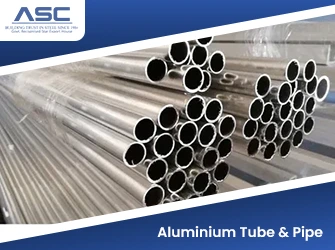
Aluminium Pipe & Tube Manufacturer, Supplier & Stockist in India
Amardeep Steel Centre is a Mumbai based manufacturer, supplier and stockist of aluminium pipes and tubes, holding round, square, rectangular and hollow sections in 6061, 6063, 6082, 5083, 5052, 7075, 3003 and 1100 across the full size range. We supply construction, automotive, aerospace, marine, electrical and general engineering projects across India and export to more than 40 countries with EN 10204 3.1 Mill Test Certificates. Request a quote with your alloy, temper, size and finish.
Specifying Aluminium Pipe and Tube: Alloy, Temper, Finish
Three decisions settle an aluminium order. Get any one wrong and the material is unusable even though the certificate is correct.
-
T6 or T651 for structural and machined work
- Both give 310 MPa tensile strength and 276 MPa yield strength.
- T651 has additionally been stretched after quenching to relieve residual stress.
- Specify T651 for heavily machined components because T6 can distort as stress is released during cutting.
-
T4 where forming follows
- 241 MPa tensile strength and 145 MPa yield strength, with substantially greater ductility.
- Specify T4 when the section will be bent or formed after delivery and then aged, or where extra ductility is more important than maximum strength.
-
O only where deep forming is required
- Maximum tensile strength of 124 MPa.
- Rarely ordered in tube form, but relevant where severe forming is followed by heat treatment.
- Ordering O temper instead of T6 is one of the most costly temper selection mistakes for Aluminium 6061.
Aluminium Alloy Selector: Which Grade for Which Job
Start here rather than with the size chart. Alloy choice constrains everything downstream, including which sections and finishes are even available.
|
If your priority is |
Specify |
Tensile (typical temper) |
Why |
|---|---|---|---|
|
Load bearing and machining |
6061-T6 |
310 MPa |
Copper addition gives strength and clean machining |
|
Maximum strength, European spec |
6082-T6 |
310 MPa |
Highest strength 6xxx, common on EN drawings |
|
Anodised or visible finish |
6063-T6 |
241 MPa |
Low copper and iron, uniform anodising, fine profiles |
|
Complex thin-wall extruded profile |
6063-T5 |
186 MPa |
Extrudes faster through more intricate dies |
|
Welded marine structure |
5083-H116 |
300 MPa |
Magnesium alloy, saltwater resistance, no heat treatment |
|
Formed marine components |
5052-H32 |
230 MPa |
Best formability of the marine alloys |
|
Aerospace and high stress |
7075-T6 |
570 MPa |
Highest strength, needs corrosion protection |
|
Deep forming and heat transfer |
3003-H14 or 1100-H14 |
90 to 150 MPa |
Formability and conductivity over strength |
Temper Designations Explained
|
Temper |
Meaning |
Where you see it |
|---|---|---|
|
O |
Annealed, softest and most formable |
1100 and 3003 for deep forming |
|
H12 to H18 |
Strain hardened to increasing strength |
Non heat-treatable 3xxx and 5xxx |
|
H32 to H38 |
Strain hardened and thermally stabilised |
5052 and 5083 marine alloys |
|
T4 |
Solution treated, naturally aged |
6061 where forming follows |
|
T5 |
Cooled from the extrusion press, artificially aged |
6063 architectural sections, the economical option |
|
T6 |
Solution treated, artificially aged to full strength |
6061 and 6082 structural, 6063 where strength matters |
|
T651 |
T6 plus stress relieved by stretching |
6061 for heavily machined parts |
Because temper is not marked on the extrusion itself, it must appear on the purchase order, the mill certificate and the packing list. Material supplied in the wrong temper is dimensionally identical and cannot be identified without testing.
How Much Weight Does Aluminium Save Against Steel?
This is the reason aluminium is specified and it is worth putting a number on rather than describing as lightweight. Aluminium is 2,700 kg per cubic metre against 7,850 for carbon steel and 8,000 for stainless.
|
NB, SCH 40 |
Aluminium kg/m |
Carbon steel kg/m |
Stainless kg/m |
Saved vs steel |
|---|---|---|---|---|
|
1 inch |
0.86 |
2.50 |
2.54 |
66 percent |
|
2 inch |
1.87 |
5.44 |
5.52 |
66 percent |
|
3 inch |
3.88 |
11.29 |
11.47 |
66 percent |
|
4 inch |
5.53 |
16.07 |
16.32 |
66 percent |
|
6 inch |
9.72 |
28.26 |
28.69 |
66 percent |
|
8 inch |
14.60 |
42.55 |
43.20 |
66 percent |
|
12 inch |
27.44 |
79.73 |
74.62 |
66 percent |
Where that matters commercially: a 100 metre run of 4 inch SCH 40 weighs 553 kg in aluminium against 1,607 kg in carbon steel. That changes crane requirement, support spacing, foundation loading, installation labour and freight cost, and in transport applications it changes payload for the life of the vehicle. Aluminium costs more per kilogram and often less per installed metre.
Design Considerations When Substituting Aluminium for Steel
Four properties differ enough from steel that a direct substitution without recalculation will fail. These are the points our technical team raises most often on enquiry.
|
Property |
Aluminium vs steel |
Design consequence |
|---|---|---|
|
Modulus of elasticity |
68.9 GPa against 200 GPa, one third |
An identical section deflects three times as much; increase section or accept deflection |
|
Thermal expansion |
23.4 against 12 x 10 to the minus 6 per K, double |
Expansion loops and support spacing must be recalculated on long runs |
|
Fatigue behaviour |
No true endurance limit, unlike steel |
Cyclically loaded parts need a finite-life calculation, not an infinite-life assumption |
|
Galvanic contact |
Anodic to steel, brass and copper |
Isolate at dissimilar metal joints or the aluminium corrodes preferentially |
|
Weld strength |
HAZ locally annealed to about T4 |
Design the joint at the lower figure or re-heat treat the assembly |
|
Service temperature |
Strength falls away above roughly 150 C |
Not a substitute for steel in elevated temperature service |
None of these rules out aluminium. They mean the design has to be done in aluminium rather than borrowed from a steel drawing, and getting that conversation right before the order is placed prevents most of the problems we see on site.
Aluminium Pipe Size Chart in MM: Standard Aluminium Pipe Sizes
Standard aluminium pipe sizes in mm follow the nominal bore and schedule system under ASME B36.10M and ASTM B241. Outside diameter is constant for a given nominal bore; only wall thickness changes with schedule.
|
NB |
OD (mm) |
SCH 5 |
SCH 10 |
SCH 40 |
SCH 80 |
SCH 40 kg/m |
|---|---|---|---|---|---|---|
|
1/4" |
13.72 |
– |
1.65 |
2.24 |
3.02 |
0.20 |
|
3/8" |
17.15 |
– |
1.65 |
2.31 |
3.20 |
0.26 |
|
1/2" |
21.34 |
1.65 |
2.11 |
2.77 |
3.73 |
0.44 |
|
3/4" |
26.67 |
1.65 |
2.11 |
2.87 |
3.91 |
0.58 |
|
1" |
33.40 |
1.65 |
2.77 |
3.38 |
4.55 |
0.86 |
|
1 1/4" |
42.16 |
1.65 |
2.77 |
3.56 |
4.85 |
1.16 |
|
1 1/2" |
48.26 |
1.65 |
2.77 |
3.68 |
5.08 |
1.39 |
|
2" |
60.33 |
1.65 |
2.77 |
3.91 |
5.54 |
1.87 |
|
2 1/2" |
73.03 |
2.11 |
3.05 |
5.16 |
7.01 |
2.97 |
|
3" |
88.90 |
2.11 |
3.05 |
5.49 |
7.62 |
3.88 |
|
4" |
114.30 |
2.11 |
3.05 |
6.02 |
8.56 |
5.53 |
|
5" |
141.30 |
2.77 |
3.40 |
6.55 |
9.53 |
7.49 |
|
6" |
168.27 |
2.77 |
3.40 |
7.11 |
10.97 |
9.72 |
|
8" |
219.07 |
2.77 |
3.76 |
8.18 |
12.70 |
14.60 |
|
10" |
273.05 |
3.40 |
4.19 |
9.27 |
15.09 |
20.75 |
|
12" |
323.85 |
3.96 |
4.57 |
10.31 |
17.48 |
27.44 |
|
16" |
406.40 |
4.19 |
4.78 |
12.70 |
21.44 |
42.53 |
|
20" |
508.00 |
4.78 |
5.54 |
15.09 |
26.19 |
63.16 |
Standard Aluminium Tube Sizes in MM
Aluminium tube is specified by outside diameter and wall thickness rather than nominal bore. These are the standard aluminium tube sizes in mm held in stock.
|
OD (mm) |
Common wall thicknesses (mm) |
Typical use |
|---|---|---|
|
6 to 12 |
0.5, 0.8, 1.0, 1.5 |
Instrumentation, pneumatic, small hydraulic |
|
15 |
1.0, 1.2, 1.5, 2.0 |
Refrigeration, AC, light structural |
|
16 to 25 |
1.0, 1.5, 2.0, 3.0 |
Framework, handrail, general fabrication |
|
30 to 40 |
1.5, 2.0, 3.0, 4.0 |
Structural framing, furniture, marine fittings |
|
50 to 63 |
2.0, 3.0, 4.0, 5.0 |
Structural, scaffold, ladder, mast |
|
75 to 100 |
3.0, 4.0, 5.0, 6.0 |
Heavy structural, conveyor rollers |
|
125 to 150 |
3.0, 5.0, 6.0, 10.0 |
Large structural, ducting, marine |
|
Above 150 to 630 |
5.0 to 30.0 |
Large bore, custom extrusion to order |
Aluminium Square, Rectangular & Hollow Section Sizes
|
Square section (mm) |
Wall (mm) |
Rectangular section (mm) |
Wall (mm) |
|---|---|---|---|
|
12.7 x 12.7 |
1.0 to 2.0 |
10 x 20 |
1.0 to 2.0 |
|
19 x 19 |
1.2 to 2.0 |
20 x 40 |
1.2 to 3.0 |
|
25 x 25 |
1.5 to 3.0 |
25 x 50 |
1.5 to 3.0 |
|
38 x 38 |
2.0 to 4.0 |
40 x 80 |
2.0 to 4.0 |
|
50 x 50 |
2.0 to 5.0 |
50 x 100 |
2.0 to 5.0 |
|
75 x 75 |
3.0 to 6.0 |
60 x 120 |
3.0 to 6.0 |
|
100 x 100 |
3.0 to 8.0 |
100 x 200 |
3.0 to 10.0 |
|
Up to 300 x 300 |
To 30.0 |
To order |
To 30.0 |
Extrusion, Drawing and Custom Profile Capability
Aluminium tubular product is made by three routes, and unlike stainless, the route is a purchasing choice with consequences for tolerance, finish and price.
|
Route |
How it works |
What you get |
Specify it for |
|---|---|---|---|
|
Extrusion |
Heated billet forced through a die, hollow formed over a mandrel |
Standard tolerance, good finish, any profile geometry |
Standard sections, architectural profiles, custom dies |
|
Cold drawing |
Extruded shell pulled through a die over a mandrel |
Tight tolerance, smooth bore, work hardened |
Hydraulic, instrumentation, precision fits |
|
Welding |
Strip roll formed and seam welded, then sized |
Economical in large diameter and thin wall |
Ducting, large bore, non-critical structural |
Custom profiles. Because aluminium extrudes through intricate dies, section geometry is a purchasable variable rather than a fixed catalogue item. Multi-void hollows, integral fins, snap-fit channels and screw ports can all be extruded in one piece. A custom profile requires a die, which carries a one-off cost and a minimum order quantity. Send a drawing or DXF with your annual volume and we will quote the die and the running rate separately. There is no equivalent capability in stainless tube.
Finish Specification: Anodising, Coating and Micron Classes
On stainless, finish is a line item. On aluminium it is a decision with its own price basis, its own failure modes and its own specification standard. Anodising and powder coating are priced by surface area, not by weight, so a thin-wall section carries proportionally more finishing cost than a heavy one.
|
Finish |
Thickness |
Priced by |
Specify it for |
|---|---|---|---|
|
Mill finish |
As extruded or drawn |
Weight |
Concealed sections, subsequent coating |
|
Clear anodised |
10 to 15 micron |
Surface area |
Interior architectural, general decorative |
|
Architectural anodised |
20 to 25 micron |
Surface area |
Exterior facades, AAMA 611 Class I |
|
Colour anodised |
15 to 25 micron |
Surface area |
Bronze, black, champagne architectural finishes |
|
Hard anodised |
25 to 50 micron |
Surface area |
Wear surfaces, 6061 is the better substrate |
|
Powder coated |
60 to 100 micron |
Surface area |
RAL matched facades and railings |
|
Polished or brushed |
Mechanical |
Surface area |
Feature sections, furniture, retail display |
|
PVC filmed |
Protective film |
Per metre |
Transit and site protection on finished sections |
The specification error that costs most: ordering exterior architectural work at 10 micron rather than 20. Thin anodic coatings chalk and fade within a few years in coastal or high-UV conditions, and the failure cannot be repaired in place. Specify a minimum 20 micron anodic coating for anything outdoors.
Applications of Aluminium Pipes & Tubes by Industry
- Construction and architecture: curtain walling, window and door frames, railings, canopies and structural framing, in 6063 for finish and 6061 or 6082 for load bearing
- Automotive and transport: chassis members, crash structures, AC lines, cooling circuits and trailer frames
- Aerospace and defence: fuselage stringers, hydraulic lines and structural tube in 7075 and 2024
- Marine and shipbuilding: hull framing, superstructure, masts and seawater lines in 5083, 5086 and 5052
- Electrical and power: busbar tube, conduit and enclosure framing, using conductivity per unit weight
- HVAC and refrigeration: condenser and evaporator tube and refrigerant lines in 1100 and 3003
- Compressed air: modular ring mains where a corrosion-free bore holds pressure drop down over the system life
- Irrigation and agriculture: portable mains and sprinkler risers, where handling weight governs cost
Aluminium Pipe & Tube Stock in Mumbai
We hold aluminium pipes and tubes ex stock at Sanghrajka House, Lamington Road, Opera House, Mumbai 400004, with same-day quotation and dispatch on standard sizes. Buyers looking for an aluminium pipe or tube supplier near them in Mumbai, Thane, Navi Mumbai or Pune can collect directly or take delivery within Maharashtra in 24 to 48 hours. Elsewhere in India we dispatch to Ahmedabad, Vadodara, Pune, Chennai, Coimbatore, Hyderabad, Bengaluru, Kolkata, Delhi NCR, Ludhiana, Indore, Nagpur, Rajkot, Surat, Jaipur, Visakhapatnam and Kochi.
Export Markets We Supply
We export aluminium pipes and tubes from Mumbai on FOB, CIF and EXW terms to the UAE and Dubai, Saudi Arabia, Qatar, Oman, Kuwait, Bahrain, Malaysia, Singapore, Indonesia, Philippines, Vietnam, Thailand, Sri Lanka, Bangladesh, Nepal, Kenya, Nigeria, Egypt, South Africa, UK, Germany, Netherlands, Italy, Spain, USA, Canada, Mexico, Brazil, Australia and New Zealand.
Aluminium Pipe Price
Aluminium pipe price is the LME aluminium price plus a conversion premium, and the premium is where the variation sits. It is a different pricing conversation from stainless, where the nickel surcharge dominates.
|
Cost driver |
Effect |
|---|---|
|
Alloy |
1xxx and 3xxx lowest, 6063 low, 6061 and 6082 mid, 7075 highest |
|
Temper |
T6 and T651 carry a heat treatment premium over T5 and O |
|
Section |
Round standard, square and rectangular a small premium, custom profile highest plus die cost |
|
Wall thickness |
Very thin and very heavy walls both attract a premium |
|
Finish |
Priced per square metre, so thin sections carry proportionally more |
|
Quantity |
Full bundle and container quantities attract the best rates |
Send your alloy, temper, size, wall, finish and quantity for a same-day quotation, quoted per metre and per kg. Request a quote.
Standards, Testing and Documentation
|
Standard |
Covers |
|---|---|
|
ASTM B241 / SB241 |
Seamless pipe and seamless extruded tube |
|
ASTM B210 / SB210 |
Drawn seamless tube |
|
ASTM B221 / SB221 |
Extruded bars, rods, wire, profiles and tubes |
|
ASTM B234 |
Drawn seamless tube for heat exchangers and condensers |
|
ASTM B429 / SB429 |
Extruded structural pipe and tube |
|
ASTM B547 |
Formed and arc welded round tube |
|
EN 755 and EN 12020 |
Extruded profiles, and precision profiles |
|
IS 1285 |
Wrought aluminium extruded round tube and hollow sections |
|
AAMA 611 |
Anodic finish specification for architectural aluminium |
Testing on every consignment covers chemical composition by optical emission spectrometry, tensile and yield strength, elongation and hardness in the supplied temper, and dimensional and straightness inspection. Anodic coating thickness is measured and certified where a finish is specified. Eddy current and ultrasonic testing on drawn seamless tube. Conductivity testing where electrical performance is specified. Third-party inspection by SGS, Bureau Veritas, TUV or Lloyd's Register on request.
Every consignment ships with an EN 10204 3.1 Mill Test Certificate. See our quality certifications and testing capabilities.
HSN Codes of Aluminium Pipes & Tubes
|
HSN code |
Description |
|---|---|
|
7608 |
Aluminium tubes and pipes |
|
760810 |
Aluminium tubes and pipes of non-alloy aluminium |
|
760820 |
Aluminium tubes and pipes of aluminium alloys |
|
7609 |
Aluminium tube or pipe fittings |
|
7604 |
Aluminium bars, rods and profiles including hollow profiles |
Related Products
Aluminium grades:
Aluminium 6061, Aluminium 6063
Aluminium range:
Aluminium Plates, Sheets & Coils, Aluminium Bars, Rods & Wires, Aluminium Flanges, Aluminium Buttweld Fittings, Aluminium Forged Fittings, Aluminium Fasteners
Get a Quote for Aluminium Pipes & Tubes
Send your alloy, temper, size, finish and quantity, or your full bill of materials, and we will quote the same working day. If you are converting a design from steel, send the steel drawing and we will advise on section and alloy before quoting. Request a quote or contact our Mumbai office.
Frequently Asked Questions - Aluminium Pipes & Tubes
What are the standard aluminium pipe sizes in mm?
Standard aluminium pipe follows the nominal bore system from 1/8 inch to 20 inch NB, with outside diameters from 13.72 mm to 508 mm. Wall thickness is set by schedule, commonly SCH 5, 10, 40 and 80. A 2 inch NB pipe has a 60.33 mm outside diameter regardless of schedule.
What are the standard aluminium tube sizes in mm?
Aluminium tube is sized by exact outside diameter, commonly 6, 10, 12, 15, 20, 25, 30, 40, 50, 63, 75, 100, 125 and 150 mm, with wall thickness from 0.5 mm to 30 mm. Square sections run from 12.7 mm to 300 mm and rectangular from 10 x 20 mm upward.
What is the difference between aluminium pipe and aluminium tube?
Pipe is sized by nominal bore and schedule, so outside diameter is fixed for a given bore and only the wall changes. Tube is sized by exact outside diameter and wall thickness or gauge. If your drawing states an outside diameter, you need tube rather than pipe.
How much lighter is aluminium than steel?
Roughly 66 percent lighter. Aluminium is 2,700 kg per cubic metre against 7,850 for carbon steel. A 4 inch SCH 40 pipe weighs 5.53 kg per metre in aluminium against 16.07 in carbon steel, so a 100 metre run saves over a tonne.
Which aluminium grade should I specify for pipe and tube?
6061-T6 for structural and machined work, 6082-T6 where a European specification applies, 6063 for anodised and architectural sections, 5083 or 5052 for marine, 7075 for aerospace strength, and 1100 or 3003 where formability and conductivity matter more than strength.
What does the temper designation mean?
The temper describes the condition the material is supplied in. T6 means solution treated and artificially aged to full strength. T5 is cooled from the extrusion press and aged. O is annealed. H32 is strain hardened and stabilised. Always state the temper on your purchase order.
Can aluminium pipe be welded?
Yes, by TIG and MIG using 4043 or 5356 filler. The 5xxx and 6xxx series weld readily; 2xxx and 7xxx are difficult and usually joined mechanically. Welding locally anneals the heat affected zone, so design the joint at the lower strength or re-heat treat the assembly.
Does aluminium pipe rust?
No. Rust is an iron oxide and aluminium contains no iron as a base metal. It forms a thin, tightly adherent aluminium oxide film within seconds of exposure, and that film self-repairs when damaged. In marine or industrial atmospheres, anodising or a 5xxx alloy extends service life considerably.
Can aluminium replace steel pipe directly in a design?
Not without recalculation. Aluminium has one third the modulus of steel, so an identical section deflects three times as much, and double the thermal expansion, which changes support spacing on long runs. Send the steel drawing and we will advise on the equivalent aluminium section.
Can you produce custom extruded profiles?
Yes. Aluminium extrudes through intricate dies, so multi-void hollows, integral fins and snap-fit channels can be produced in one piece. A custom profile requires a die, which carries a one-off cost and a minimum order quantity. Send a drawing or DXF with your annual volume.
What anodising thickness should I specify?
A minimum of 20 micron for exterior architectural work, per AAMA 611 Class I. Interior and general decorative work is normally 10 to 15 micron. Thinner coatings chalk and fade within a few years outdoors, and the failure cannot be repaired in place once installed.
What is the HSN code for aluminium pipe?
Aluminium tubes and pipes fall under HSN 7608, with 760810 for non-alloy aluminium and 760820 for aluminium alloys. Aluminium tube and pipe fittings fall under 7609. Confirm the exact classification with your customs broker, as it depends on alloy and end use.
