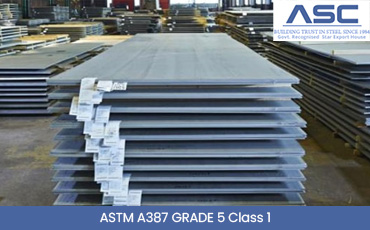
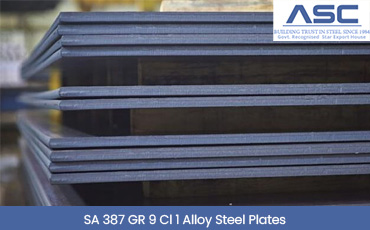
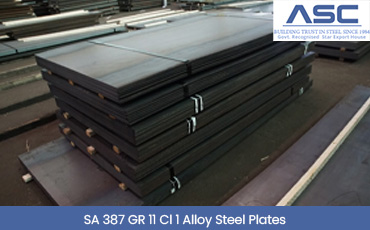
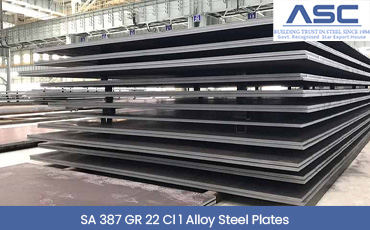
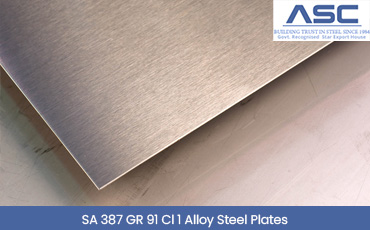
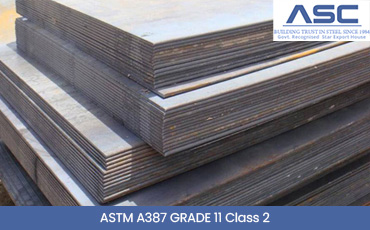
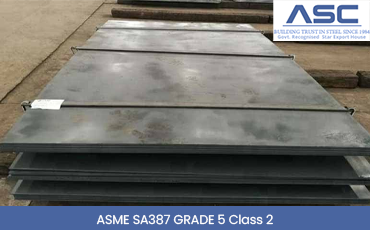
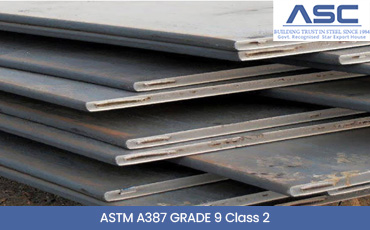
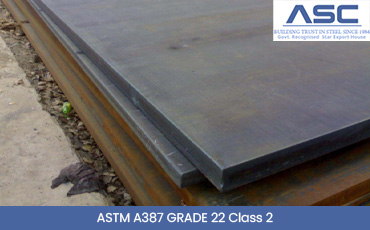
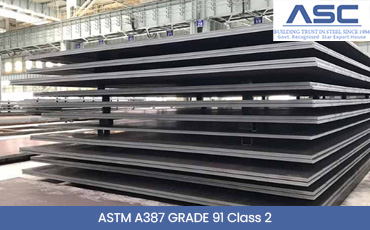
Amardeep Steel is a Leading Manufacturer and Exporter of High Integrity ASTM A387 / ASME SA387 Chrome Molybdenum alloy steel Plates. Such are very important plates for use in critical pressure vessels in Grades 11 (1.25Cr-0.5Mo) and Grade 22 (2.25Cr-1Mo). In Grades 91 (9Cr-1Mo-V) and 5 (5Cr-0.5Mo), they are also used for class 1 and class 2 tensile strength purposes. Chrome Molybdenum Plates (ASTM A387) are specifically designed to give a unique chemical structure (Carbon, Silicon, Manganese, Chromium, Molybdenum). Our heavy plates are available in a range of dimensions, thicknesses and supply conditions such as Hot Rolled (HR), Normalised (N), Normalised and Tempered (N+T) and Quenched and Tempered (Q+T) that meet the rigorous demands of international manufacturing codes. Class 2 plates provide a minimum tensile strength of 515 MPa, and a yield strength of 310 MPa, which is much higher than their Class 1 counterparts, and thus are the worldwide specification standard for high-pressure boilers, hydrogen-service vessels, and high-temperature reactors used above 350°C.
What is ASTM A387 GR 11 CL 2 Alloy Steel Plates?
The ASTM A387 Grade 11, 22 and 91 alloy steel plates are chromium-molybdenum alloy plates specially specified for high-temperature applications in ASME pressure vessels, in Section VIII, Division 1 and 2. Chromium imparts significant high-temperature resistance to graphitization, scaling, and oxidation to this alloy matrix and molybdenum increases elevated-temperature creep strength, structural shear stability, and resistance to high-temperature hydrogen attack (HTHA) of this alloy matrix.
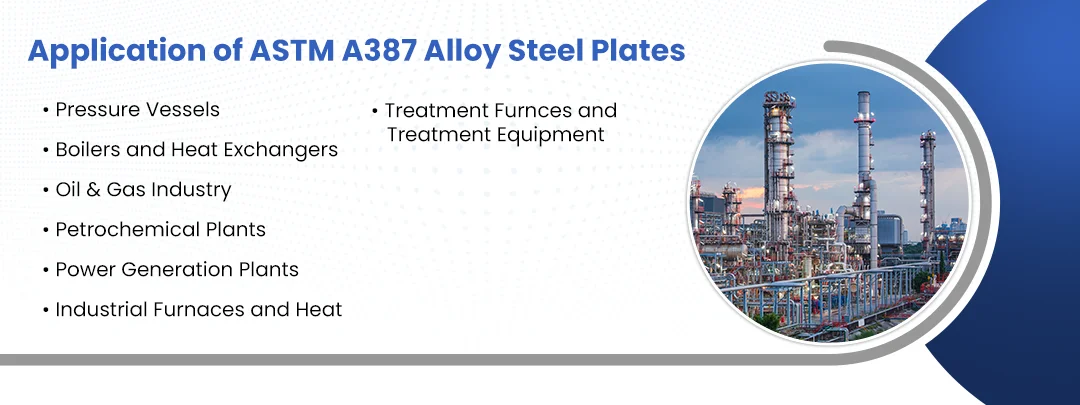
Conventional carbon steels would exhibit hydrogen embrittlement or creep deformation at high temperature in an extreme environment, but these plates are designed for such environments. These alloy plates are used in catalytic cracking and high pressure steam headers, as well as in the refining of columns, and are required to remain structurally sound at continuous operating temperatures of between 350°C and 600°C. Additionally, these grades are very resistant to long-term temper embrittlement when specified with low residual trace elements. Our ASTM A387 plates meet the NACE MR0175 / ISO 15156 limits and API 934 requirements for applications that require sour gas (H₂S) or high pressure hydrogen to prevent sulfide stress cracking (SSC) and hydrogen induced cracking (HIC) risks.
All Amardeep Steel plates are subjected to extensive non-destructive testing (NDT) and mechanical evaluation procedures prior to dispatch, ensuring absolute safety and traceability. This consists of 100% Ultrasonic Testing (UT) according to ASTM A578, Charpy V-Notch Impact Analysis (ASTM A370), Positive Material Identification (PMI), Brinell Hardness Mapping and Hydrostatic testing / validation.
ASTM A387 / ASME SA387 Alloy Steel Plates Specification Chart
| Property |
Specification Details |
| Specifications |
ASTM A387 / ASME SA387 |
| Standard |
ASTM, ASME, and API |
| Thickness Range |
4.0mm – 100mm (Custom heavy thicknesses available upon inquiry) |
| Supply Configuration |
Heavy Pressure Vessel Plates, Profiling Blanks, Circles, and Rings |
| Supply / Heat Treatment Condition |
Hot Rolled (HR), Normalised (N), Normalised & Tempered (N+T), Quenched & Tempered (Q+T) |
| Hardness Parameters |
Class 1: ≤ 179 HB Max │ Class 2: ≤ 197 HB Max (Grade 91: ≤ 241 HB Max) per ASTM A387 |
| Primary Material Grades |
ASTM A387 Grades 2, 5, 9, 11, 12, 21, 22, 91 (Class 1 and Class 2) |
| Material Density |
7.85 g/cm³ (Typical alloy steel weight metric) |
Chemical Composition of ASTM A387 Grade 11 Class 2 Plates
| Grade Designation |
C |
Si |
Mn |
P (Max) |
S (Max) |
Cr |
Mo |
| A387 GR.11 CL.2 |
0.05–0.17 |
0.50–1.00 |
0.35–0.65 |
0.035 |
0.035 |
1.00–1.50 |
0.45–0.65 |
ASTM A387 Grade 11 Class 2 Mechanical & Physical Properties
| Grade / Condition |
Material Thickness (mm) |
Yield Strength, Min (MPa) |
Tensile Strength (MPa) |
Elongation, Min % |
Max Brinell Hardness |
| A387 GR.11 CL.2 |
t ≤ 50 mm |
310 |
515–690 |
18 |
197 HB |
| A387 GR.11 CL.2 |
50 < t ≤ 200 mm |
275 |
515–690 |
18 |
197 HB |
Equivalent Grades of ASTM A387 Grade 11 Class 2 Steel Plates
| ASTM / ASME Standard |
EN 10028-2 Designation |
DIN Material Number |
Old BS Standard |
ISO Equivalent |
| A387 GR.11 / SA387 GR.11 |
13CrMo4-5 (1.7335) |
13 CrMo 44 |
1501-620 Gr.27 |
13CrMo4-5 |
ASTM A387 Alloy Steel Plates Classes
ASTM A387 Mechanical Properties — Class 1 vs. Class 2 Comparison
Class 1 Lower Tensile Property Matrix
| Material Grade |
Tensile Strength (MPa) |
Yield Strength, Min (MPa) |
Elongation (50mm), Min % |
Elongation (200mm), Min % |
Reduction of Area, Min % |
| Grade 2 |
380–515 |
230 |
22% |
18% |
— |
| Grade 12 |
380–515 |
230 |
22% |
18% |
— |
| Grade 11 |
415–585 |
240 |
22% |
19% |
— |
| Grades 22, 21, 5, 9 |
415–585 |
205 |
18% |
— |
40% |
| Grades 21L, 22L |
415–585 |
205 |
18% |
— |
40% |
Class 2 Higher Tensile Property Matrix
| Material Grade |
Tensile Strength (MPa) |
Yield Strength, Min (MPa) |
Elongation (50mm), Min % |
Elongation (200mm), Min % |
Reduction of Area, Min % |
| Grade 2 |
485–620 |
310 |
22% |
18% |
— |
| Grade 11 |
515–690 |
310 |
22% |
18% |
— |
| Grade 12 |
450–585 |
275 |
22% |
19% |
— |
| Grades 22, 21, 5, 9 |
515–690 |
310 |
18% |
— |
40% |
| Grade 91 |
585–760 |
415 |
18% |
— |
— |
Post-Weld Heat Treatment (PWHT) and Welding Preheats
Being highly hardenable materials, chromium-molybdenum steels require appropriate heating control during manufacturing of thick sections in order to avoid micro-cracking in the heat-affected zone (HAZ). The requirement for ASTM A387 Gr. 11 and Grade 22 material is that minimum preheat temperature ranging from 150°C to 250°C should be applied based on plate thickness. After the welding process, Post Weld Heat Treatment is necessary at temperatures ranging from 650°C to 760°C according to ASME Section VIII, Division 1
Related Products :