
| Tube OD range | Groove depth | Max service temp | Fin material |
|---|---|---|---|
| 16–50.8 mm | ≈0.4 mm | 380–420 °C | Aluminium / Copper |
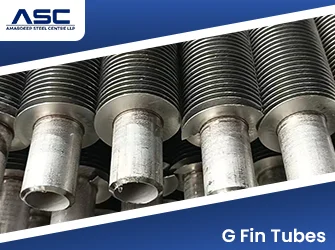
G Finned Tubes Manufacturer, Supplier and Exporter in India
G fin tubes are embedded finned tubes in which the fin strip is wound into a helical groove machined in the base tube and then mechanically locked by backfilling the parent metal around the fin foot. That embedded bond is the differentiator: it holds a stronger mechanical grip than tension-wound L and LL fins and tolerates far higher operating temperatures than L-foot types, while staying more economical than fully extruded bimetallic fins. The result is a fin tube built for hot, continuous-duty air-cooled service.
What Is a G Fin Tube?
A G fin tube also called an embedded fin tube or G type finned tube is a finned tube whose fin is anchored inside the tube wall rather than merely wrapped around it. During manufacture a continuous helical groove is machined into the outer surface of the base tube. A metal fin strip (usually aluminium) is then wound edge-on into that groove under tension, and the shoulder of parent metal alongside the groove is rolled back over the fin foot. This backfilling step is what defines the G-type: the fin is not glued, welded or clamped; it is mechanically trapped by the tube's own material.
Because the fin root sits below the original tube surface and is captured on both sides, the joint resists the two things that degrade a finned tube in service: loosening under thermal cycling and lift-off under vibration. That is why embedded G-fin construction is specified for continuous high-temperature duty where tension-wound fins would relax and lose thermal contact. The trade-off is that the groove consumes a small amount of wall, so groove depth is always matched to the base tube wall thickness and the fin foot dimension.
Technical Data
G Fin Tube vs Other Finned Tube Types
The fin-to-tube bond method decides the temperature ceiling, the durability, and the price. The table below places embedded G-fin against the common alternatives so you can size a fin type to the duty before you raise an RFQ.
| Fin type | Construction / bond | Max temp | Bond | Cost | Best-fit environment |
|---|---|---|---|---|---|
| G-fin (embedded) | Fin wound into machined helical groove, locked by backfilled parent metal | 380–420 °C | High | Medium | Hot, continuous air-cooled service; waste-heat recovery |
| L-fin (tension wound) | L-shaped foot tension-wrapped onto plain tube | ≈130–150 °C | Low | Low | Low-temp coolers; foot shields tube from corrosion |
| LL-fin (overlapped) | L-fin with overlapping foot fully sheathing tube | ≈160–180 °C | Low–Med | Low–Med | Corrosive but cool streams needing full coverage |
| KL / knurled-foot | Knurled groove grips a wrapped L-foot | ≈250 °C | Medium | Medium | Mid-temperature duty between L and G |
| Extruded (bimetallic) | Fin cold-extruded from aluminium sleeve over tube | ≈280–300 °C | High | High | Corrosive service needing sheathed tube + efficiency |
Temperature figures are typical industry ranges for selection guidance and vary with base tube grade, fin material and duty cycle; confirm the rated limit against the project data sheet before ordering.
Base Tube & Fin Material Options
Because the fin handles heat transfer and the base tube handles pressure and corrosion, the two are chosen separately. The G-type bond stays identical while the base tube grade is upgraded to suit the stream.
Base tube materials
| Base tube grade | Family | Typical service |
|---|---|---|
| ASTM A179 | Carbon steel | Standard, non-corrosive air-cooled & waste-heat service |
| ASTM A192 | Carbon steel | Higher-pressure boiler / economiser duty |
| ASTM A210 | Carbon / C-Mn steel | Superheater & higher-temperature boiler service |
| Low-alloy steel | Cr-Mo alloy | High-temperature waste-heat recovery |
| TP304 / TP316 | Stainless steel | Corrosive flue gas & condensing service |
Fin materials
The fin is normally aluminium (grade 1060 / 1100) for its high conductivity, light weight and low cost — the standard choice for aluminum embedded fin tubes. Where a higher heat transfer coefficient is needed, a copper fin is used. Fin thickness is typically 0.4–0.6 mm and is matched to groove depth so the embedded foot seats fully.
Worked example. For an air-cooled heat exchanger running at 350–400 °C on a non-corrosive process gas, a G-fin on an A179 carbon steel base tube with an aluminium fin gives the best balance of thermal performance and cost. Keep the same G-type construction but switch to a stainless steel TP304 base tube when the stream turns to corrosive flue gas — the fin stays aluminium; only the pressure-bearing tube is upgraded.
Specifications of Embedded G-fin Tubes
| Parameter | Value | Notes |
|---|---|---|
| Groove depth | ≈0.35–0.40 mm | Matched to fin foot & base tube wall |
| Fin height | 9–16 mm | Larger heights for lower-density air side |
| Fin pitch | 7–11 FPI (≈275–433 FPM) | Set by air-side pressure-drop target |
| Fin thickness | 0.4–0.6 mm | Aluminium standard; copper on request |
| Base tube OD | 16 – 50.8 mm | Common ACHE range |
| Max continuous service temp | 380–420 °C | Grade-dependent; embedded bond retains grip |
Dimensional Range for G Fin Tubes
| Dimension | Range | Detail |
|---|---|---|
| Base tube outside diameter | 16 mm – 50.8 mm | 5/8" to 2" nominal |
| Finned length | up to 18 m | Per bundle / bay length |
| Fin height | 9 – 16 mm | To air-side design |
| Fin pitch | 7 – 11 FPI | Fins per inch |
| Fin thickness | 0.4 – 0.6 mm | Aluminium / copper |
| Groove depth | ≈0.4 mm | Helical, continuous |
How G Fin Tubes Are Manufactured
The embedding sequence is what separates a true G-fin from a wrapped fin. The four-stage route:
- Groove machining: A single-point tool cuts a continuous helical groove (~0.4 mm deep) into the base tube at the target fin pitch.
- Fin winding: The aluminium or copper fin strip is fed edge-on and wound into the groove under controlled tension.
- Embedding / backfill: A forming roller deforms the parent-metal shoulder back over the fin foot, locking it mechanically in the groove.
- Finishing & QC: Ends are trimmed, fin height and pitch are gauged, and a bond/adhesion pull test verifies the embedded joint.
Testing & Quality Inspection
Every embedded fin tube is verified for both the joint and the geometry before dispatch. Inspection covers fin bond / adhesion pull testing to confirm the embedded foot holds its rated grip, dimensional inspection of OD, fin height and fin pitch, a mechanical strength check on the base tube, and a thermal-contact / conductivity verification of the fin-to-tube interface. Orders ship with EN 10204 3.1 mill test certificates and dimensional records; third-party inspection can be arranged on request.
Which Fin Type Should You Choose?
Use temperature, corrosivity and cleaning frequency as the three deciding axes.
Choose G-fin when
- Service runs hot & continuous (up to ~380–420 °C)
- Waste-heat recovery, HRSG, economiser duty
- You need a strong bond without extruded-fin cost
- The stream is non-corrosive, or the base tube can be upgraded
Choose L / LL-fin when
- Service is cool (≤ ~150–180 °C)
- The fin foot must sheath & protect the tube
- Frequent cleaning / lower first cost matters
Choose an extruded fin when
- You need the tube fully sheathed against corrosion
- Sustained peak efficiency is the priority; budget allows higher unit cost
Applications of G Fin Tubes
Embedded G-fin tubes are the workhorse of the air side wherever the process runs hot and the bond must not relax. Typical duties include:
- Air-cooled heat exchangers: ACHE bundles in refineries & petrochemical plants
- Air-cooled condensers: Steam-turbine flue-gas condensation in power generation
- HRSGs & economisers: Waste-heat recovery on the flue-gas path
- Gas coolers: Process-gas cooling in gas processing plants
- Compressor Coolers: Inter- and after-cooling on compression trains
- Steel-plant systems: Blast furnace / converter waste-heat duty & HVAC air handling
Advantages of G Fin Tubes
The embedded groove earns its place for three reasons. First, higher temperature tolerance: because the fin is trapped in the tube wall it will not unwind as the assembly heats, so it holds thermal contact well past the point where an L-foot fin loosens. Second, a strong, durable mechanical bond that resists vibration lift-off and thermal-cycling fatigue over long continuous runs. Third, it is cost-effective versus extruded fins; you get a high-integrity, high-temperature bond without paying for a full bimetallic sleeve.
Why Choose Amardeep Steel Centre
- Multi-material base tubes: Carbon, alloy and stainless base tubes under one roof, not a single-material catalogue.
- Global export capability: Documented, packed-for-export supply to refineries, power and EPC contractors worldwide.
- Testing & MTCs: Fin bond testing, dimensional records and EN 10204 3.1 mill test certificates with every order.
Frequently Asked Questions
What is a G fin tube?
A G fin tube is an embedded finned tube in which a helical groove is machined into the base tube and a fin strip is wound into that groove, then locked in place by backfilling the parent metal around the fin foot. The mechanical grip gives a strong, high-temperature bond.
What is the difference between a G fin tube and an L fin tube?
A G fin tube is embedded in a machined groove and backfilled, so it tolerates higher temperatures (about 380–420 °C). An L fin tube is tension-wound with an L-shaped foot pressed onto the tube and is limited to roughly 130–150 °C because the wrap can loosen as it heats.
What is the maximum operating temperature of a G fin tube?
Embedded G fin tubes are typically rated for continuous service up to about 380–420 °C. The exact limit depends on the base tube grade and fin material; verified figures should always be confirmed against the project data sheet before ordering.
Which base tube materials are used for G fin tubes?
Common base tubes include carbon steel boiler grades such as ASTM A179, A192 and A210, low-alloy steel for higher temperatures, and stainless steel TP304 or TP316 for corrosive flue-gas service. The fin is usually aluminium, or copper where higher conductivity is needed.
How deep is the groove in a G fin tube?
The helical groove is shallow, typically around 0.35–0.40 mm deep, which is enough to seat the fin foot without significantly reducing the pressure-bearing wall of the base tube. Groove depth is matched to fin thickness and base tube wall.
When should I choose a G fin tube over an extruded fin tube?
Choose a G fin tube when you need high-temperature service and a strong mechanical bond at a lower cost than extruded bimetallic tubes. Choose extruded fins when you need the base tube fully sheathed for corrosion and the highest sustained efficiency, and can accept the higher price.
Are G fin tubes suitable for corrosive flue gas?
Yes, when built on a corrosion-resistant base tube. The G-type construction stays the same; the base tube is upgraded to stainless steel TP304 or TP316 so the pressure-bearing tube resists the corrosive stream while the aluminium fin handles heat transfer.
What documentation is supplied with G fin tubes?
Each order ships with EN 10204 3.1 mill test certificates for the base tube, dimensional inspection records, and fin bond and adhesion test reports. Third-party inspection and additional NDT can be arranged on request.
Get a Quote on G Fin Tubes
Send us the base tube grade, fin material, OD and finned length, fin height/pitch and service temperature — we'll quote embedded G-fin tubes matched to your duty, mill-tested and packed for export.
Request a Quote