10 Stainless Steel Facts and Statistics Every Engineer Should Know
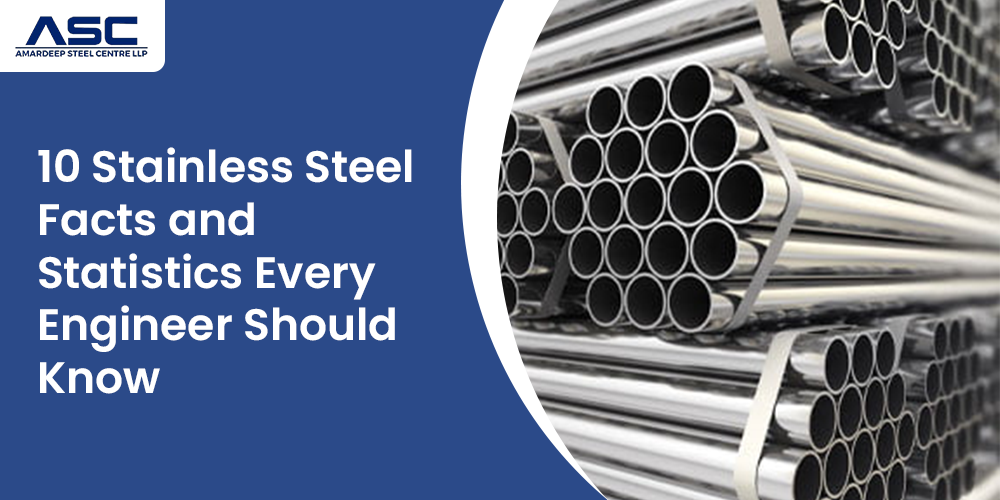
The Stainless Steel Facts outline the reasons why this material is known as one of the most important engineering materials in modern industrial society. Stainless steel is an important material in many critical industries, including the oil and gas, pharmaceutical, food processing, marine, and construction industries, among others, due to its special properties of corrosion resistance, high strength, and durability. This provides it with unique versatility features that enable it to work very well in extreme environments as well as hygienic environments. Moreover, it is commonly used to achieve the sustainability objective also because it can be recycled 100% and it does not lose its qualities even when used several times. Its global demand is increasing, whether in massive infrastructure projects or in finely-tuned parts. The following are the top stainless steel facts supported by industry statistics.
In 1913 Stainless Steel was Invented
In 1913, Harry Brearley in Sheffield, UK discovered stainless steel when he was studying gun barrels that would resist erosion. He discovered that chromium in steel formed a surface that was resistant to corrosion. This refutes the myth that stainless steel is hundreds of years old and it is a new-fangled engineering product.
Produced in Excess of 55 Million Tonnes per Year
In 2023, International Stainless Steel Forum (ISSF) is a highly advanced steel production which has scaled to approximately 55.7 million tonnes. Over the years, production has increased, and China is supplying 55% of the total production making it the world leader in stainless steel production.
Third Largest Market for Stainless Steel is India
India is among the third largest markets for stainless steel in the world. The country manufactures about 4 million tons per year. In India there are two major places that produce stainless steel in the major amount, which are Mumbai and Gujarat.
Grade 304 Makes up Almost 50% of Production
Stainless steel Grade 304 mostly acquires almost 50% of the total production of stainless steel worldwide. It has an average composition of 18% chromium and 8% nickel, making it highly resistant to corrosion.
Stainless Steel Can Be Recycled 100 Per Cent
Stainless steel can be completely re-used, and re-used indefinitely without compromising its properties. In reference to the industry statistics, more than 80 percent of the stainless steel in circulation is recycled and is one of the most sustainable engineering materials.
Chromium Passive Layer is Self-Healing
A minimum of 10.5% chromium is required for steel to be classified as stainless. This chromium produces automatic oxide coating on the surface which automatically repairs itself upon damage to offer continuous corrosion protection.
It Has More than 200 Stainless Steel Grades
All stainless steel grades are 200+ and fall into categories like austenitic, ferritic, martensitic and duplex. Examples are 304 and 316 with higher grades such as 904L, 2205 Duplex and 2507 Super Duplex being applied in high-performance settings.
High Strength-to-Weight Ratio
Stainless steel has a high strength to weight ratio and with this, engineers have been able to design lighter yet strong structures. This renders it perfect to be used in infrastructure, transportation, and heavy engineering projects.
904L Made to Be Acid Resistant
Grade 904L was designed to work under conditions of high levels of corrosivity especially in the presence of sulfuric and phosphoric acids. Its copper content increases its resistance to the reducing acids thus making it applicable in chemical processing industries.
Growing Market up to 170 Billion
According to the data provided by the World Steel Association and market research reports, the global stainless steel market is expected to hit 170 billion by 2030, with oil and gas, pharmaceutical, desalination and food processing being the primary industries to use stainless steel.
Frequently Asked Questions
When was stainless steel invented?
Stainless steel was invented in 1913 by Harry Brearley in England.
What is the most commonly used stainless steel grade?
The most commonly used grade is 304 stainless steel due to its excellent corrosion resistance and versatility.
Is stainless steel 100% recyclable?
Yes, stainless steel is 100% recyclable and can be reused without losing its properties.
How much stainless steel is produced each year globally?
Over 55 million metric tons of stainless steel are produced globally each year.
Why does stainless steel not rust?
Stainless steel does not rust because it contains chromium, which forms a protective oxide layer that prevents corrosion.
304 Stainless Steel: Everything You Need to Know – Simple Guide
Ever found yourself wondering what gives your kitchen sink that lasting shine, or what tough material keeps those big industrial pipes from turning into rust buckets?