Difference Between Low Alloy Steel & High Alloy Steel
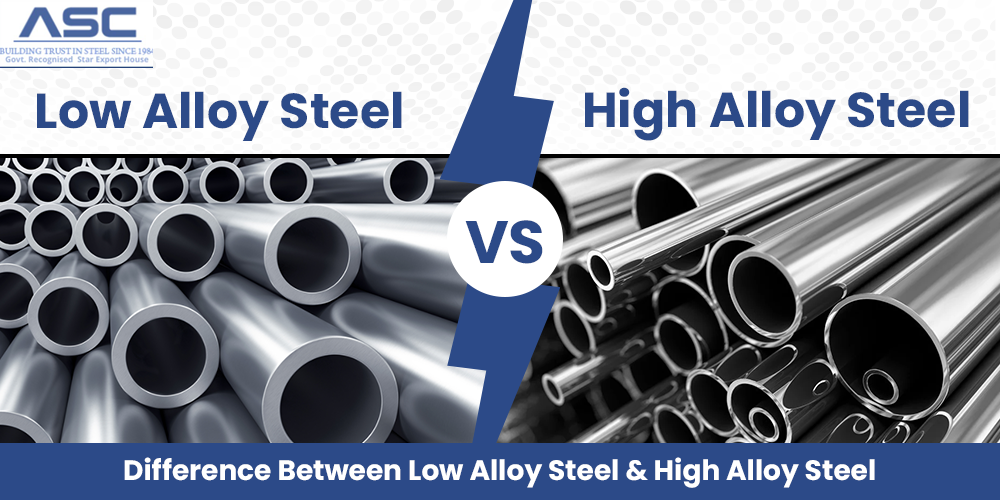
Overall, there are some differences between the low alloy steel and the high alloy steel. In plain words, low alloy steel is an ordinary alloy steel with some little added or high alloy steel is generally stainless steel with a huge alloy blend.
At Amardeep Steel Centre, we give high quality low alloy steel and high alloy steel. We have explained the vital distinctions of low alloy vs high alloy steel compositions and grades to assist you in the correct selection of your project.
What is Low Alloy Steel?
The low alloy steel is an alloy type of steel, which has better mechanical properties in comparison to plain carbon steel. Although it is composed mostly of iron, it has low percentages of alloying elements- usually between 1 percent and 5 percent (definition may go up to 8 percent).
Regarding low alloy steel composition, they are usually less than 0.2% carbon in composition to retain weldability with trace additives of Nickel (Ni), Chromium (Cr), Molybdenum (Mo), Vanadium (V), Boron (B), Tungsten (W) and Copper (Cu).
These aspects are not introduced accidentally; they are planned to obtain certain advantages:
- Molybdenum (Mo): Strengthens in high temperatures.
- Nickel (Ni): Enhances toughness and impact strength particularly at low temperatures.
- Chromium (Cr): Provides hardness and average corrosion resistance.
- Vanadium (V): Adds to the toughness by refining the grain structure.
Low Alloy Steel Manufacturing and Properties
In the process of making these steels, heat treatment (normalizing) and tempering are usually involved most of the time. This normally involves specific cooling and heating steps in order to obtain the desired structure.
Most forms of low alloy steel are welded, but they may be difficult to weld as compared to mild steel. In order to prevent cracking, the material is occasionally pre-treated (pre-heating) or post-treated (after the weld). Although these conditions demand it, much large pipes (i.e. funnels) of the oil business, construction, and the military are made out of low alloy steel.
Key Advantages of Low Alloy Steel
- High Yield strength
- Creep strength
- Oxidation resistance
- Hydrogen resistance
- Low-temperature ductility
Read our full guide on What is Low Alloy Steel to understand its composition, properties, grades, and industrial applications.
What is High Alloy Steel?
High alloy steel is defined by having a significantly higher volume of alloying elements, generally more than 10%. The most well-known type of this material is Stainless Steel.
The defining difference in high alloy steel composition is the presence of Chromium and Nickel. To be classified as stainless (high alloy), the steel must contain at least 10.5% Chromium.
The Science of High Alloys
The secretive constituent that provides high alloy steel with its durability is chromium. It combines with oxygen to create a thin, invisible layer of the oxide on the surface, the so-called latent layer or passive layer. The layer eliminates corrosion or rust.
As well, manufacturers tend to add large volumes of:
- Nickel: To add rigidity to the austenitic structure (lose the magnetic and plastic properties of the steel).
- Manganese and Carbon: To enhance the working hot properties and strength.
Due to such prohibitive alloying elements, high alloy steel is typically more expensive than low alloy steel yet it has unparalleled corrosiveness resistance, extreme hot gas and liquids.
Comparison Guide: Low Alloy and High Alloy Steel
Although either of the two types are better than basic carbon steel, it is imperative to learn the actual difference between low alloy steel and high alloy steel in order to achieve the appropriate grade.
What makes it different is its composition of the steel. The first difference is the percentage of alloying elements and the property of the material that is produced as in the case of the Alloy Steel Products section in our catalog.
| Feature | Low Alloy Steel | High Alloy Steel |
|---|---|---|
| Alloy Content | Generally < 5% to 8% | Generally > 10% |
| Primary Composition | Iron, Carbon (<0.2%), small amounts of Ni, Cr, Mo, V | Iron, High Chromium (>10.5%), Nickel, Manganese |
| Corrosion Resistance | Moderate (Better than carbon steel, but can rust) | Excellent (Due to the Chromium "latent layer") |
| Cost | More economical | Higher cost due to expensive alloys |
| Weldability | Good (may require pre/post heat) | Varies (requires specific filler metals) |
| Primary Use Cases | Structural integrity, pressure vessels, automotive gears | Chemical handling, aesthetic surfaces, food processing |
Applications and Industries of Low Alloy Steel VS High Alloy Steel
The varying properties dictate where these steels are used:
- Low Alloy Steel Applications: Because it offers a superior strength-to-weight ratio, it is used where structural integrity is paramount.
- Aerospace & Automotive: Gears, axles, and stamped parts.
- Yellow Goods: Bulldozers and cranes requiring high yield strength.
- Energy: Piping for oil and gas (high pressure).
- High Alloy Steel Applications: This is non-negotiable in environments involving moisture, chemicals, or hygiene.
- Chemical Processing: Tanks and valves holding corrosive acids.
- Food & Beverage: Hygienic surfaces that do not contaminate food.
- High Heat: Jet engine components (superalloys).
Standard Steel Grades
At Amardeep Steel, we stock a wide variety of grades compliant with ASTM/ASME standards.
High Alloy Steel Grades
- Pipes: ASTM A335 Gr P1, P5, P11, P22, P9, P91
- Fittings: ASTM A234 Gr.WP5, WP9, WP11
- Forging: ASTM A182 F5, F9, F11
Low Alloy Steel Grades Chart
| Steel Category | ASTM Standard | Plate / Pipe / Component | Electrode / Wire |
|---|---|---|---|
| 0.5% Mo | ASTM A204 / A335 P1 | Plates Gr A,B,C / Pipe P1 | GL76/78 (A1) |
| 0.5% Cr - 0.5% Mo | ASTM A387 / A335 P2 | Grade 2 / Pipe P2 | GL86/88 (B1) |
| 1.25% Cr - 0.5% Mo | ASTM A387 / A335 P11 | Grade 11, 12 / Pipe P11, P12 | GL86/88 (B2) |
| 2.25% Cr - 1.0% Mo | ASTM A387 / A335 P22 | Grade 22 / Pipe P22 | GL86/88 (B3) |
| 5.0% Cr - 0.5% Mo | ASTM A387 / A335 P5 | Grade 5 / Pipe P5 | GL86/88 (B6) |
| 9.0% Cr - 1.0% Mo | ASTM A387 / A335 P9 | Grade 9 / Pipe P9 | GL86/88 (B8) |
The Bottom Line
The decision between the two materials is eventually decided on the environment and the budget. Low alloy steel is the right choice in case you require strength, which is less expensive in undertaking structural projects. In case your project consists of corrosive conditions or high hygienic needs, the required investment is high alloy steel.
The first thing that is fundamental in achieving good weld integrity and longevity is knowing precisely what kind of steel you are working with. The Amadeep Steel is there to guide you through such technical requirements.
Looking for specific materials?
Explore our full range of Alloy Steel Products to find the perfect match for your industrial requirements.