Comprehensive Guide: What Type of Steel Is Used in the Automotive Industry?
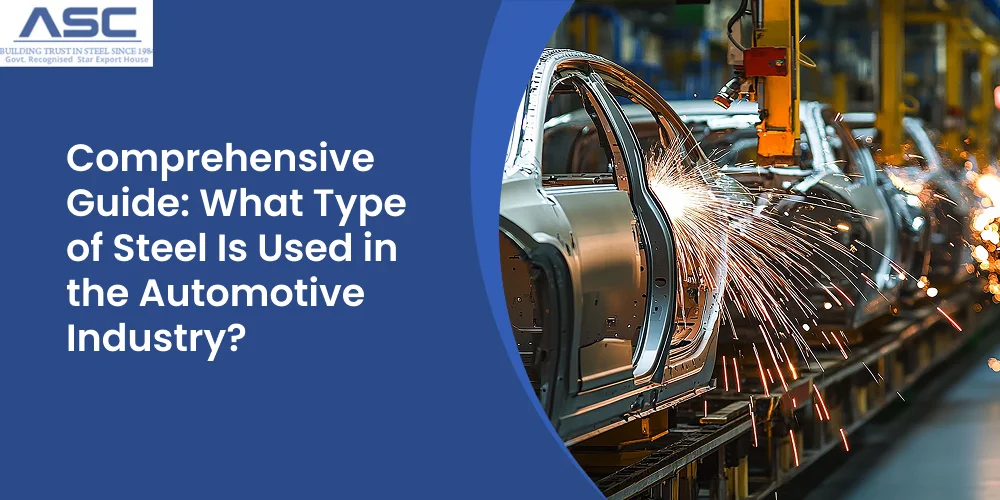
The automobile sector is undergoing a gigantic change. Since the emergence of electric vehicles (EVs) to the quest of achieving increased fuel efficiency and tougher safety standards, producers have been put in a constant stress to develop innovatively. Nevertheless, in the era of introducing composites, carbon fibers, and aluminum, there is still one material that serves as the unquestionable leader of the automotive production. About 60 percent of the weight of an average modern vehicle is composed of steel. However the steel that is used in a 2024 sedan is incredibly different to the metal that is used in a 1970s muscle car. The present-day automotive eco-system is based on a complex material combination of high-tech alloys that vary significantly in terms of chemistry, tensile strength, and formability. We are going to discuss the particular species of steel utilized in the contemporary automotive engineering, the science of the same and how Amardeep Steel is assisting this industry with high quality metal solutions.
1. The Engineering Challenge: Why Steel Prevails
It is necessary to know the reasons as to why the automakers have not fully moved to lighter materials such as aluminum or carbon fiber before analyzing individual grades. The solution is three-fold, it is in the areas of Cost, Manufacturability, and Crashworthiness. Aluminum has the benefit of saving weight but it is much more costly to manufacture, and it is more difficult to welding. Instead, steel provides an extraordinary strength to weight ratio- particularly with the introduction of Advanced High-Strength Steels (AHSS). Moreover, steel
possesses a special property of absorbing impact energy through the process of work hardening, i.e. it gets hardened when it is deformed during a car crash and this saves the occupants of the passengers. In the case of manufacturers, it is to put the right steel at the right place. Here comes the question of the hierarchy of steel grades.
2. Mild Steel (Low-Carbon Steel): The Skin of the Vehicle
Mild steel is the most widely utilized material when it comes to manufacturing of cars, mainly because it is malleable and economical. It usually has a content of 0.05-0.25% carbon content.n.
Characteristics and Applications
Mild steel is known to be formable. The automotive factories have very large hydraulic presses that stamp flat metal sheets into intricate shapes-fenders, doors, hoods and trunk lids. It is possible to deep draw using mild steel without failure.
- Exterior Body Panels: Mildred steel is the best choice when one is interested in the visible portion of the car which is painted on because it offers high quality surface finishing.
- Floor Pans and Chassis Parts: It gives a base structure that is solid and offers a foundation on parts that do not demand ultra-high tensile strength yet require being rigid..
Sourcing Mild Steel
For general automotive fabrication and structural components, manufacturers rely on high-quality carbon steel sheets and pipes that meet rigorous standards.
- Explore our range:Carbon Steel Plates & Sheets
- Structural Piping:ASTM A106 Gr B/C Carbon Steel Pipes
3. High-Strength Low-Alloy (HSLA) Steel: The Structural Skeleton
As we go deeper into the surface of the car to the structural skeleton, the mild steel may be substituted with the High-Strength Low-Alloy (HSLA) steel. HSLA does not pass off as a product by the content of carbon but because of the incorporation of micro-alloying elements that include manganese, silicon, nickel and chromium.
The Chemistry of Strength
The HSLA steels are constructed in a way that they offer superior mechanical characteristics and resistance to corrosion in the atmosphere as compared to the conventional carbon steels. With minor additions of vanadium or niobium the grain structure of the steel is refined, thus making the material up to 30 times stronger than mild steel.
Applications
HSLA being stronger, the manufactures can make it with a thinner gauge and have the same strength as thicker mild steel. This is what is meant by lightweighting.
Suspension Systems: Control arms and brackets.
Chassis Reinforcement: Side beams and cross members which safeguard in case of a collision on the sides.
Underbody Structures: Here, durability and load bearing are important factors.
In Amardeep Steel, we are specialized in supplying alloy products that fulfill such specifications that are quite demanding.
- View our inventory:Alloy Steel Products
- Specialized Sheets:16Mo3 Steel Sheets & Plates
4. Advanced High-Strength Steel (AHSS): The Safety Shield
With the skeleton being HSLA, the armor is Advanced High-Strength Steel (AHSS). AHSS has transformed the vehicle safety ratings. In comparison to the traditional steels, AHSS experiences the specific heat treatment and cooling sequences to develop a multiphase microstructure that consists of martensite, bainite, and retained austenite.
The main purpose of AHSS in a car is the energy absorption. In case of a high speed crash, the crumple zones of the car are made to collapse smoothly and to absorb the kinetic energy. The passenger cabin (the safety cell) should however not be deformed.Here, the AHSS grades (e.g., Dual Phase (DP) and Transformation Induced Plasticity (TRIP) steels are utilized. They provide yield strengths that are above 1000 MPa (Megapascals).
Applications
- B-pillars and Roof Rails: This is to ensure that the roof does not cavity in case of a rollover accident.
- Door Intrusion Beams: These are used to prevent intrusion in T-bone accidents.
- Bumpers: It is used to provide low speed impact absorption without damaging to the frame.
- High tensile and abrasion resistant materials are needed to ensure high stress applications which demand the use of exceptionally tough materials.
Abrasion Resistant Plates Abrasion Resistant Plates.
High Tensile Tubing: 4340 Tubes AISI.
- Heavy Duty Solutions:Abrasion Resistant Plates
- High Tensile Tubing:AISI 4340 Tubes
5. Stainless Steel: Heat and Corrosion Resistance
Most of them believe that the stainless steel is exclusively applied to the DeLorean DMC-12 or Tesla Cybertruck. Although a full stainless body is uncommon, the inner organs of all combustion engines cars are completely in need of stainless steel.
Managing Extreme Heat
Internal combustion engine produces huge quantities of heat and corrosive exhaust fumes. Ordinary carbon steel would rust or bend out in weeks given such conditions. Stainless steel, which has not less than 10.5% chromium, forms a passive oxide coating, which inhibits corrosion.
Key Automotive Grades
- Ferritic Stainless (400 Series): Magnetic and containing high chromium but low nickel. Used for catalytic converters and exhaust pipes.
- Product Highlight:ASTM A240 TP410 Stainless Steel Plates
- Austenitic Stainless (300 Series): Non-magnetic with high formability. Used for fuel tanks, clamps, and intricate exhaust manifolds.
- Product Highlight:304 Stainless Steel Plates
- Product Highlight:316Ti Stainless Steel Pipes (Titanium stabilized for high-temperature stability).
6. High-Carbon & Specialty Alloy Steels
High-Carbon steel (0.6%-1.0% carbon) is preferable to use in parts that experience continuous motion, friction and wear. This is heat-treatable steel that attains high hardness.
The Moving Parts
Transmission Gears: These should be able to withstand wear during rotation in thousands of RPM.
Springs & Suspension: This should bend millions of times without breaking its shape or snapping.
Bearings & Valves: Must be of very hard surface.
Chromoly (Chromium-Molybdenum) steel, or AISI 4130, is one of the most popular grades of motorsport and high-performance automotive application. It has an amazing strength to weight ratio and it is easy to weld thus this is the norm in roll cages and race car chassis.
- Motorsport Grade:AISI 4130 Tubing Manufacturer
7. The Competitor: Aluminum vs. Steel
The automotive materials cannot be discussed without mentioning Aluminum. Aluminum is a lot lighter than steel which may result in saving of fuel but there are challenges.
Price: Aluminum is approximately three times higher than steel in terms of cost.
Repairability: Aluminum also retains a memory and is hard to recover a dent in. It is not always necessary to repair it, it usually needs to be replaced.
Joining: It is not easy to spot-weld aluminum to steel, it must use rivets or industrially-adhesive.
There are however very many contemporary vehicles that adopt a Hybrid Approach. They can have an Aluminum hood (weight) and Steel chassis (strength).
- Check our Aluminum range:Aluminium Products
8. The Future: Steel in Electric Vehicles (EVs)
In an EV, the battery pack is volatile. Battery thermal runaway (fire) can happen in the event of a crash, when the battery is punctured. As such, the battery casing should be comprised of the toughest substance possible. The material of choice nowadays in battery cases is Ultra-High Strength Steel (UHSS) that is more likely to stop intrusion in side-impact crashes in comparison with aluminum.
EVs are 20-30% heavier than gas cars. This places additional load on the suspension and the chassis. This is leading to the demand of stronger alloy tubes and hollow sections.
- High-Load Tubing:AISI 4140 Alloy Tubing
9. Sustainability and Recycling
Steel used in automobiles is a hero of the circle economy. The most recycled material on planet earth is steel. Once a car is at the end of its service (usually after 12-15 years), more than 95 percent of its steel material is reclaimed and reused.
The steel is not a polymers or carbon fiber composite and although they are hard to separate and are mostly discarded in landfills, the steel may be melted and re-formed again without compromising on its quality. This renders steel as the green choice of automobile in the future.
Conclusion: Sourcing the Right Steel
In summary, the procurement of steel is about finding the right steel.
The automobile driver is a symphony of various metals in harmony. This is because the Stainless Steel in the exhaust, the HSLA in the frame, the Mild Steel on the surface and the Chromoly in the suspension are all important grades that have a vital role to play.
To manufacturers, fabricators and repair specialists, access to certified, specification-compliant steel is not a bargain. It is not only a quality problem but also a safety concern to use inferior material in a car.
- Carbon Steel Pipes & Plates for structural integrity.
- Alloy Steel Tubing for high-stress components.
- Stainless Steel for corrosion resistance and thermal management.
Whether you are prototyping a new component or managing supply for a large-scale production line, our team is ready to assist with technical expertise and a vast inventory.
Ready to Source Automotive Grade Steel?
Ensure your project meets the highest standards of safety and durability.
- Browse our full catalog: Amardeep Steel Products
- Get a Quote: Contact Us Today