Stainless Steel Metal Fabrication — Processes, Grades, Welding & Surface Finishing Guide
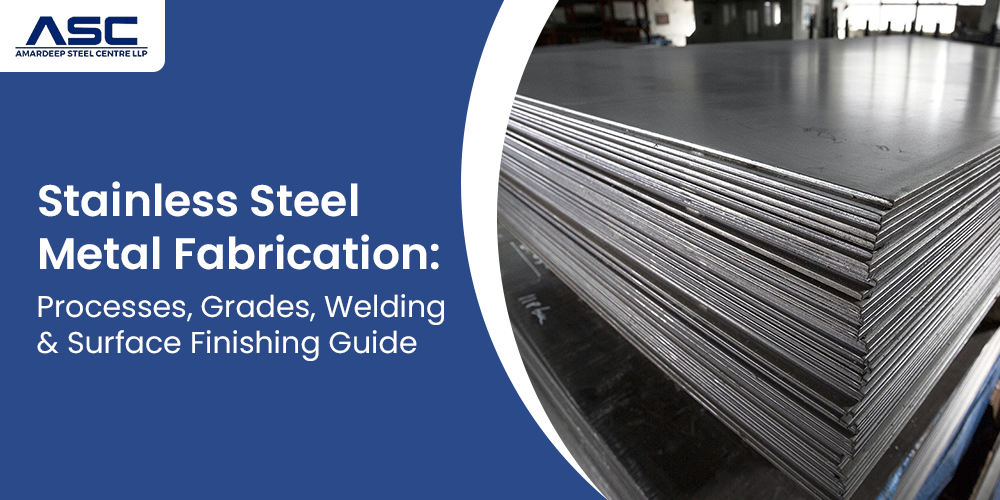
Stainless Steel Metal Fabrication is a very specialised process and is very different from carbon steel, as it has a very different metallurgical behaviour. In contrast to traditional material, stainless steel needs to be controlled strictly in the process of stainless steel fabrication, particularly in cutting, forming, and welding. The three key issues are that it hardens quickly (up to 2-3 times faster than carbon steel), is highly sensitive to heat, which interferes with the integrity of the weld and its contact with carbon steel, which contaminates it and causes corrosion. These aspects render SS cutting, forming, and welding processes much more challenging and demand proficient use in industry.
The other important factor is the SS surface finish following fabrication, which is critical in industries such as pharmaceuticals, food processing, and marine systems. Pickling and passivation are among the processes that are obligatory to provide corrosion resistance and hygienic standards. With products such as stainless steel pipe fittings fabrication, surface quality and structural integrity are of great importance to ensure long-term performance. This manual describes the entire stainless steel fabrication landscape in India, including process and grade welding practice and finishing methodology adopted by manufacturers such as Amardeep Steel.
Why Stainless Steel Fabrication Is Different from Carbon Steel
The stainless steel fabrication process requires harder control than carbon steel because of its unique material behavior. Stainless steel hardens quickly- 2-3 times faster than carbon steel, and, thus, it is a more difficult and specific tool demanding to cut and shape. It has very low thermal conductivity, resulting in heat accumulation during machining and welding, thus posing a threat of distortion and defects when proper SS cutting, forming, and welding methods are not observed. The chromium oxide coating needs to be maintained and replenished during the fabrication process, and also avoid contact with carbon steel because it can cause rusting. These aspects render fittings of stainless steel pipes fabrication a highly crafted procedure that involves governed manipulation in every phase.
Key Stainless Steel Fabrication Processes
The stainless steel fabrication process consists of various steps, which need specialised handling to ensure material integrity and resistance to corrosion. The main operations are cutting (laser, plasma, waterjet), forming (bending, rolling), machining (turning, drilling, milling), and welding (TIG, MIG, SAW), each modified to work with various grades of stainless steel. Every step requires accurate performance due to work hardening, heat buildups, and contamination sensitivity. These are the basic SS cutting, forming, and welding methods, which will be understood to accomplish uniform quality in the material used in the fabrication of stainless steel pipe fittings and other industrial parts.
Best Cutting Practices Used for Stainless Steel
The cutting process is the important and critical stage in the stainless steel fabrication process that requires tighter control due to work hardening and contamination risk. Stainless Steel needs to be cut with a lower speed with a sharp tool, and also only use dedicated SS tools to avoid any cross-contamination. The choice of method depends on the different things that include material grade, thickness, and application, especially in stainless steel fitting fabrication.
Laser Cutting
Laser cutting is best used with thin gauges and grades such as 304 and 316L, as it gives high accuracy, small heat-affected zone (HAZ), and clean edges.
Plasma Cutting
Plasma cutting is ideal in thicker sections; it is fast, but has a larger HAZ. Welds must be prepared by post-cut cleaning or grinding.
Waterjet Cutting
An uncomplicated cold cutting technique that has zero HAZ, allowing it to be used on heat-sensitive alloys such as duplex and 904L without degradation of material characteristics.
Mechanical Saw Cutting
This technique is less speedy, yet accurate, in pipes and sections. It needs SS-only blades to avoid contamination and retain the quality of the surface.
Bending and Forming Stainless Steel
The stainless steel fabrication process is characterized by the need to control bending and forming as the material is highly resistant to deformation. Stainless steel work hardens quickly through cold forming; that is, more force is required than carbon steel, and when not properly handled, cracks may form. Spring-back is another critical issue, and it is much more extreme in stainless steel– more overbend angles are needed when using SS cutting, forming and welding methods to obtain the required geometry.
Minimum bend radius, depending on grade, and need to follow strictly to prevent defects. In case of 304, the minimum radius of bending is 1.5x wall thickness and 316 is 2x wall thickness since this alloy has a higher content. Grade 321, which is titanium-stabilised, acts like 316 only that it is somewhat less ductile to cold work. Even higher alloy grades such as 904L require even larger bend radii and higher compensatory spring-back. Additionally, forming operations must use dedicated stainless steel tooling to prevent contamination, and processes like deep drawing require controlled lubrication and tooling design, especially for austenitic grades used in stainless steel pipe fittings fabrication.
Welding Stainless Steel Grade-by-Grade Requirements
Welding 304 and 304L
Grade 304 is very popular, but its level of sensitisation to heavy parts is a threat because of the formation of chromium carbides, and may necessitate post-welding annealing in highly critical applications. Conversely, 304L is a low-carbon version that removes this risk and does not need PWHT and is thus more fabrication-friendly.
Welding 316 and 316L
Grade 316L has significant benefit in the fabrication process of stainless steel, since it does not have to undergo PWHT and has good corrosion resistance. It is favored in marine, chemical and pharmaceutical industries. In the welding of pipes, the use of argon purge gas (backing gas) is necessary to ensure that the root side is not oxidized.
Welding 321
Grade 321 is titanium-stabilised, eliminating the possibility of carbide precipitation and the post-weld annealing. It works well in areas of high temperatures, with temperatures reaching about 900 °C.
Welding 347
Grade 347 is niobium-stabilised, which provides the same advantages as 321, but with no PWHT requirement. It is also especially resistant to polythionic acid stress corrosion cracking and therefore used in service in refineries and petrochemical plants.
Welding 904L
Grade 904L needs no PWHT, but may require solution annealing to regain its properties following severe cold work. The filler is highly alloyed, so welding is a process that demands careful control and specialised filler materials, like Alloy 625 or equivalent 904L filler. It is generally employed in violent environments such as sulphuric and phosphoric acid processing.
Surface Finishing and Post-Fabrication Treatment
Pickling
Removal of weld scale, heat tint, and surface oxides formed during fabrication is done by the pickling Method. It is normally accomplished by the use of acid paste or immersion baths, which recover the initial metal surface and set it up to further treatment.
Passivation
Passivation is a very important procedure in the fabrication of stainless steel and the passive layer of chromium oxide is replenished after fabrication. This is required in food processing, pharmaceutical and marine industries. This is normally done through citric acid or nitric acid solutions in order to increase corrosion resistance.
Electropolishing
Applications of electropolishing are in high-purity applications, including pharmaceutical and hygienic systems. It shapes the surface by eliminating micro-level irregularities, which leads to better corrosion and less adhesion of bacteria.
Standard Mill Finishes
- 2B Finish: The most popular industrial finish, which has a smooth and moderately reflective surface that can be used for general use.
- BA (Bright Annealed) Finish: Extremely reflective and is typically applied to food processing and clean areas.
- No.4 Finish: A brushed finish, commonly used in architectural and hygienic applications where looks and ease of cleaning are critical.
Common Fabrication Challenges for Stainless Steel
Carbon Steel Contamination
Contact with carbon steel tools, particles, or grinding discs contaminates the stainless steel surface with rust spots, which occur because of contamination by carbon steel. This problem may be avoided through the application of special stainless steel tools exclusively and by absolutely avoiding all contact with carbon steel in fabrication and finishing.
Heat Tint / Discolouration
The tint or discoloring is seen around the weld areas because too much heat is applied when welding and this destroys the protective layer of oxide. This can be fixed through pickling paste or chemical cleaning following welding in order to regain corrosion resistance.
Distortion and Warping
Due to the low thermal conductivity of stainless steel, distortion and warping is observed since there is uneven heat distribution when fabricating it. Proper tack welding sequences, fixtures, or jigs and controlled heat input during the process can control this.
Threading in Threaded Connections
Galling is often a problem with stainless steel when threads freeze or are damaged through friction between surfaces of similar metals. Anti-galling lubricants and alternative grade combinations of mating components can help prevent this.
Sensitisation
Sensitisation leads to low resistance to corrosion in the heat-affected region because of the carbide precipitation between 425 and 860 °C. This may be avoided by fabricating with low-carbon grades such as 304L, 316L, or stabilised grades such as 321 and 347.
Fabrication Properties of Different Stainless Steel Grades
| Grade | Weldability | Formability | PWHT Required | Min Bend Radius | Typical Products |
|---|---|---|---|---|---|
| 304 | Good (heavy sections may need anneal) | Excellent | Optional (heavy sections) | 1.5 × t | General fittings, tanks |
| 304L | Excellent | Excellent | No | 1.5 × t | Pipe fittings, food equipment |
| 316L | Excellent | Very Good | No | 2 × t | Marine, pharma, chemical fittings |
| 321 | Very Good | Good | No | 2 × t | High-temp fittings, exhaust |
| 317L | Good | Good | No | 2 × t | High chloride environments |
| 904L | Good (specialized filler) | Moderate | No (solution anneal after cold work) | 2.5 × t | Acid-resistant fittings, heat exchangers |
Engineered Stainless Steel Materials by Amardeep Steel
Amardeep Steel is a reputable manufacturer of precision-engineered components in line with the most modern standards of stainless steel fabrication process, and provides critical products to piping systems in any industrial sector. They are also available in Stainless Steel Buttweld Fittings, which are in ASME B16.9 like elbows, tees, and reducers as well as SS Forges Fittings, couplings, unions and elbows in ASME B16.11 and Stainless Steel Flanges, including slip-on, weld neck, and blind flanges in ASME B16 Having strong manufacturing base in India, Amardeep Steel has a combination of strict quality control and global export capacity and has guaranteed material performances, dimensional accuracy and international specifications.
Frequently Asked Questions
What is the difference between fabricating stainless steel and carbon steel?
Stainless steel requires more controlled fabrication due to faster work hardening, heat sensitivity, and contamination risk, unlike carbon steel which is easier to cut, form, and weld.
Which stainless steel grade is easiest to weld?
Low-carbon grades like 304L and 316L are the easiest to weld because they resist sensitisation and do not require post-weld heat treatment.
Is post-weld heat treatment required for stainless steel?
Most stainless steels like 304L, 316L, 321, and 347 do not require PWHT, but standard grades like 304 may need it in heavy sections.
What is passivation and when is it required after fabrication?
Passivation is a chemical process that restores the protective chromium oxide layer and is required after fabrication, especially in food, pharma, and marine applications.
What cutting method is best for stainless steel?
It depends on the application—laser cutting is best for thin sections, plasma for thick plates, and waterjet is ideal when zero heat impact is required.
304 Stainless Steel: Everything You Need to Know – Simple Guide
Ever found yourself wondering what gives your kitchen sink that lasting shine, or what tough material keeps those big industrial pipes from turning into rust buckets?