Titanium Applications: Where Titanium Is Used in Aerospace, Medical, Chemical, Marine and Other Industries
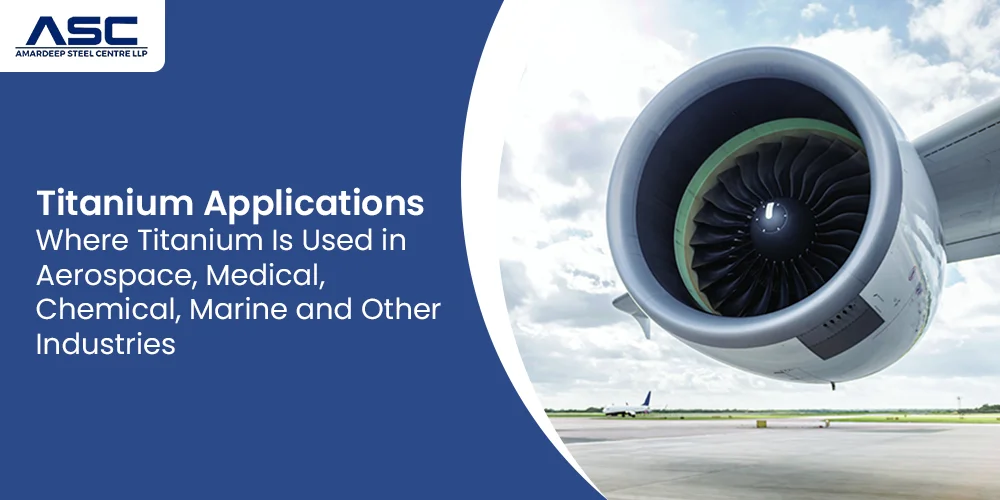
Ask an engineer where titanium ends up and the answer starts with 'aircraft', then branches off in four or five other directions. Titanium applications follow one simple rule. The metal gets chosen when a part must be light, or must survive salt water and acid, or must sit inside a human body, and steel or aluminium cannot do the job. According to the US Geological Survey, most titanium metal still goes into aerospace, and the rest is spread across hospitals, chemical plants, ships, power stations and even bicycle frames. This guide goes through the main uses of titanium in industry one by one, names the grade that usually gets picked for each, and is honest about when titanium is the wrong call. If you are choosing a material for a real project, the product links along the way will take you to the matching range.
KEY TAKEAWAYS
- Most titanium metal goes into aerospace. The rest goes into medical implants, chemical plants, ships, power stations and consumer goods.
- Titanium is chosen for three reasons: high strength for its weight, resistance to corrosion, and compatibility with the human body.
- Grade 2 is the usual pick for chemical, marine and heat exchanger work. Grade 5, which is Ti 6Al 4V, is the usual pick for aerospace and other high-strength parts.
- Grade 7 adds a little palladium for reducing acids, and Grade 9 is the common alloy for thin-walled tubes.
- Titanium costs more and is harder to weld and machine, so it is used only where its properties pay for themselves.
Why Titanium Is Used: The Properties Behind Its Applications
Three properties drive most titanium uses and titanium applications: high strength to weight ratio, corrosion resistance and biocompatibility.
Titanium is about 55 per cent as dense as steel, while Grade 5 offers high tensile strength. This makes aerospace titanium useful where low weight and strength are critical.
Its protective oxide film provides excellent resistance to seawater, chlorides and many corrosive environments, supporting titanium industry applications. Its biocompatibility and bone-compatible stiffness also make it valuable for medical titanium metal applications.
|
Property |
Titanium Grade 2 |
Titanium Grade 5 |
316 stainless steel |
Aluminium 6061 T6 |
|
Density, grams per cubic cm |
4.51 |
4.43 |
about 8.0 |
2.70 |
|
Minimum tensile strength, MPa |
345 |
895 |
515 |
290 |
|
Tensile strength divided by density |
about 76 |
about 202 |
about 64 |
about 107 |
|
Modulus of elasticity, GPa |
about 105 |
about 114 |
about 193 |
about 69 |
|
Behaviour in seawater |
Excellent |
Excellent |
Pitting and crevice attack possible |
Poor without protection |
Titanium values are minimums from ASTM B338 and ASTM B861 for Grade 2 and Grade 5. Stainless steel is ASTM A312 TP316, and aluminium is 6061 T6 sheet to ASTM B209. Strength divided by density is calculated from the rows above it.
A Short History of Titanium
William Gregor found titanium in Cornwall in 1791, and Martin Klaproth named it four years later after the Titans of Greek myth. For more than a century it stayed a laboratory curiosity because it is so hard to extract. That changed in the 1940s, when William Kroll developed a magnesium reduction process that could make metal in useful quantities. Military aircraft designers took it up in the 1950s, and the SR 71 Blackbird of the 1960s was built largely from titanium.
Aerospace Titanium: Aircraft, Engines and Spacecraft
Aerospace titanium is one of the largest titanium applications. The US Geological Survey reports that most titanium metal is used in aerospace, while other titanium uses include chemical processing, marine equipment, medical implants and power generation.
Airframe and Landing Gear
Titanium in aerospace is used for wing structures, engine mounts, pylons and landing gear because it combines low weight, high strength and fatigue resistance. It also works well alongside carbon fibre composites without the galvanic corrosion associated with aluminium.
Jet Engines
Fan blades, compressor discs and casings live in the cooler front end of the engine, where titanium alloys keep their strength at temperatures up to roughly 550 degrees Celsius. Further back, where gases are hotter, nickel alloys take over. Most of this work is done in Ti 6Al 4V, sold as Titanium Grade 5.
Fasteners and Hydraulic Tubing
An aircraft holds together with many thousands of fasteners, so even a small weight saving per bolt adds up. See our range of Titanium Fasteners for the fastener side. Hydraulic and fuel lines are commonly made from Grade 9, which is Ti 3Al 2.5V, because it can be cold-worked into a thin-wall tube at good strength. Grade 5 is also available in pipe and tube; see Titanium Grade 5 Pipe and Tube.
Spacecraft and Rockets
Pressure vessels for propellant and gas, engine parts and structural fittings use titanium because every kilogram lifted into orbit is expensive. Machined parts usually start life as a bar, and Titanium Grade 5 Round Bar and Hex Bar is the typical starting stock.
Titanium in Medical and Dental Applications
Medical and dental uses are among the major titanium applications and uses. The body generally tolerates titanium well, body fluids do not easily corrode it, and implants can remain functional for decades.
Orthopaedic Implants
Hip stems, bone plates, screws and spinal cages use titanium because its stiffness is closer to bone than steel, helping reduce stress shielding. Commercially pure grades suit formable components, while Grade 5 and Grade 23 ELI provide higher strength.
Dental Implants
Dental implants depend on osseointegration, where bone bonds directly to the titanium surface. This makes titanium suitable for posts that provide long term support for replacement teeth.
Surgical Instruments and Devices
Titanium is used for pacemaker cases and surgical instruments because it is lightweight, durable and sterilisation resistant. It is not ferromagnetic, so titanium implants can generally be compatible with MRI, subject to the specific device's MR conditions.
For titanium metal applications in medical devices, ASTM F67 covers unalloyed titanium and ASTM F136 covers Ti 6Al 4V ELI. Industrial titanium products are not implant materials unless specifically certified for medical use.
Titanium in Chemical Processing
Chemical plants use titanium for heat exchangers, reactors, tanks, piping and coated electrodes. It resists chlorides, wet chlorine and oxidising acids such as nitric acid, which destroy many stainless steels. Grade 2 is the everyday choice. Our Heat Exchanger Tubes page lists the wider tube range used in this work, and titanium tube itself is covered on the Titanium Pipes and Tubes page.
|
Grade |
UNS |
Nitrogen, max. % |
Carbon, max. % |
Hydrogen, max. % |
Iron, max. % |
Oxygen, max. % |
Aluminium, % |
Vanadium, % |
Palladium, % |
Molybdenum, % |
Nickel, % |
Titanium |
|
Grade 1 |
R50250 |
0.03 |
0.08 |
0.015 |
0.20 |
0.18 |
Balance |
|||||
|
Grade 2 |
R50400 |
0.03 |
0.08 |
0.015 |
0.30 |
0.25 |
Balance |
|||||
|
Grade 5 |
R56400 |
0.05 |
0.08 |
0.015 |
0.40 |
0.20 |
5.5–6.75 |
3.5–4.5 |
Balance |
|||
|
Grade 7 |
R52400 |
0.03 |
0.08 |
0.015 |
0.30 |
0.25 |
0.12–0.25 |
Balance |
||||
|
Grade 9 |
R56320 |
0.02 |
0.05 |
0.013 |
0.25 |
0.12 |
2.5–3.5 |
2.0–3.0 |
Balance |
|||
|
Grade 12 |
R53400 |
0.03 |
0.08 |
0.015 |
0.30 |
0.25 |
0.2–0.4 |
0.6–0.9 |
Balance |
Grade 7 contains palladium, improving resistance to reducing acids such as hot dilute hydrochloric and sulphuric acid. Grade 12 provides better crevice corrosion resistance in hot brine. Grades 2, 7 and 12 are also used in high pressure acid leach plants for nickel ore processing.
Titanium is not suitable for hydrofluoric acid or dry chlorine gas. Material selection should consider the specific medium, temperature and concentration.
Titanium Mechanical Properties by Grade
|
Grade |
Minimum Tensile Strength, MPa |
Minimum Yield Strength, MPa |
Elongation, min. %* |
Typical Modulus of Elasticity, GPa |
Density, g/cm³ |
|
Grade 1 |
240 |
138 |
24 |
105 |
4.51 |
|
Grade 2 |
345 |
275 |
20 |
105 |
4.51 |
|
Grade 5 |
895 |
828 |
10 |
114 |
4.43 |
|
Grade 7 |
345 |
275 |
20 |
105 |
4.51 |
|
Grade 9 |
620 |
483 |
15 |
109 |
4.48 |
|
Grade 12 |
483 |
345 |
18 |
110 |
4.51 |
Minimum elongation can vary with product form, thickness and applicable ASTM specification. Confirm the required values against the material standard and mill test certificate for the purchased product.
Titanium Grade Selection by Corrosive Service
|
Service condition |
Grade commonly considered |
Main reason for selection |
Important limitation |
|
Seawater and marine cooling |
Grade 2 |
Excellent resistance to pitting and crevice corrosion |
Galvanic coupling with less noble metals must be controlled |
|
General chemical processing |
Grade 2 |
Good corrosion resistance with good formability |
Exact chemical concentration and temperature must be checked |
|
Reducing acids |
Grade 7 |
Palladium improves resistance in reducing acid environments |
Service chemistry must be verified before selection |
|
Hot brine and crevice corrosion service |
Grade 12 |
Mo and Ni additions improve corrosion resistance |
Temperature, chloride concentration and crevice conditions must be assessed |
|
Aircraft hydraulic and fuel tubing |
Grade 9 |
Higher strength than commercially pure titanium with good tube formability |
Selection depends on pressure, temperature and design requirements |
|
Oxidising acids |
Grade 2 / Grade 7 |
Titanium offers strong resistance in suitable oxidising environments |
Hydrofluoric acid is not suitable |
|
Hydrofluoric acid service |
Not generally suitable |
Titanium is attacked by hydrofluoric acid |
Consider an alternative alloy system |
|
Dry chlorine gas |
Not generally suitable |
Titanium requires moisture to maintain its protective oxide behaviour |
Check process conditions before material selection |
Titanium in Marine and Offshore Applications
Seawater is where titanium shows its value most clearly. Condensers and cooling systems on ships, offshore platforms and coastal plants use titanium tube because it does not pit or suffer crevice attack in seawater, and it resists the erosion that wears away copper alloys at high flow speed. See our Condenser Tubes page for condenser tube options.
Copper nickel is the older choice and usually costs less, so compare the two using our Copper Nickel Products range before deciding. One design point must not be missed. Titanium is cathodic to steel and aluminium, so coupling them in seawater can speed corrosion of the other metal. Use isolation or pick compatible metals.
Titanium in Power Generation, Desalination and Oil and Gas
Power stations that use seawater or polluted river water for cooling fit titanium condenser tubes to avoid leaks that contaminate boiler water. Last stage steam turbine blades are another titanium job, where low weight cuts the load on the rotor. Geothermal plants use it to survive hot, salty and acidic fluids.
Desalination plants use titanium tube in brine heaters and heat exchangers, where hot chloride rich water would wear through most other metals. Oil and gas operators use it for subsea risers, seawater systems and heat exchangers. For process heat transfer equipment, see our Shell and Tube Heat Exchangers page.
Other Uses of Titanium: Automotive, Sports, Architecture and Consumer Products
Beyond heavy industry, the uses of titanium turn up in more everyday places than most people expect.
Performance cars and motorcycles use welded Grade 1 or Grade 2 tube in exhaust systems, plus valves, springs and connecting rods where low weight helps engine response. Golf clubs, bicycle frames and tennis rackets use titanium for stiffness without weight. Eyewear frames and watches use it because it is light and does not irritate skin. Titanium plate is also used in some armour.
In architecture, the Guggenheim Museum in Bilbao is clad in thin titanium sheet that has weathered for decades without corroding. Flat products for these jobs is covered on our Titanium Plates, Sheets and Coils page.
|
For the full specification range, see our titanium products overview |
Which Titanium Grade Is Used for Which Application
Grades are not a ladder from weak to strong. Each one is a different trade off between strength, formability and corrosion resistance. The table shows the grades we list for pipe and tube, with the ASTM minimum strength and where each is usually used.
|
Grade |
UNS |
Type |
Min tensile MPa |
Min yield MPa |
Typical applications |
Tube and pipe standards |
|
1 |
R50250 |
Commercially pure |
240 |
138 |
Heavily formed parts, chemical plant, desalination, architecture |
ASTM B338, B861, B862 |
|
2 |
R50400 |
Commercially pure |
345 |
275 |
Heat exchangers, condensers, chemical processing, marine, HPAL plants |
ASTM B338, B861, B862 |
|
5 |
R56400 |
Alpha-beta alloy, Ti 6Al 4V |
895 |
828 |
Aerospace structure and engines, fasteners, high strength parts |
ASTM B861, B862 |
|
7 |
R52400 |
Commercially pure with palladium |
345 |
275 |
Reducing acids in chemical processing, power, desalination |
ASTM B338, B861, B862 |
|
9 |
R56320 |
Alpha beta alloy, Ti 3Al 2.5V |
620 |
483 |
Aircraft hydraulic and fuel tubing, sports equipment |
ASTM B338, B861, B862 |
|
12 |
R53400 |
Alloy, Ti 0.3Mo 0.8Ni |
483 |
345 |
Hot brine and crevice corrosion service, HPAL plants |
ASTM B338, B861, B862 |
Minimum values follow ASTM B338 for tube and ASTM B861 for Grade 5. Elongation and exact limits depend on product form and wall thickness, and the mill test certificate states the actual values for your order.
Full specifications are on our Titanium Grade 2 Pipes and Tubes, Titanium Grade 7 Pipes and Tubes and Titanium Grade 5 Pipe and Tube pages. Grades 1, 9 and 12 are available on enquiry.
Frequently Asked Questions
What is titanium used for?
Titanium is used in aerospace, medical and dental implants, chemical processing equipment, seawater condensers, offshore systems, power plants and sports equipment. Its high strength-to-weight ratio and corrosion resistance make it suitable for these applications.
What are the main titanium applications by industry?
Aerospace uses titanium for airframes, engines, fasteners and tubing. Medical applications include joint and dental implants. Chemical, marine and power industries use it for heat exchangers, condensers, piping and condenser tubes.
Why is titanium used in aircraft?
Titanium alloys offer high strength at about 55 percent of steel's density, along with corrosion resistance and compatibility with carbon fibre composites. These properties make titanium useful for demanding aircraft components.
Why is titanium used in medical implants?
Titanium is well tolerated by the body, resists corrosion from body fluids and supports bone growth through osseointegration. ASTM F67 covers unalloyed titanium, while ASTM F136 covers Ti 6Al 4V ELI.
Which titanium grade is used in aerospace?
Grade 5, or Ti 6Al 4V, is the most common aerospace titanium alloy. Grade 9, or Ti 3Al 2.5V, is widely used for hydraulic and fuel tubing.
Which grade is best for chemical processing and seawater?
Grade 2 is commonly used for its balance of corrosion resistance, strength and formability. Grade 7 suits reducing acids, while Grade 12 is used where improved crevice corrosion resistance is required in hot brine.
Is titanium stronger than steel?
Weight for weight, titanium can provide higher strength because of its lower density. Grade 5 has a minimum tensile strength of 895 MPa at about 4.43 g/cm³, compared with 515 MPa at about 8.0 g/cm³ for 316 stainless steel.
Why is titanium not used everywhere?
Titanium costs more than steel or aluminium and is more demanding to weld and machine. It is mainly selected when its low weight, corrosion resistance or biocompatibility justifies the additional cost.
Is titanium dioxide the same as titanium metal?
No. Titanium dioxide is a white pigment used in paint, plastics, paper and sunscreen. Titanium metal is a separate material used for structural, medical and corrosion resistant components.
Can titanium be used in seawater?
Yes. Titanium resists pitting and crevice corrosion in seawater and is used in condensers, cooling systems and offshore equipment. Galvanic isolation may be required when it contacts steel or aluminium.
Titanium Products from Amardeep Steel Centre
Amardeep Steel Centre LLP supplies titanium in the forms these industries buy. Start with the titanium products overview or go straight to the item you need.
- Titanium Pipes and Tubes in seamless and welded forms
- Titanium Plates, Sheets and Coils
- Titanium Bars, Rods and Wires
- Titanium Flanges, Titanium Buttweld Fittings and Titanium Forged Fittings
- Titanium Fasteners
- Titanium Tapered Plugs for plugging leaking heat exchanger tubes
Every order ships with a mill test certificate, typically to EN 10204 3.1. For projects that need third party inspection, we coordinate SGS, Bureau Veritas, TUV or a client nominated agency. See our Testing and Certificates pages for how material is checked and documented.
|
Send the grade, size and quantity, or ask us which grade suits your service. We reply within one business day. |
Stainless Steel Metal Fabrication — Processes, Grades, Welding & Surface Finishing Guide
Stainless Steel Metal Fabrication is a very specialised process and is very different from carbon steel, as it has a very different metallurgical behaviour.