High Pressure Forged Fittings — Applications, Types, Pressure Classes & Grades
What are High-Pressure Forged Fittings?
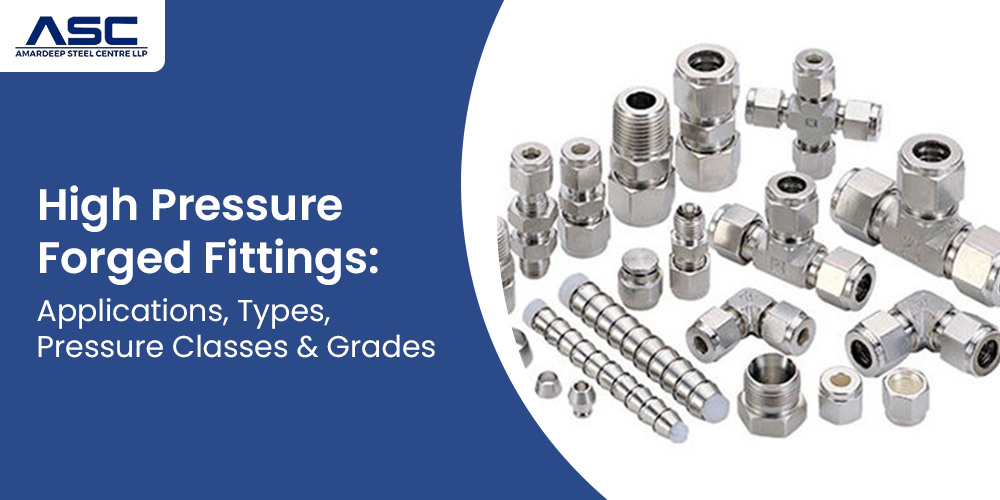
High-pressure forged fittings are used to connect pipes, connecting valves, pipes, pumps, & other equipment to create piping systems. This Forged Socket Weld Pipe Fittings come in different forms and sizes and this type of pipe fitting is typically used in oil and gas pipelines. The high-pressure forged fittings have a greater resistance to corrosion and abrasion than other types of fittings. High-pressure forged fittings are a strong, durable kind of fitting with a lower installation cost than others. High-pressure forged fittings (HPF) are a type of pressure-tempered fitting that can be used for different applications. HPF fittings use high pressure and heat to create a carcass with better structural properties and minimal distortion or deformation during installation.
Types of High Pressure Forged Fittings
- Forged Socket Weld Pipe Fittings
- Forged Threaded Pipe Fittings
- Forged Elbows
- Forged Tees
- Forged Crosses
- Forged Couplings
- Forged Half Couplings
- Forged Unions
- Forged Caps
- Forged Bushings
- Forged Plugs
- Swage Nipples
Applications of High Pressure Forged Fittings
Oil & Gas
In oil and gas operations, forged fittings are relied on in areas where failure is not an option. They are usually applied in wellhead control lines, high pressure manifolds and natural gas pipelines where they are subjected to constant pressure variations, corrosive media and rigorous field environments.
Aerospace
These fittings are selected in aerospace systems because they provide strength without the needless extra weight. They can be found in hydraulic circuits, fuel delivery systems and other high-pressure areas where the performance and safety margins are required to be the same even under extreme operating conditions.
Power Generation
Forged fittings are used in steam lines and boiler systems of power plants, particularly thermal and nuclear plants, where the temperature and pressure are extremely high. They are stable in their structure to ensure that the system has stability in its operations over a cycle.
Automotive
In the automotive industry, forged fittings are employed in high-performance systems like fuel injection pipes and high-pressure fluid lines. They are resistant to vibration and durable enough to endure vibrations, which is critical in engines that are used under dynamic loads.
Marine
Components undergo exposure to saltwater, pressure, and constant motion in marine environments. Ship piping and offshore installations employ forged fittings since they can withstand corrosion and mechanical stress throughout the service life.
Chemical Processing
Forged fittings are the ideal choice of pipelines and instrumentation connections in chemical plants, where fluids can be extremely aggressive. They can perform their duties in such controlled environments due to their capability of remaining leak tight even when they are subjected to chemical exposure and under pressure.
Water Infrastructure
In water supply and treatment systems, high pressure distribution lines and storage connections frequently use forged fittings. They are reliable, which guarantees consistent flow management in particular in large-scale infrastructure projects where access during maintenance may be restricted.
Benefits of High Pressure Forged Fittings
High Strength
The fittings are forged hence they are very strong since the forging process enhances the metal structure and hence it can be used in high pressure and high temperature conditions.
Corrosion Resistance
They also work in corrosive conditions, which protects against spillage and destruction of materials when using chemicals or fluids.
Handles High Pressure
These fittings are engineered to be used in very high pressure, and therefore can be used in very stressful industrial applications.
Long-Lasting
Forged fittings are also strong and can withstand wear and fatigue hence they have a long service life.
Accurate & Reliable
They are produced with accuracy, giving adequate fitting and performance stability in the piping systems.
Wide Applications
They are strong and reliable and are employed in various industries such as oil and gas, chemical and power plant industries.
Tips for Working With High Pressure Forged Fittings
Working with high pressure forged fittings requires proper handling and installation to ensure long-term performance and safety. Here are some practical tips to follow:
Choose the Right Material
Always select fittings based on your application. Materials like carbon steel, stainless steel, and alloy steel are commonly used, but make sure they match the pressure, temperature, and fluid requirements of your system.
Use Proper Lubrication
Apply suitable lubricants, especially for threaded fittings, to prevent galling, seizure, or corrosion during installation and operation.
Ensure Correct Installation
For socket weld fittings, maintain proper alignment and welding procedures. For threaded fittings, avoid over-tightening as it can damage threads and cause leakage.
Check Pressure Ratings
Always verify that the fitting class (2000#, 3000#, 6000#, etc.) matches the system pressure to avoid failure under load.
Avoid Contamination
Keep fittings clean and free from dust, oil, or metal particles before installation, especially in stainless steel systems where contamination can lead to corrosion.
Inspect Before Use
Check for any visible defects, cracks, or damage before installation to ensure reliability in high-pressure conditions.
Conclusion
We've seen that there are numerous benefits to using high-pressure forged fittings. These are the reduced price, shorter lead-time, and possibility of customization of the design to your needs. High-pressure forged fittings have increasingly been in demand due to their easy installation and capability to withstand the presence of highly corrosive environments. Amardeep Steel is proud of providing the finest quality of High-Pressure Forged fittings to its clients. A newer generation of HPDs is more resistant to corrosion, has a longer life, is more efficient when shut off at low temperature and is more flexible in its design.
Stainless Steel Metal Fabrication — Processes, Grades, Welding & Surface Finishing Guide
Stainless Steel Metal Fabrication is a very specialised process and is very different from carbon steel, as it has a very different metallurgical behaviour.