If you have ever pulled a block of air preheater tubes out of a boiler, you already know where the trouble is. The hot end usually looks fine. The cold end, where the flue gas leaves and fresh air comes in, is thin, pitted and full of holes. Most of those tubes are plain carbon steel ERW tubes made to BS 3059, and they fail there for one reason: sulphuric acid condenses on them and eats the steel.
Corten steel pipes, which contain small quantities of copper, chromium, and nickel, resist acid damage and increase the longevity of the cooler end. While a transition to Corten steel pipes may be beneficial in some cases, it is not in all boilers. Below we explain why APH tubes fail, what Corten changes, what the test data says, where Corten will not help, and how to plan the change. Amardeep Steel supplies both BS 3059 and Corten APH tubes, so this is the conversation we have with plant engineers every week.
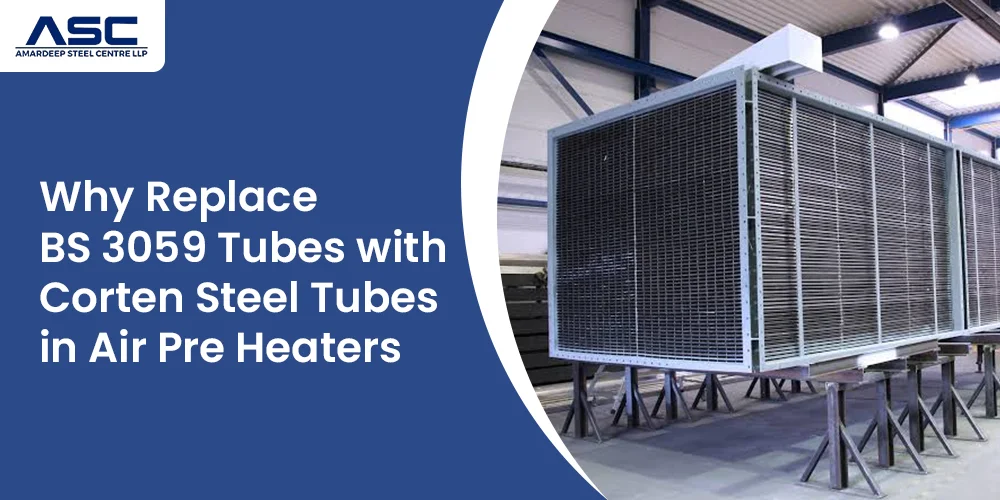
In a tubular air pre heater, hot flue gas leaving the boiler flows through a bank of thin wall steel tubes while cold combustion air flows across the outside. Heat passes through the tube wall, so the air reaches the furnace warmer and the boiler burns less fuel for the same steam. The tubes are expanded or welded into tube sheets and grouped in blocks. Every APH tube does the same job, but they do not all live the same life: the cold end block, where gas is coolest and the incoming air is coldest, decides how often the unit needs retubing. Sizes and specifications are on our air pre heater tubes page.
Sulphur in coal, oil or bagasse burns to sulphur dioxide, and a small part of it turns into sulphur trioxide. That combines with water vapour in the flue gas to form sulphuric acid vapour. As long as the gas stays hot, the acid stays a vapour. The moment it touches a surface colder than its acid dew point, it condenses into a liquid film on the metal.
In an air pre-heater, the coldest metal is at the cold end, because the incoming air cools the tubes well below the gas temperature. The acid film corrodes the tube wall, wet deposits trap ash and block the tubes, and once a tube is holed, air leaks straight into the gas side. The fan works harder, the APH loses efficiency, and the boiler loses output. This is APH tube corrosion in almost every plant we see.
Acid dew point corrosion is the attack that happens when sulphuric acid condenses out of flue gas onto a surface below the acid dew point. The important word is surface. In one published field test on an oil-fired boiler, the flue gas was 124 to 130°C and the acid dew point was 130°C, yet the tube metal at the cold end was only 70 to 80°C. The gas temperature looked safe. The metal temperature was not. The acid dew point itself changes with the sulphur and moisture in the fuel, so it is different from boiler to boiler.
Corten is a weathering steel: a low carbon steel with small, deliberate additions of copper, chromium, nickel and phosphorus. Outdoors, those elements build a tight, adherent rust layer that slows further corrosion, which is why weathering steel tubes and plates are used unpainted on bridges and structures.
Inside an air pre-heater, the benefit comes from the same chemistry. Copper in particular slows attack in dilute sulphuric acid condensate, which is why the special acid dew point steels used in boilers are also built on copper-bearing chemistry. Corten APH tubes are usually ERW tubes made from Corten A strip, or tubes supplied to ASTM A423 Grade 1, a copper-bearing low-alloy tube specification with a similar chemistry. For European projects, the nearest equivalent is S355J2WP Corten tubes. Available sizes are listed on our Corten steel APH tubes page.
The quickest way to see the difference is the chemistry. A BS 3059 tube has no corrosion resisting elements at all; a Corten A tube or an ASTM A423 Grade 1 tube carries copper, chromium and nickel.
|
Element |
BS 3059 Part 1 ERW 320 |
Corten A |
ASTM A423 Grade 1 |
|
Carbon |
0.16 max |
0.12 max |
0.15 max |
|
Manganese |
0.30 to 0.70 |
0.20 to 0.50 |
0.55 max |
|
Phosphorus |
0.040 max |
0.07 to 0.15 |
0.06 to 0.16 |
|
Sulphur |
0.040 max |
0.030 max |
0.060 max |
|
Silicon |
As per standard |
0.25 to 0.75 |
0.10 min |
|
Copper |
Not specified |
0.25 to 0.55 |
0.20 to 0.60 |
|
Chromium |
Not specified |
0.50 to 1.25 |
0.24 to 1.31 |
|
Nickel |
Not specified |
0.65 max |
0.20 to 0.70 |
|
Property |
BS 3059 Part 1 ERW 320 |
Corten A |
ASTM A423 Grade 1 |
|
Tensile strength (MPa) |
320 to 480 |
485 min |
415 min |
|
Yield strength, min (MPa) |
195 |
345 |
255 |
|
Elongation, min (%) |
25 |
20 |
25 |
|
Corrosion resisting elements |
None |
Copper, chromium, nickel, phosphorus |
Copper, chromium, nickel, phosphorus |
Corten A values are for hot rolled strip and plate (SSAB COR TEN A data). BS 3059 values from BS 3059 Part 1:1987. Always check the mill test certificate on the tubes you receive.
A fair note on that test figure: the steel in the Nippon Steel trial was S TEN 1, a purpose made acid dew point steel, not Corten. It shows how much copper bearing chemistry can help. How much Corten helps in your boiler depends on your fuel, ash and metal temperature, which is why the next section matters.
Tube material is one tool. These work alongside it:
For a wider look at how material choice affects corrosion, read our guide on the difference between stainless steel and carbon steel.
At the cold end the tube metal falls below the acid dew point, so sulphuric acid condenses on it. BS 3059 carbon steel has no alloying to resist that attack.
Acid dew point corrosion occurs when sulfur trioxide reacts with moisture, forming sulfuric acid that condenses on cold APH tube surfaces, accelerating corrosion in air pre heater tubes.
Copper, chromium and nickel in Corten slow sulphuric acid attack at the cold end, so tubes thin more slowly and need replacing less often.
It depends on fuel sulphur, ash and metal temperature. Measure wall thickness at each shutdown and compare it with your old BS 3059 tubes for a real figure.
Yes, if ordered in the same outside diameter and wall thickness. They fit the same tube sheet holes and are expanded the same way.
|
Planning an APH retubing? Send us the tube size, quantity and your current material, and we will quote BS 3059 and Corten options side by side. Browse our APH tube range, Corten steel pipes and tubes, boiler tubes and ERW welded pipes, or contact Amardeep Steel. |
Stainless Steel Metal Fabrication is a very specialised process and is very different from carbon steel, as it has a very different metallurgical behaviour.