Written by the Amardeep Steel Centre Technical Team. Published 22 October 2026.
Ask anyone who has opened up a seawater condenser after a few seasons and they will tell you the same thing. The tubes rarely fail where you expect. They fail where the water moves fastest and where the metal has the most surface to give away, and on a finned tube that is nearly everywhere. Chlorides pit the wall, marine growth settles in and starts its own quiet damage, and fast flowing water strips off whatever protective film the metal tries to build.
A fin exposes far more metal to the flow per metre than a plain tube does, so a poor choice of material costs you more and costs you sooner. For most engineers we speak to, copper nickel finned tubes in CuNi 70 30 are where the search ends, and the rest of this guide explains why.
Amardeep Steel Centre has manufactured and exported copper nickel tubes and fin tubes, including CuNi 70 30 to ASTM B111, since 1982, with mill test certification to EN 10204 3.1 on every shipment. Everything below comes from how we specify and build these tubes every day, so you can judge the right seawater heat exchanger tubes for your own duty.
Copper nickel 70 30, UNS C71500, is a wrought copper alloy with 29 to 33 percent nickel and iron additions of 0.4 to 1.0 percent, the balance copper. It is produced to ASTM B111 for seamless tube and ASTM B543 for welded tube. The equivalent European designation is CuNi30Mn1Fe.
For ASTM B111 CuNi tubes, the proof that the material matches the drawing is the mill test certificate. Ask for an EN 10204 3.1 certificate that shows the UNS number, chemistry and tube
90 10 copper nickel, UNS C70600, is the lower cost and higher conductivity grade. It performs well in clean freshwater and in moderate seawater duty, and it is the more common specification for that reason.
CuNi 70 30 carries roughly three times the nickel. That gives it a thicker and more stable protective oxide film and materially better resistance to higher velocity seawater, to polluted or brackish water, and to sulfide bearing conditions. These are the situations where 90 10 is more prone to impingement attack and sulfide induced corrosion.
For seawater intakes, coastal power plants and marine condensers where water quality or velocity cannot be tightly controlled, 70 30 is the safer specification, even though its thermal conductivity is lower than 90 10. If your water is cleaner and the flow is gentle, our copper nickel 90 10 fin tubes may be the more economical route. The point is to choose against the worst day of the water, not the average one.
Need CuNi 70 30 finned tubes to ASTM B111 for a seawater application? Amardeep Steel Centre has manufactured copper nickel fin tubes since 1982. Request a quote with your fin geometry and duty conditions.
Admiralty brass, C44300, has higher thermal conductivity than either copper nickel grade and it costs less. On paper it looks attractive. The trouble is zinc. Admiralty brass carries a small arsenic addition to inhibit dezincification, but in seawater and polluted water it is still more prone to dezincification and impingement attack than copper nickel. Admiralty brass also has much lower resistance to erosion corrosion at the velocities common in seawater intake systems.
It remains a sound choice for freshwater and lightly brackish service where velocity is well controlled. For continuous seawater duty, especially where flow or water quality varies, CuNi 70 30 gives up some thermal conductivity in return for a corrosion allowance that keeps the tube in service for decades rather than years. When people compare admiralty brass vs copper nickel finned tubes for seawater, this is the whole argument in one line.
CuNi 70 30 thermal conductivity is roughly 29 W per metre kelvin. CuNi 90 10 sits at roughly 50 and admiralty brass at roughly 110, so 70 30 is well under half of the brass figure. Nobody should pretend that gap does not exist.
In practice it is handled at the design stage with slightly more heat transfer area or a marginally thinner wall gauge, an adjustment heat exchanger designers make routinely. The conductivity gap is a fixed, one time design input. Corrosion failure is a recurring, unplanned cost. Over a 15 to 20 year service life in seawater, the lower maintenance and replacement burden of 70 30 outweighs its conductivity disadvantage in almost every real application of a copper nickel heat exchanger.
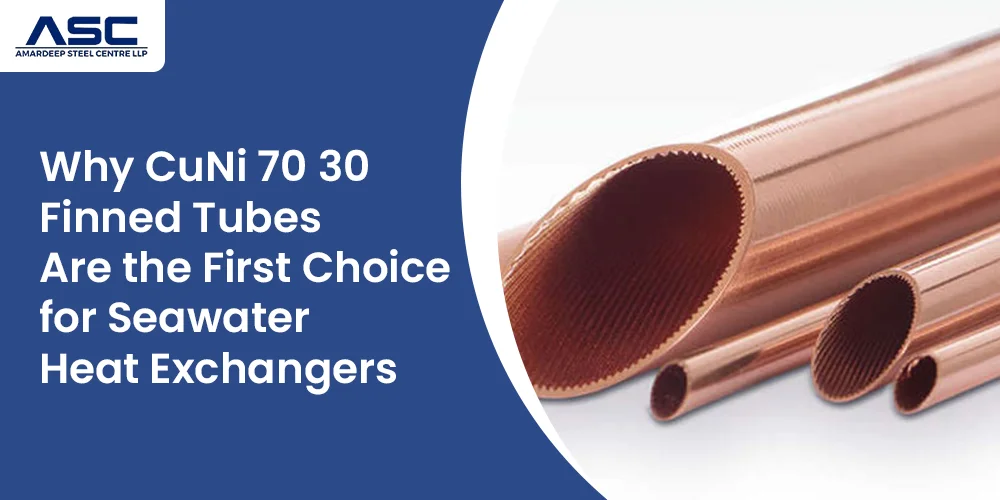
Most guides stop at plain tube. Finned tube behaves differently, and this is where the alloy and the fin have to be thought about together.
Because CuNi 70 30 has lower thermal conductivity than copper or 90 10, fin height and fin density are usually increased slightly to recover the surface area a given duty needs. The alloy has moderate hardness, around 80 HRB, so it rolls cleanly into integral low fin profiles without cracking at the fin root. That is not always true of harder alloy or stainless base tubes at the same fin height.
Amardeep Steel Centre manufactures CuNi 70 30 integral low fin tubes and copper fin tubes to an ASTM B111 base tube, with fin geometry matched to the surface area the designer requires. Every order is supplied with full dimensional and MTC documentation.
|
Property |
CuNi 70 30, C71500 |
CuNi 90 10, C70600 |
Admiralty Brass, C44300 |
|
Nominal composition |
29 to 33 percent nickel, balance copper |
9 to 11 percent nickel, balance copper |
70 to 73 percent copper, balance zinc |
|
Thermal conductivity |
About 29 W per metre kelvin |
About 50 W per metre kelvin |
About 110 W per metre kelvin |
|
Seawater corrosion resistance |
Highest of the three |
Good, best in cleaner water |
Lower, dezincification risk |
|
Typical service |
Aggressive or high velocity seawater |
Freshwater, moderate seawater |
Freshwater, controlled velocity |
|
Governing standard |
ASTM B111 and B543 |
ASTM B111 and B543 |
ASTM B111 |
Figures are representative handbook values. Final design values should be confirmed against the mill data supplied with your order.
These tubes are not a general purpose option. They go into specific equipment where seawater is the cooling medium.
If your equipment is on this list, our range of copper fin tubes is a good place to begin.
Copper nickel finned tubes are used in seawater heat exchangers, marine cooling systems, condensers, and industrial applications requiring corrosion resistance and efficient heat transfer.
CuNi 70-30 tubes contain 30% nickel, offering greater corrosion resistance and strength than 90-10 tubes, especially in demanding seawater environments.
Copper nickel heat exchanger tubes resist seawater corrosion, biofouling, and erosion, making them reliable for marine cooling and desalination applications.
CuNi 70-30 finned tubes feature integral, low-fin, and extruded fins, improving heat transfer efficiency for marine and industrial heat exchanger applications.
CuNi 70-30 thermal conductivity is approximately 29–45 W/m·K, depending on temperature and composition. ASTM B111 CuNi tubes are widely used in heat exchangers.
Talk to our technical team about CuNi 70 30 finned tube sizing for your seawater heat exchanger. Get a quote with full ASTM B111 mill certification.
Choosing tube material for seawater is a decision you live with for fifteen or twenty years. CuNi 70 30 asks for a little more surface area at the design stage and pays that back every year the exchanger stays in service. Amardeep Steel Centre has manufactured and exported copper nickel tubes and fin tubes, including CuNi 70 30 to ASTM B111, since 1982, with mill test certification to EN 10204 3.1 on every shipment. Send us your duty conditions and we will help you size the fin and the tube.
Stainless Steel Metal Fabrication is a very specialised process and is very different from carbon steel, as it has a very different metallurgical behaviour.