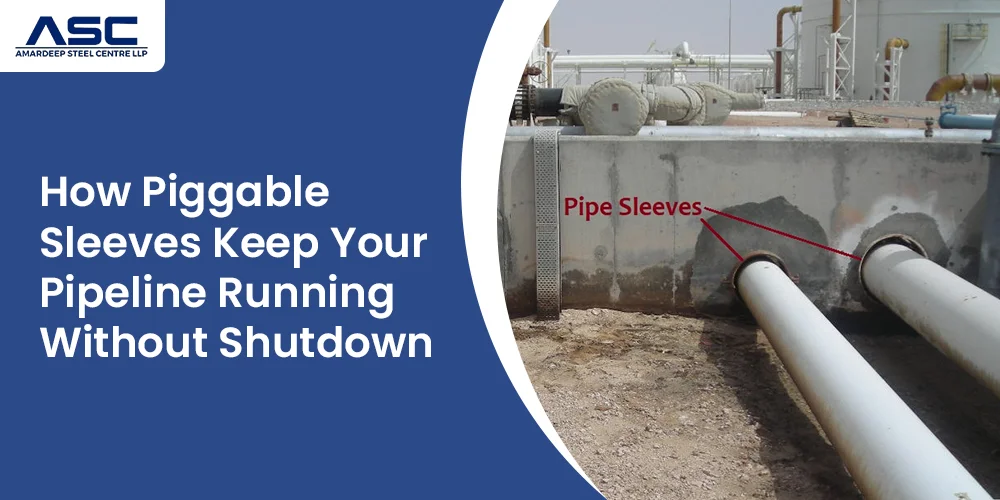
Piggable pipe repair sleeves are used to strengthen damaged areas of pipeline that have been damaged by corrosion, dents, or leaks and to provide continuity of product flow. These sleeves are installed externally around the pipe and restore the structural integrity without adding restriction to the pipe's interior. This makes them suitable for pipelines that need to be cleaned, maintained or inspected in-line (using pipeline pigs) regularly. Type A sleeves are typically applicable to non-leaking defects, whereas Type B sleeves are usually applicable to pressure containment applications, provided they are engineered and installed in the right way. If the defect is not too large or the operating conditions are not too severe, a composite sleeve can be used. Amardeep Steel Centre provides pipeline products, fittings and pipeline repair components for various industrial applications with material test certification and supporting documentation.
What Is a Piggable Repair Sleeve?
A piggable repair sleeve is an external reinforcement to be installed around a damaged pipeline section maintaining its internal bore while structurally refurbished. A full encirclement sleeve keeps the pig's pathway intact as long as it is installed properly, unlike internal liners. But the ability of the pipe to be piggable is still dependent on the remaining internal condition of the pipe, such as dents, ovality, and bore restrictions. The piggability rating is not given for the sleeve itself. Confirm the repaired area with the pig manufacturer and notify the inspection company of the sleeve location prior to making cleaning and/or inspection trips.Our guides to piggable pipes and piggable pipe fittings cover this in detail.
Repair sleeves may help pipelines stay operational while undergoing repairs by eliminating downtime if the site conditions and engineering evaluations deem such repairs possible. B type welded repair sleeves may be used on existing pipelines using appropriate welding techniques, but composite wraps may be used to repair pipelines without any welding at all. However, live repairs will need to carefully evaluate the remaining wall thickness, operating pressure, properties of the products and severity of the defects.
A type A repair sleeve is made of two steel half-shells that are welded together along the length of the pipe, and placed around the damaged section of pipe. The sleeve ends will not be welded to pipe, therefore it provides reinforcement of areas where external corrosion, localized metal loss, or mechanical damage has occurred, but it does NOT prevent the pressure from flowing through the pipe. Type A sleeves can only be used for non-leaking defects and should not be used for active leaks, cracks or through-wall damage. They can be temporary or permanent reinforcement depending on the engineering assessment and the condition of pipe.
A Type B repair sleeve consists of two half-shells of steel that are welded together longitudinally and at either end of the sleeve to the pipe circumference. As long as it is engineered properly for the pipeline operating conditions, this configuration allows pressure containment. Can be used for some leaks (after engineering assessment and approved procedures for installation). Thicknesses, material compatibility, operating pressure, and external loads should be taken into account when designing a sleeve. Appropriate inspection in compliance with applicable requirements (ASME PCC-2) helps to determine repair suitability and long-term performance. Because the sleeve is made to suit the pipe, it is specified by pipe diameter, wall thickness, material grade and design pressure. If you need help with the pipe side of that, see our range of carbon steel pipes and API 5L line pipe.
|
Property |
Type A Sleeve |
Type B Sleeve |
Composite Sleeve |
|
Welded to pipe wall |
No (longitudinal seams only) |
Yes (full encirclement) |
No, resin wrap with no hot work |
|
Contains pressure |
No |
Yes |
Yes, within design life |
|
Repairs active leaks |
No |
Yes |
No, non-leaking defects only |
|
Governing standard |
ASME PCC-2 |
ASME PCC-2 (welded sleeve article) |
ASME PCC-2 (composite article) |
|
Typical status |
Temporary or permanent (engineered) |
Permanent (engineered, inspected) |
Temporary in hazardous service; permanent in utility service with approval |
|
Installed live (no shutdown) |
Yes |
Yes |
Yes |
In every case, a qualified piping engineer must confirm the final selection against the specific damage assessment. This guide is not a substitute for that assessment. The table is consolidated from public ASME PCC-2 and API 570 reference material, so check the current editions for exact requirements.
This outline helps a buyer scope a repair. The details belong in a certified welding procedure and the operator's own repair procedures, which must always be followed.
Type B welded sleeve
Composite sleeve
Plan the repair with your inspection team too. After the repair, a pig run is a good way to confirm the bore is unchanged, and the sleeve location should be recorded for future inspection runs.
A Type A sleeve reinforces the pipe but cannot contain pressure. A Type B sleeve is welded to the pipe at both ends and can contain pressure when properly engineered.
Yes. Type B sleeves and composite wraps may be installed on operating pipelines when engineering assessments and approved procedures permit.
No, an external sleeve does not obstruct the internal bore when correctly installed. However, check the remaining bore and ovality before pigging.
Composite repairs are used for suitable corrosion, wall-thinning, and other defects when the repair system is approved for the service conditions.
ASME PCC-2 provides requirements for repairing pressure equipment and piping, including welded sleeves and composite repairs.
No. A Type A sleeve cannot contain pressure. A properly engineered Type B sleeve may be used to repair a leak.
Stainless Steel Metal Fabrication is a very specialised process and is very different from carbon steel, as it has a very different metallurgical behaviour.