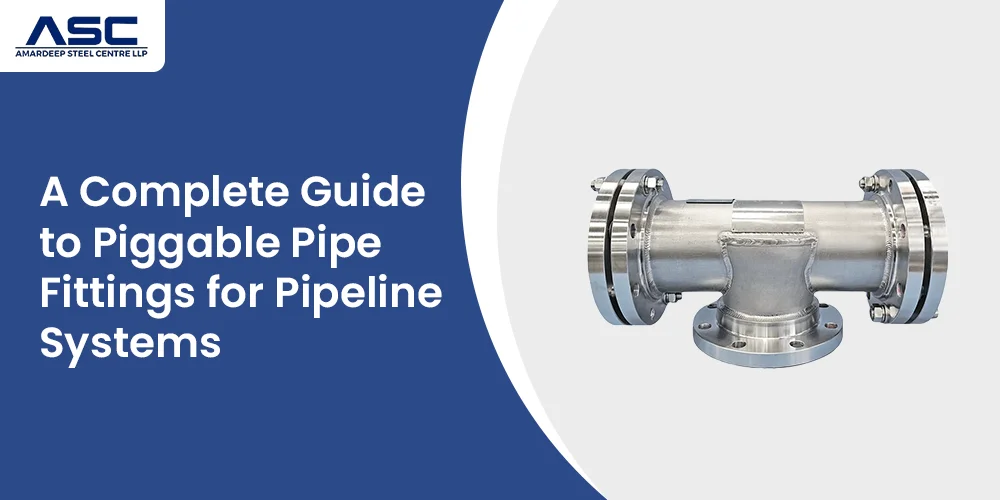
Piggable pipe fittings are specially selected pipeline components designed to permit passage of cleaning, inspection and product-separation pigs through a pipeline without obstruction. These are long radius elbows, tees, reducers and full bore valves, all of which ensure smooth internal passage. The successful travel of the pig all the way through the system hinges on geometry and proper alignment. The selection of the proper fittings is important for reducing downtime of the pipeline, avoiding any problems of pigging and facilitating good maintenance work. Standard, dimensional requirements and material grade should also correspond to the working conditions of the pipeline. Amardeep Steel Centre stocks buttweld elbows, tees and reducers that meet ASME B16.9 specifications, for dependable pipeline fabrication with material test certification.
A pipeline is piggable if a pig can travel its entire length from a pig launcher to a pig receiver without any problems. There is one rule that applies to each selection on one of these lines, and that is that there is no part of the line within the bore which the pig cannot pass through, step or otherwise. This is the reason why it is vital to have the right fitting. Pigs are fitted into the inside of the pipe, so if it is narrower, there is a side passage, or a sharp bend, it's risky. These five types of fittings determine the piggability: bends, tees, elbows, reducers and valves; in turn, the sections below discuss each of these. See our piggable pipes guide and a pipeline pigging guide for more information on the general workings of pigs and what makes a pipe piggable.
ASME B16.9 provides dimensions and tolerances for factory-made wrought buttweld fittings such as elbows and tees, reducers, and caps for pipeline systems. The most common elbow designs are long radius elbows having a center line radius of 1.5 times the nominal pipe size (1.5D) and short radius elbows of 1D. But, compliance to ASME B16.9 does not mean pigging compatibility, especially with intelligent inspection tools, which demand greater turning radius and uninterrupted bore transitions. Determine the fitting size and radius as per pig design and pipeline needs. ASME B16.49 applies to pipe sections bent for use that are induced bends. Amardeep Steel Centre offers piggable bends that are used in challenging pipeline applications.
A standard equal tee has an open branch connection. When a pig reaches it, the pig can catch on the edge of the opening, turn into the branch, or lodge completely, which stops the run. This is the clearest example of a fitting that looks harmless on the drawing and fails in service.
A piggable tee, usually called a barred tee, solves this. Internal bars or deflector plates sit across the branch opening, and they guide the pig straight through the main run while still letting process flow pass into and out of the branch. The bars have to match the pipe diameter and the pig type.
Barred tees are normally made to order, so they need to be specified at the design stage. A standard tee cannot simply be fitted with bars after installation, and replacing a tee in a live line is a major job. On very small branches, bars may not be needed, but that should be confirmed for each case with the pig vendor. Our butt weld tees can be supplied as barred tees to order.
Engineers use the words elbow and bend in slightly different ways, and the difference matters when you write a specification.
With that clear, the radius comparison is simple.
If ILI inspection is planned now or might be needed later, specify 3D from the start. It costs far less to choose a generous radius at design than to replace fittings after a tool has stuck.
Reducers. A reducer narrows the bore. If its small end is smaller than the pig, the pig cannot pass. Where a size change cannot be avoided, long taper reducers are preferred over short taper or abrupt transitions, because they change the bore gradually. Any pig run through a reducer must be sized with that smaller bore in mind.
Valves. Isolation valves on a piggable line must be full bore. A standard reduced bore ball valve narrows the passage enough to trap a correctly sized pig. This is one of the most common and most preventable causes of a stuck pig in an otherwise well designed line. Pipeline valves are normally specified to API 6D, and a valve must also be fully open before any pig is launched.
A pig launcher is the station where a pig is loaded into the line, and a receiver is where it is taken out at the far end. They allow routine pigging while the main line stays in service. Each is connected to the pipeline through flanged connections and valves, and each is operated under a written procedure with the barrel isolated, vented and drained before it is opened.
The barrel is usually sized one nominal pipe size, sometimes two, larger than the pipeline. This gives the pig room to be inserted and removed without damaging its seals or cups. Handling a launcher or receiver involves pressure and, in some services, hazardous product, so this guide is for awareness only. Operators must follow their own procedures and permit rules.
|
Fitting Type |
Standard Radius or Type |
Piggable? |
Recommended Piggable Spec |
|
Elbow |
1D short radius |
No |
Avoid in piggable lines |
|
Elbow |
1.5D long radius |
Marginal (foam and disc pigs only) |
3D for intelligent pigging |
|
Elbow or bend |
3D |
Yes |
Specify for ILI tool compatibility |
|
Tee |
Standard equal tee |
No |
Barred tee with internal deflector |
|
Reducer |
Short taper or concentric |
Conditional |
Long taper reducer preferred |
|
Valve |
Reduced bore ball valve |
No |
Full bore valve required |
Radius multipliers and pig requirements are typical industry values consolidated from ASME B16.9 reference data and general pigging practice. Confirm the exact minimum radius against the tool vendor's datasheet and your project piping class.
A piggable fitting keeps a consistent internal bore, with no obstruction, sharp bore reduction or trap point that would stop a pig. That includes the correct bend radius, barred tees and full bore valves.
Foam and disc pigs typically pass bends of about 1.5D. Intelligent inspection pigs typically need 3D at minimum, and some rigid tools need 5D or more. Always confirm the exact minimum with the pig tool vendor.
A standard equal tee has an open branch opening where a pig can catch or lodge. A piggable tee uses internal bars or deflectors to guide the pig straight through the main run.
It is marginal. Foam and disc pigs usually pass a 1.5D elbow, but intelligent pig tools often cannot. A 3D elbow is the safer specification for ILI pigging.
ASME B16.9 governs the dimensions of factory-made buttweld elbows and tees. Induction bends for pipelines are covered by ASME B16.49. Always call out the pigging radius as well, because the standard does not set pigging suitability.
No. Isolation valves on a piggable line must be full bore. A reduced bore valve can trap a correctly sized pig.
Stainless Steel Metal Fabrication is a very specialised process and is very different from carbon steel, as it has a very different metallurgical behaviour.