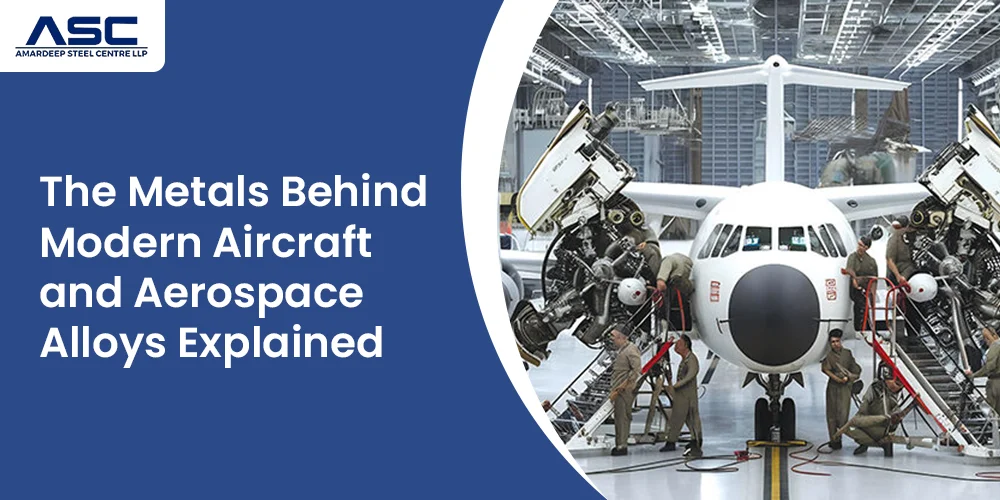
Aerospace alloys must carry large loads, survive millions of stress cycles and resist heat and corrosion, all at the lowest possible weight. Aluminium suits most of the airframe, titanium 6Al-4V gives strength at low density, steels such as 15-5PH serve landing gear and fittings, and nickel alloys such as Inconel 718, Waspaloy and A286 handle engine heat.Titanium alloys can provide a high strength-to-weight ratio for structural components. 15-5PH is an example of a high-strength stainless steel which is utilized for structural parts that require strength and fatigue resistance, while nickel-based superalloys, such as Inconel 718 and Waspaloy, ensure good mechanical properties under elevated temperatures. A286 is a material for parts that need to have heat resistance and strength.
Why Aircraft Need Special Alloys
A metal that is fine for a bridge or a pressure vessel can fail in an aircraft, because aircraft ask for several hard things at once:
The table below shows which alloys usually appear in each part of an aircraft, and why. Individual aircraft differ, but the pattern holds: the hotter and more heavily loaded the zone, the further the choice moves from aluminium toward titanium, steel and nickel.
|
Zone |
Typical Alloys |
Why |
|
Fuselage and wing skins |
Aluminium 2024, 7075 |
Light, easy to form, good fatigue life |
|
Wing box, frames, engine pylons |
Titanium 6Al-4V; aluminium 7xxx |
High strength-to-weight, corrosion resistant, compatible with composites |
|
Landing gear, actuators, shafts |
AISI 4340, 300M, 15-5PH, 17-4PH |
Very high strength and toughness |
|
Engine cold section (fan, compressor) |
Titanium 6Al-4V; 15-5PH; A286 |
Strength and low density at moderate temperature |
|
Engine hot section (discs, turbine cases) |
Inconel 718, Waspaloy |
Strength and creep resistance at high temperature |
|
Fasteners and fittings |
A286, Inconel 718, Ti-6Al-4V, Waspaloy |
Strength, corrosion and temperature resistance |
The Four Families of Aerospace Alloys
|
Family |
Example Grades |
Strength / Limit |
Main Use |
|
Aluminium alloys |
2024, 7075, 6061 |
Lightest; lower temperature limit |
Airframe skin and structure |
|
Titanium alloys |
Ti-6Al-4V (Grade 5) |
High strength at low density; about 315–400 °C |
Airframe, engine cold section, fasteners |
|
Alloy and PH stainless steels |
4340, 300M, 15-5PH, 17-4PH, A286 |
Highest room-temperature strength |
Landing gear, shafts, fittings, fasteners |
|
Nickel and iron-nickel superalloys |
Inconel 718, Waspaloy, A286 |
Strength to 650 °C and above |
Engine hot section, exhaust, fasteners |
Aluminium deserves its own guide, because it makes up a large share of airframe structure on many aircraft. We cover it separately, and you can browse our aluminium bars, rods and wires and aluminium plates, sheets and coils. The rest of this guide focuses on titanium, steel and nickel alloys.
Inconel 718 is a nickel-based superalloy used in aircraft engines and other high-temperature aerospace equipment. It offers high strength, excellent corrosion resistance and good weldability. Typical applications include engine discs, casings, shafts and high-strength fasteners. It contains about 5% niobium, which combines with other alloying elements to form strengthening precipitates during ageing heat treatment. AMS 5662 generally covers solution-treated material, while AMS 5663 covers material supplied in a precipitation-hardened condition. Mechanical properties should always be evaluated against the applicable specification and heat-treatment condition.
Grade 5 titanium (Ti-6Al-4V) is the most widely used aerospace titanium alloy because of its excellent strength-to-weight ratio, corrosion resistance and suitability for demanding structural applications. It is also compatible with carbon-fibre structures when appropriate design measures address galvanic corrosion. Typical applications include aircraft frames, wing structures, engine pylons and other structural components. The alloy is supplied to specifications such as AMS 4928 for bar and ASTM B348 Grade 5 for bars and billets. Although titanium offers substantial weight savings, its machining costs are relatively high, and its use in engine components depends on local temperature and operating conditions.
A286 is an iron-nickel-chromium precipitation-hardening alloy that provides high strength, good oxidation resistance and useful mechanical properties at elevated temperatures. It also maintains toughness at lower temperatures. Aerospace applications include fasteners, bolts, fittings, engine casings and exhaust-system components. Where the temperature and strength requirements are less demanding than those typically addressed by Inconel 718, A286 can be a more economical choice. It retains useful strength at temperatures approaching 700°C, although its suitability depends on the applied stress, exposure duration and operating environment.
15-5PH is a precipitation-hardening stainless steel that offers high strength, corrosion resistance and good toughness. Its mechanical properties can be adjusted through heat treatment to meet specific component requirements. Aerospace applications include landing gear components, structural fittings, actuators and precision-engineered parts. AMS 5659 is a commonly specified material standard for aerospace applications. The required heat-treatment condition should be selected according to the component's strength, toughness and other applicable design requirements.
|
Alloy |
UNS |
Common AMS Specification |
Product Forms |
|
Inconel (Alloy) 718 |
N07718 |
AMS 5662 (solution treated), AMS 5663 (aged) |
Bar, forgings |
|
Waspaloy |
N07001 |
AMS 5706 |
Bar, forgings |
|
A286 |
S66286 |
AMS 5731 / 5732 |
Bar, forgings |
|
15-5PH |
S15500 |
AMS 5659 |
Bar, forgings |
|
Titanium 6Al-4V |
R56400 |
AMS 4928 (bar), AMS 4911 (sheet) |
Bar, sheet, forgings |
|
4340 |
G43400 |
AMS 6414 / 6415 |
Bar, forgings |
Composition and Strength Compared
|
Alloy |
Base |
Main Alloying Elements (% by mass) |
|
Inconel 718 |
Nickel (50–55) |
Cr 17–21; Fe balance; Nb + Ta 4.75–5.50; Mo 2.80–3.30; Ti 0.65–1.15; Al 0.20–0.80; Co 1.0 max |
|
Waspaloy |
Nickel (balance) |
Cr 18–21; Co 12–15; Mo 3.5–5.0; Ti 2.75–3.25; Al 1.2–1.6; C 0.02–0.10; Zr 0.02–0.12; B 0.003–0.010 |
|
A286 |
Iron (balance, ~55) |
Ni 24–27; Cr 13.5–16; Mo 1.0–1.5; Ti 1.9–2.35; V 0.10–0.50; B 0.001–0.010; Al 0.35 max |
|
15-5PH |
Iron (balance) |
Cr 14.0–15.5; Ni 3.5–5.5; Cu 2.5–4.5; Nb + Ta 0.15–0.45; C 0.07 max; Mn 1.0 max; Si 1.0 max |
|
Titanium 6Al-4V (Grade 5) |
Titanium (balance) |
Al 5.50–6.75; V 3.50–4.50; Fe 0.40 max; O 0.20 max; C 0.08 max |
|
Alloy and Condition |
Tensile Strength |
Yield Strength |
Elongation |
Practical Temperature Limit |
|
Inconel 718, aged bar (AMS 5663) |
185 ksi (1275 MPa) min |
150 ksi (1035 MPa) min |
12% min |
~650–700 °C for strength |
|
Waspaloy, aged (AMS 5706) |
185 ksi (1275 MPa) min |
130 ksi (895 MPa) min |
15% min |
650 °C critical rotating; 760–870 °C non-rotating |
|
A286, aged (AMS 5731) |
140 ksi (965 MPa) min |
95 ksi (655 MPa) min |
12% min |
~700 °C |
|
15-5PH H900 |
190 ksi (1310 MPa) min |
170 ksi (1170 MPa) min |
10% min |
~300 °C |
|
15-5PH H1025 |
155 ksi (1070 MPa) min |
145 ksi (1000 MPa) min |
12% min |
~300 °C |
|
Titanium 6Al-4V, annealed |
130 ksi (895 MPa) min |
120 ksi (828 MPa) min |
10% min |
~315–400 °C |
How to Choose an Aerospace Alloy
|
Need |
Choose |
Check First |
|
Lightest airframe structure |
Aluminium 7075 / 2024 |
Corrosion protection, fatigue |
|
High strength, low weight, corrosion resistant |
Titanium 6Al-4V |
Cost, machinability, galling |
|
Highest strength landing gear part |
4340 / 300M, or 15-5PH where corrosion matters |
Toughness, coating, hydrogen embrittlement |
|
Corrosion resistant, high-strength fitting |
15-5PH (H1025 or H1150 for toughness) |
Condition and transverse properties |
|
Fastener to about 700 °C |
A286 or Inconel 718 |
AMS spec, non-magnetic need |
|
Hot-section disc or shaft |
Waspaloy or Inconel 718 |
Temperature, creep, forging source |
Have a part in mind but unsure which grade, form or condition to specify? Request a quote with your drawing or specification, and we will help you match the alloy to the requirement.
Aerospace alloys are metals designed for aircraft and engines that combine high strength, low weight, and resistance to fatigue, heat and corrosion. Major families include aluminium alloys, titanium alloys, alloy steels, precipitation-hardening stainless steels and nickel-based superalloys.
Common aerospace grades include aluminium 2024 and 7075, titanium Ti-6Al-4V, steels such as 4340, 15-5PH and 17-4PH, the iron-nickel alloy A286, and nickel-based superalloys such as Inconel 718 and Waspaloy. Each grade is typically procured to a specific AMS or ASTM specification.
Inconel 718 stays strong at temperatures of about 650–700 °C, resists creep and fatigue, and can be welded in its solution-treated condition before ageing. Niobium contributes to the strengthening precipitates that develop during ageing heat treatment.
Titanium 6Al-4V is used for aircraft frames, engine pylons, compressor components and fasteners, where high strength and low density are important and operating temperatures are within the alloy's service limits.
A286 is an iron-nickel-chromium austenitic alloy that is strengthened by ageing. It is used for aerospace fasteners, engine components and exhaust-system parts at elevated temperatures, with useful strength up to about 700 °C depending on service conditions. It is generally non-magnetic in its solution-treated condition.
Yes. 15-5PH is a precipitation-hardening martensitic stainless steel used for landing gear components, structural fittings and actuators. It is commonly supplied to AMS 5659 in specified heat-treatment conditions, including H900 through H1150.
Waspaloy maintains its strength and resists oxidation at the high temperatures found in the hot section of jet engines. It is used in components such as turbine discs, shafts and casings where elevated-temperature performance is essential.
AMS stands for Aerospace Material Specification. It is a specification system developed by SAE International that defines requirements for materials and product forms, including chemical composition, mechanical properties, testing and dimensional tolerances, as applicable to each specification.
Stainless Steel Metal Fabrication is a very specialised process and is very different from carbon steel, as it has a very different metallurgical behaviour.