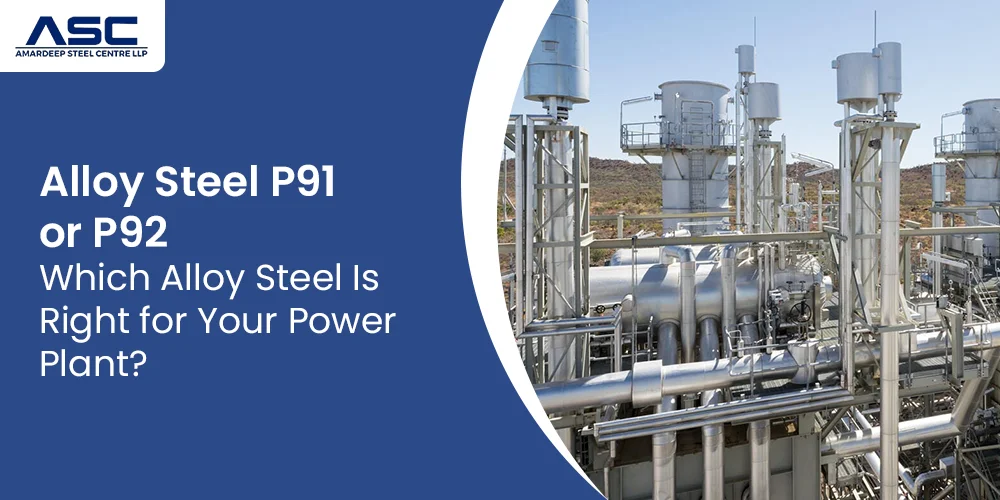
The alloy steels P91 and P92 are chromium-molybdenum creep resistant steels intended for use at high temperature, high pressure in power generation systems. These grades are employed in superheater tubes, steam headers and main steam pipelines where long duration strength and resistance to creep deformation are required properties. But, they have different compositions of alloys, performance at elevated temperatures, production requirements and costs. Depending on the steam application, P91 can be used in many demanding applications, and P92 can provide higher creep strength under certain operating conditions. The selection of the correct grade depends on the design temperature, pressure, service life, welding procedures and post-weld heat treatment requirements. Amardeep Steel Centre is a source of P91 and P92 Mill test certified alloy steel pipes as per ASTM A335 standard that are used for various industrial applications.
P91 alloy steel is a type of creep resistant, Chromium-Molybdenum alloy steel that is specified by ASTM A335 for seamless high temperature piping. It has about 8.0-9.5% chromium, 0.85-1.05% molybdenum with controlled additions of vanadium, niobium and nitrogen. These alloying elements contribute to its long lasting creep resistance at high temperature and pressure and help strengthen its microstructure. Typical steam operating temperatures for P91 in power plant steam piping, boiler headers and superheater systems are in the range of 540-565°C depending on the design conditions. The allowable stress and service life needs to be checked against the relevant design code.
P92 alloy steel is an improved form of 9% chromium creep-resistant steel, which is specified in ASTM A335 for seamless high-temperature piping. It is approximately 8.5-9.5% chromium, 1.5-2.0% tungsten and has controlled additions of vanadium, niobium and boron. P92 is similar to P91, except for the lower molybdenum content, that tungsten and boron levels increase microstructural stability and creep resistance. The combination of these properties makes P92 an ideal material for applications in power plants, such as main steam lines, headers, and high-temperature piping systems. It can withstand service temperature of around 600-620°C for suitable design, as per applicable limitations of code, pressure, fabrication process and post weld heat treatment requirement.
P91 vs P92: Creep Resistant Steel Comparison
The tungsten and boron in P92 give it better creep rupture strength than P91 at high temperature. That is why P92 is specified for supercritical and ultra-supercritical boiler and steam pipe applications, where P91 would be near its practical limit.
|
Property |
P91 (9Cr-1Mo-V) |
P92 (9Cr-0.5Mo-1.8W-VNb-B) |
|
Chromium |
8.0 to 9.5% |
8.5 to 9.5% |
|
Molybdenum |
0.85 to 1.05% |
0.30 to 0.60% |
|
Tungsten |
Not present |
1.5 to 2.0% |
|
Vanadium |
0.18 to 0.25% |
0.15 to 0.25% |
|
Niobium |
0.06 to 0.10% |
0.04 to 0.09% |
|
Boron |
Not present |
0.001 to 0.006% |
|
Tensile strength (min) |
585 MPa |
620 MPa |
|
Yield strength (min) |
415 MPa |
440 MPa |
|
Typical max service temperature |
About 565 degrees C in design practice |
About 600 to 620 degrees C |
|
Governing standard |
ASTM A335 P91 |
ASTM A335 P92 |
In practical terms, P91 suits plants with steam temperatures up to roughly 565 degrees Celsius. P92 extends that to around 600 to 620 degrees Celsius, which is the range of modern supercritical and ultra-supercritical plant design. Figures are consolidated from public ASTM A335 reference data. They can vary by edition and project specification, so confirm them against the current standard and the mill test certificate.
When welding P91 and P92 alloy steel pipes, it is necessary to carry out post-weld heat treatment (PWHT). The two grades require very careful heat treatment to assure adequate weld strength and weld toughness. The temperature range for PWHT for P91 is typically 730-770°C, and for P92, the approved welding procedure specifies the range for PWHT. Too much heat will have an impact on the microstructure and creep characteristics of the steel, and too little heat will result in a weld that is too hard and prone to cracking.
The interpass temperature is also important in welding, and is usually controlled in the range 200-300°C, which is the regime of preheating. Fabricators should be certain to use a qualified welding procedure as per ASME Section IX, project specification, and material. The actual PWHT temperature, holding time and heating and cooling rates should be established by the welding engineer and not from general guidelines.
P91 and P92 alloy steel pipes are used in power plants, where the conditions of high temperature and pressure require reliable operation over a long period of time. In conventional power plants and other process systems with high temperatures, P91 is typically used for superheater and reheater tubes, steam headers, and main steam pipes.
P92 is normally applied in more challenging applications, such as supercritical and ultra-supercritical power plants, where steam temperatures are increased. It is employed in main steam lines, hot reheat piping, and high-pressure headers to provide improved creep strength for extended service life.
In these important applications, material quality, grade verification and traceability are imperative. Visit Amardeep Steel Centre's material of construction selection to discover more of the alloy steel grades available.
Start with the plant's actual design steam temperature and pressure, and treat cost as the second factor.
P92's higher purchase and fabrication cost can be offset over the plant's life. Its strength at temperature supports higher efficiency steam conditions, and it can give a longer predicted component life at those conditions. Weigh these against your own project numbers and your code requirements. The wall thickness the code allows for each grade also changes the weight and cost of a given line, and our steel pipe weight formula guide helps with that estimate.
P92 replaces part of P91's molybdenum with tungsten and adds a small amount of boron. This gives it higher creep strength and a higher usable service temperature than P91.
No. P92 has lower molybdenum, about 0.30 to 0.60 percent, than P91, about 0.85 to 1.05 percent. Tungsten, not molybdenum, is P92's key strengthening addition.
P91 is typically used up to around 565 degrees Celsius in design practice, with a rated ceiling nearer 600 degrees Celsius. P92 extends that to around 600 to 620 degrees Celsius, which suits supercritical and ultra-supercritical plant design. The design code sets the allowable stresses.
Post weld heat treatment outside the specified temperature window can permanently harm the microstructure and the precipitates that give these grades their creep strength. It must follow a qualified procedure within a narrow temperature range.
Not automatically. P92 costs more and needs more demanding welding and PWHT control. It is the right choice only where the plant's actual steam temperature and pressure require its higher creep strength.
Both are covered by ASTM A335. P91 is the 9Cr-1Mo-V grade, and P92 is the modified 9Cr-0.5Mo-1.8W-V-Nb-B grade.
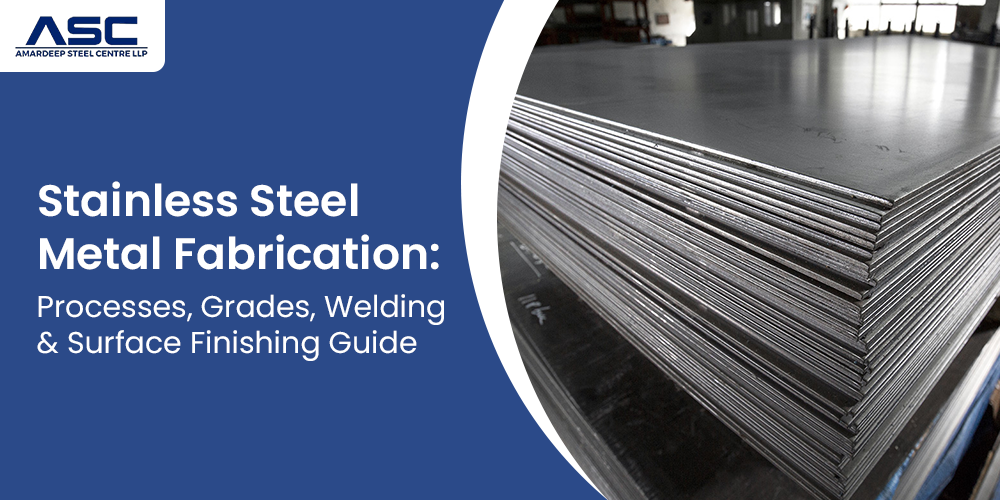
Stainless Steel Metal Fabrication is a very specialised process and is very different from carbon steel, as it has a very different metallurgical behaviour.