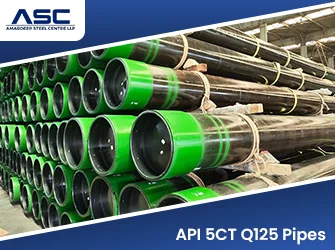
Deep and ultra-deep oil and gas wells can place substantial pressure and collapse loads on casing strings, making high-strength casing essential for demanding well sections. Amardeep Steel supplies API 5CT Q125 casing for applications where its high yield strength is required beyond grades such as API 5CT P110 pipes. For wells requiring sour-service casing, see our API 5CT T95 pipes. We also offer seamless pipes and tubes in various grades and specifications for oilfield and process applications.
Each order is supplied with mill test certificates, Charpy impact test results, and grade colour banding on every length for material identification and traceability.
What Are API 5CT Q125 Pipes?
API 5CT Q125 is the only grade in Group 4 of the specification. It has a yield strength of 862 to 1034 MPa and a minimum tensile strength of 931 MPa. Unlike most API grades, Q125 is made as casing only, not as tubing.
Q125 lets well designers handle the pressure and collapse loads found in very deep wells without moving to extremely heavy walls.
Why Q125 Is Kept for Sweet Wells
At this strength level steel is highly sensitive to sulphide stress cracking, so Q125 is not recommended where hydrogen sulphide is present. Sour deep wells normally use T95 or another restricted yield grade.
API 5CT Q125 Casing Pipe Specifications
Parameter | Details |
|---|---|
Specification | API 5CT / ISO 11960 |
Grade | Q125 Type 1 |
API Group | Group 4 (very high strength) |
Product Form | Casing only (Q125 is not made as tubing) |
Manufacturing Process | Seamless |
Casing Outside Diameter | 4 1/2 inch to 20 inch (114.3 mm to 508 mm) |
Casing Length | Range 1: 4.88 to 7.62 m, Range 2: 7.62 to 10.36 m, Range 3: 10.36 to 14.63 m |
Casing Connections | STC, LTC and BC (buttress) |
Premium Connections | Available on request |
Heat Treatment | Quenched and tempered |
Product Specification Level | PSL 1, PSL 2 and PSL 3 |
Test Certificate | EN 10204 3.1, with 3.2 on request |
API 5CT Q125 Chemical Composition
Element | Content (%) |
|---|---|
Carbon (C) | 0.35 max |
Manganese (Mn) | 1.35 max |
Molybdenum (Mo) | 0.85 max |
Chromium (Cr) | 1.50 max |
Nickel (Ni) | 0.99 max |
Phosphorus (P) | 0.020 max |
Sulphur (S) | 0.010 max |
API 5CT Q125 Mechanical Properties
Property | Requirement |
|---|---|
Yield Strength | 862 to 1034 MPa (125 to 150 ksi) |
Tensile Strength, min | 931 MPa (135 ksi) |
Maximum Hardness | Not specified, hardness variation is controlled |
Total Elongation Under Load | 0.65% |
Impact Testing and Hardness Variation
Charpy V-notch impact tests are mandatory for Q125, with minimum energy values that rise with wall thickness. API 5CT also limits how much hardness may vary through the wall, which keeps the strength even across each length.
API 5CT T95 vs P110 vs Q125
Property | T95 | P110 | Q125 |
|---|---|---|---|
API Group | Group 2 | Group 3 | Group 4 |
Yield Strength | 655 to 758 MPa | 758 to 965 MPa | 862 to 1034 MPa |
Tensile Strength, min | 724 MPa | 862 MPa | 931 MPa |
Maximum Hardness | 25.4 HRC | Not specified | Not specified |
Sour Service (H2S) | Yes, SSC tested | Not recommended | Not recommended |
If the design loads allow it, P110 casing is usually easier to source and more economical. Q125 is the right call when P110 would need a wall that is too heavy for the hole size.
API 5CT Q125 Colour Code
Q125 casing is identified by one orange band, and the grade, size, weight and heat number are stencilled on each length.
Heat Treatment of API 5CT Q125 Pipes
All Q125 casing is quenched and tempered along its full length. The tight yield window of 862 to 1034 MPa means quenching and tempering have to be closely controlled on every heat.
Applications of API 5CT Q125 Casing
- Production and intermediate casing in deep and ultra deep sweet wells
- High pressure, high temperature well designs
- Casing strings that face high collapse loads, such as through salt zones
- Offshore deep water wells
Testing and Documentation
Every order of API 5CT Q125 casing goes through the checks below at our testing facility or approved third party labs.
- Heat and product chemical analysis
- Tensile test for yield, tensile strength and elongation
- Charpy V-notch impact test
- Hardness variation check through the wall
- Hydrostatic test on every length
- Full length drift test
- Ultrasonic or electromagnetic inspection of the pipe body
- Thread gauging, visual and dimensional inspection
- Third party inspection on request
Mill test certificates are issued to EN 10204 3.1, with 3.2 available on request. You can view our approvals on the certificates page.
Packing and Marking
Each length is stencilled with the manufacturer name, API 5CT, size, weight, grade, connection and heat number, and carries the API colour band for its grade. Threads are protected with steel or plastic thread protectors, and pipes are bundled or loaded loose with spacers depending on size. Read more about our packing and despatch process.
Request a Quote for API 5CT Q125 Pipes
Send us the outside diameter, weight, connection, range length and quantity, and our team will reply with price and delivery. Use the enquiry form or reach us through the contact page.
Frequently Asked Questions
What is API 5CT Q125 pipe used for?
API 5CT Q125 pipe is used as casing in deep and ultra deep sweet oil and gas wells where very high pressure and collapse resistance are needed. It is the highest strength grade in the API 5CT specification.
Is API 5CT Q125 available as tubing?
No. API 5CT Q125 is a casing only grade. For high strength tubing, P110 is the usual API choice, and T95 or C90 are used for sour wells.
What is the yield strength of API 5CT Q125?
API 5CT Q125 has a yield strength of 862 to 1034 MPa (125 to 150 ksi) and a minimum tensile strength of 931 MPa (135 ksi).
What is the difference between API 5CT P110 and Q125?
Q125 has a higher yield range of 862 to 1034 MPa against 758 to 965 MPa for P110, tighter chemistry limits and is made as casing only. P110 is available as both casing and tubing.
