
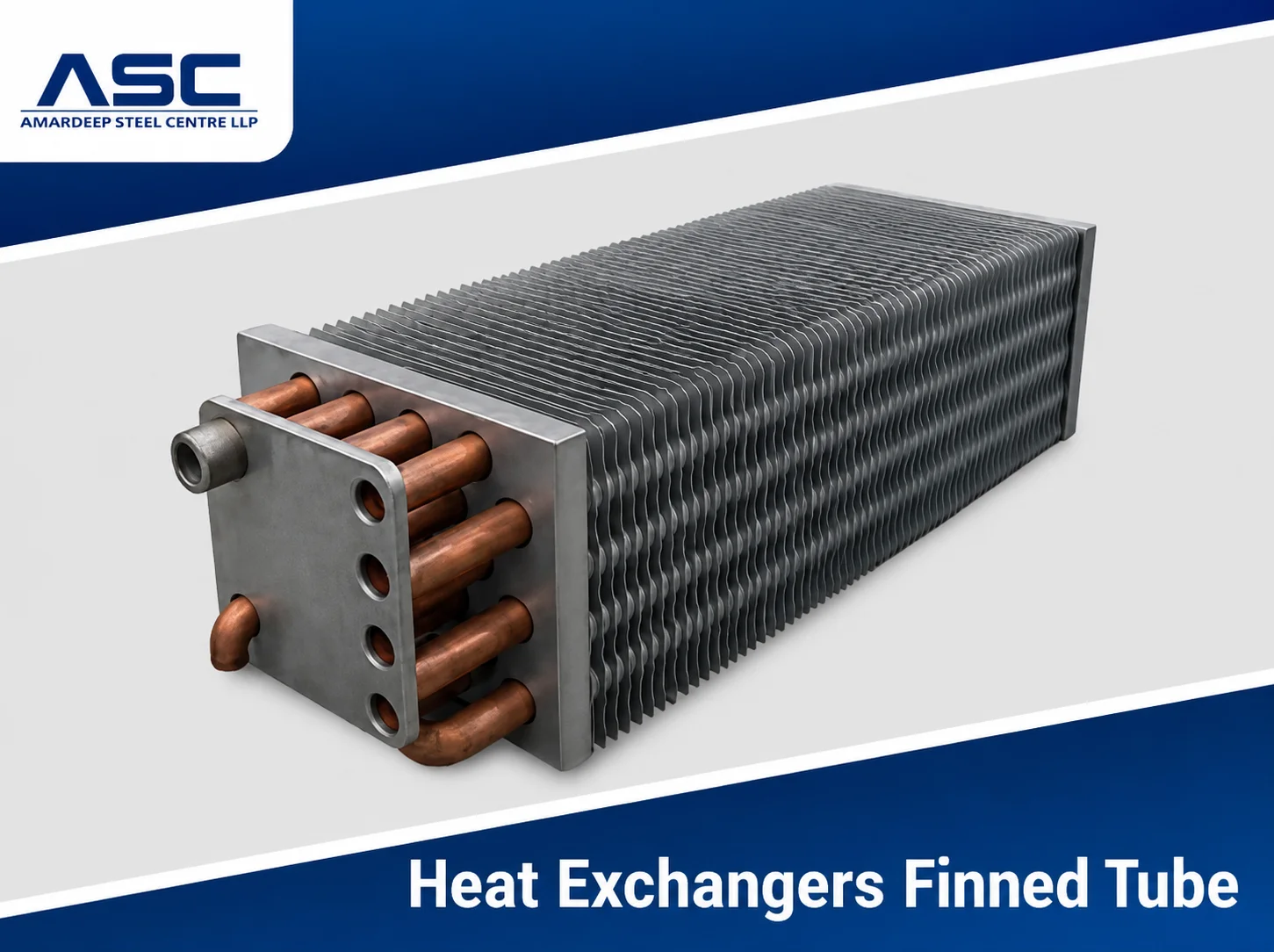
Heat Exchangers Finned Tube Manufacturer & Supplier in India
Finned tube heat exchangers are effective in increasing the outside heat-transfer area of the tubes, particularly where a lower heat-transfer coefficient is required than the air or gas for the heat transfer process. The tube can be either seamless or welded and the fin construction can be L-foot, G-fin, extruded, or welded, depending on the duty. These are used typically in air-cooled heat exchange applications, economiser coils, process coolers, condensers and waste-heat-recovery systems. Amardeep Steel offers carbon steel, stainless steel, construction of alloy, duplex, copper-nickel, titanium and nickel alloy constructions (if available). The tube size, wall thickness, fin height and fin pitch are chosen based on the thermal and mechanical duty.
Technical Data
Specifications of Heat Exchangers Finned Tube
| Attribute | Specification Details |
|---|---|
Applicable Standards |
ASTM A498, ASTM A1012, ASTM B359, ASME SA213, ASME SA249 |
Base Tube Outside Diameter (OD) |
9.52 mm to 203.2 mm (3/8" to 8") |
Base Tube Wall Thickness |
1.24 mm to 12.7 mm (0.049" to 0.500") |
Fin Height |
0.8 mm to 38.0 mm (0.031" to 1.50") |
Fin Thickness |
0.4 mm to 3.2 mm (0.015" to 0.125") |
Fin Density (Pitch) |
60 to 315 fins per meter (1.5 to 8 fins per inch - FPI) |
Maximum Tube Length |
Up to 24 meters (78.7 ft) |
Tube Manufacturing Types |
Seamless, ERW (Electric Resistance Welded), EFW (Electric Fusion Welded) |
Fin Attachment Types |
Extruded, Embedded (G-Fin), L-Foot, KL-Fin, High Frequency Welded (HFW) |
Chemical Compositions of Heat Exchangers Finned Tube
| Material Standard & Grade | UNS Designation | Carbon (C) | Manganese (Mn) | Silicon (Si) | Chromium (Cr) | Nickel (Ni) | Molybdenum (Mo) | Other Elements |
|---|---|---|---|---|---|---|---|---|
Carbon Steel |
— |
0.06 – 0.18% |
0.27 – 0.63% |
0.25% max |
— |
— |
— |
P ≤ 0.035% |
Austenitic Stainless Steel |
UNS S30403 |
0.030% max |
2.00% max |
0.75% max |
18.0 – 20.0% |
8.0 – 12.0% |
— |
N ≤ 0.10% |
Austenitic Stainless Steel |
UNS S31603 |
0.030% max |
2.00% max |
0.75% max |
16.0 – 18.0% |
10.0 – 14.0% |
2.00 – 3.00% |
N ≤ 0.10% |
Duplex Stainless Steel |
UNS S31803 |
0.030% max |
2.00% max |
1.00% max |
21.0 – 23.0% |
4.5 – 6.5% |
2.50 – 3.50% |
N: 0.08 – 0.20% |
Copper-Nickel Alloy |
UNS C70600 |
— |
1.00% max |
— |
— |
9.0 – 11.0% |
— |
Cu: Remainder |
Commercially Pure Titanium |
UNS R50400 |
0.08% max |
— |
— |
— |
— |
— |
Fe ≤ 0.30% |
Mechanical Properties of Heat Exchangers Finned Tube
| Material Grade | Tensile Strength (Min) | Yield Strength 0.2% Proof (Min) | Elongation in 2" / 50mm (Min) | Hardness (Max) |
|---|---|---|---|---|
Carbon Steel A179 |
325 MPa (47 ksi) |
180 MPa (26 ksi) |
35% |
72 HRB |
Carbon Steel A214 |
310 MPa (45 ksi) |
175 MPa (25 ksi) |
30% |
72 HRB |
Stainless Steel 304 / 304L |
485 MPa (70 ksi) |
170 MPa (25 ksi) |
35% |
90 HRB |
Stainless Steel 316 / 316L |
485 MPa (70 ksi) |
170 MPa (25 ksi) |
35% |
90 HRB |
Duplex 2205 (UNS S31803) |
620 MPa (90 ksi) |
450 MPa (65 ksi) |
25% |
31 HRC |
Cu-Ni 90/10 (UNS C70600) |
275 MPa (40 ksi) |
105 MPa (15 ksi) |
30% |
75 HRB |
Equivalent Grades of Heat Exchangers Finned Tube
| Material Category | ASTM / ASME Standard | EN / DIN Equivalent | BS Standard | JIS Standard | AFNOR Standard |
|---|---|---|---|---|---|
Carbon Steel (Finned) |
ASTM A498 / SA498 |
EN 10216-2 (1.0305 / St35.8) |
BS 3602 Pt 1 |
JIS G3461 (STB340) |
NF A49-215 |
Stainless Steel (Finned) |
ASTM A1012 / SA1012 |
EN 10216-5 (1.4307 / 1.4404) |
BS 3605 Pt 1 |
JIS G3463 (SUS304L/316L) |
NF A49-117 |
Copper Alloy (Finned) |
ASTM B359 / SB359 |
EN 12451 (CuNi10Fe1Mn) |
BS 2871 Pt 3 |
JIS H3300 (C7060) |
NF A51-102 |
Base Tube: Boiler / Exchanger |
ASTM A179 / SA179 |
EN 10216-2 (P235GH) |
BS 3602 Gr 360 |
JIS G3461 (STB380) |
NF A49-211 |
Base Tube: Stainless Seamless |
ASTM A213 / SA213 |
EN 10216-5 (X2CrNi19-11) |
BS 3605 Gr 304S11 |
JIS G3463 (SUS304TB) |
NF A49-117 |
Different Types of Heat Exchangers Finned Tube
- Extruded Aluminum Finned Tubes
- High-Frequency Welded Finned Tubes
- Embedded Finned Tubes
- L-Foot Finned Tubes
- LL-Foot Finned Tubes
- KL-Foot Finned Tubes
- G-Fin / Embedded Finned Tubes
- Serrated Finned Tubes
Applications and Industrial Uses of Heat Exchangers Finned Tube
- Air-Cooled Heat Exchangers
- Power Generation Plants
- Oil Refineries
- Petrochemical Plants
- Chemical Processing Plants
- Waste Heat Recovery Systems
- Industrial Refrigeration Systems
- HVAC and Air Conditioning Systems
Frequently Asked Questions
What are Heat Exchanger Finned Tubes?
Heat Exchanger Finned Tubes are tubes with extended fins on their outer surface that increase the heat-transfer area and improve thermal performance.
How do Finned Tube Heat Exchangers work?
They transfer heat between fluids as one fluid flows inside the tube while the other flows over the finned outer surface.
Why are fins used in heat exchangers?
Fins increase the external surface area, improving heat transfer where the surrounding fluid, especially air or gas, has a relatively low heat-transfer coefficient.
Are Finned Tube Heat Exchangers suitable for high-temperature applications?
Yes, they are suitable for high-temperature applications when the tube and fin materials are selected according to the operating temperature and service conditions.
What is the difference between finned tubes and bare tubes?
Finned tubes have extended surfaces that provide greater heat-transfer area, while bare tubes have a smooth surface and generally offer lower external heat-transfer capacity.
Are Finned Tube Heat Exchangers suitable for air-cooled applications?
Yes, they are widely used in air-cooled heat exchangers, fin-fan coolers, radiators, and other air-side heat-transfer systems.
