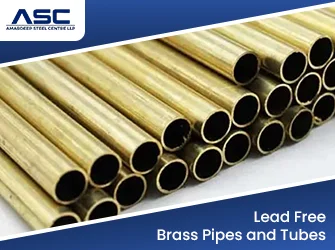
Lead free brass pipes and tubes are yellow brass with no lead added, which is why plumbing, sanitary and appliance makers reach for 63/37 and 65/35 when a drawing says lead restricted. At Amardeep Steel Centre in Mumbai we supply and export lead free brass tube in C27000, C27200 and C27400, cut to your length, with a mill test certificate that shows the lead figure for your lot.
Pick the grade first and the size second. Amardeep Steel Centre supplies lead free brass pipe and lead free brass tube from Mumbai, as a lead free brass tube supplier in India and for export buyers. Lead free here means no lead is added and the limit is 0.07 to 0.10 per cent maximum, which is not zero, so the lead figure on the mill test certificate matters. This page sets out the grades, and where lead free brass is the wrong choice. Send your drawing on our enquiry page when you are ready.
Technical Data
Technical Specifications of Lead Free Brass Pipes and Tubes
| Parameter | Specification Details |
|---|---|
|
Standards |
ASTM B135 for seamless brass tube, ASTM B587 for welded brass tube, ASTM B111 for condenser tube. Verify that each lists the grade. |
|
Grades |
C27000 65/35, C27200 63/37, C27400 63/37 yellow brass |
|
Lead limit |
0.07 to 0.10 per cent maximum by grade. No lead is added. |
|
Size Range (Pipe) |
1/8inch to 12inches (NPS) |
|
Wall Thickness (Schedules) |
Schedule 40, Schedule 80, Regular, Extra Strong (XS) |
|
Size Range (Tube OD) |
3mm to 100mm (0.118in to 4in) |
|
Tube Wall Thickness |
0.5mm to 12.5mm |
|
Tempers Available |
Annealed (O60), Light Drawn (H55), Hard Drawn (H80) |
Chemical Composition of Lead Free Brass Tube
| Element | C27000 | C27200 | C27400 |
|---|---|---|---|
|
Copper (Cu) |
63.0 to 68.5 |
62.0 to 65.0 |
61.0 to 64.0 |
|
Zinc (Zn) |
Remainder |
Remainder |
Remainder |
|
Lead (Pb) |
0.10 maximum |
0.07 maximum |
0.10 maximum |
|
Iron (Fe) |
0.07 maximum |
0.07 maximum |
0.05 maximum |
Physical Properties of Lead Free Yellow Brass in SI Units
| Property | Typical value |
|---|---|
|
Density |
8440 kilograms per cubic metre |
|
Thermal conductivity |
About 120 watts per metre kelvin |
|
Electrical conductivity |
About 27 per cent IACS |
|
Modulus of elasticity |
About 110 gigapascals |
|
Coefficient of thermal expansion |
About 20 micrometres per metre per kelvin |
Application of Lead Free brass pipes & tubes
- Plumbing and Sanitary Fittings: tube for taps, mixers, couplings and accessories where the finished part has to meet a lead rule.
- Water Meters and Valves: bodies, sleeves and connectors where a low lead alloy is specified.
- Appliances: water heaters, coffee machines and dispensers, where the tube touches drinking water.
- HVAC and Refrigeration: headers, connectors and small coils, subject to the ammonia caution above.
- Electrical Hardware: terminals, sleeves and conduit parts that need conductivity and good forming.
- Decorative and Architectural Hardware: rails, fixtures and trim where the colour of yellow brass is part of the specification.
Frequently Asked Questions
What are lead free brass pipes and tubes?
Lead free brass pipes and tubes are made from yellow brass with no lead added, such as C27000, C27200 and C27400. The lead is held to a low residual limit, 0.07 to 0.10 per cent maximum. They are used for plumbing and sanitary fittings, appliances, HVAC parts and general engineering.
Is lead free brass really free of lead?
Not entirely. No lead is added, but the standard allows a small residual amount, 0.07 to 0.10 per cent maximum for these grades. The commonly cited drinking water limit is a weighted average of 0.25 per cent across wetted surfaces. Check the certificate and your own regulations.
Which grades of lead free brass tube do you supply?
We supply C27000 65/35, C27200 63/37 and C27400 63/37 yellow brass tube against your drawing. Each has its own page with composition, standards and sizes. Tell us the grade and standard on your drawing and we will confirm availability.
What is the difference between brass pipe and brass tube?
Brass pipe is sized by nominal bore with a fixed wall, and is used for water and gas lines. Brass tube is sized by outside diameter and wall thickness, and is used for fittings, heat exchange and parts. Tell us which your drawing calls for and the size.
Is lead free brass suitable for drinking water?
It can be, but the grade alone does not decide it. Lead limits, dezincification in aggressive water and the finished part's certification all matter. Yellow brass with 37 per cent zinc can lose zinc in aggressive water, so ask for a dezincification resistant grade. Tell us the water and the service.
How is lead free brass different from free cutting brass?
Free cutting brass such as C36000 has 2.5 to 3.7 per cent lead, which breaks chips and makes it machine fast. Lead free brass has almost none, so it machines more slowly and suits drawing, bending and forming. For parts turned on a lathe in volume, ask us about free cutting bar.
Looking to Enquire or Place an Order?
Share your requirement and our team will respond with pricing, availability and technical details. Upload your drawing with the form.
Get EnquiryExplore Related Ranges
- Pipes and Tubes: the full catalogue, one level up
- Copper Nickel and Brass Products: the wider copper alloy family
- Admiralty Brass Seamless Tube: inhibited brass for condenser and heat exchanger service
- Aluminium Brass Seamless Tube: for seawater cooled condensers
- Copper Nickel 90 10 Pipes and Tubes: where the water is too aggressive for brass
- Brass Round Bars to IS 319 1989 Gr.1: free cutting stock for turned parts
- Bars, Rods and Wires: the wider bar range
