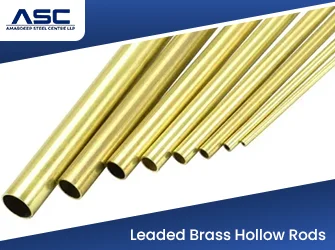
Leaded brass hollow rods are a practical choice when a machined component needs a bore and the job involves producing the same part repeatedly. Starting with a hollow bar can save the time spent drilling solid stock and reduce the amount of brass that ends up as machining waste. Grades such as C36000 and CW614N are widely associated with free machining brass, making them suitable for precision turned components, fittings and valve parts. The right grade and dimensions depend on the component design, machining process and material specification. Amardeep can be contacted to discuss leaded brass hollow rod requirements, subject to confirmation of the available product range.
Specifications of Leaded Brass Hollow Rods
Parameter | Details |
|---|---|
Product | Leaded brass hollow rods, also known as leaded brass hollow bars |
Product Shape | Round hollow section |
Grades | C36000, CW614N, CW617N, C37700 and applicable IS 319 grades, subject to confirmation |
Standards | EN 12168, ASTM B16, ASTM B453, ASTM B124 and IS 319, as applicable to the grade and product form |
Outside Diameter | To be confirmed according to manufacturing capability |
Bore | To be confirmed according to manufacturing capability |
Wall Thickness | Determined by the outside diameter, bore and applicable dimensional tolerance |
Length | Random length or cut to length, subject to availability |
Lead content | 1.5 to 3.7 per cent depending on grade |
Machinability | C36000 is the reference free cutting brass at 100 on the machinability scale. Other grades are rated against it. |
Dimensional tolerance | Agreed with the order |
Temper | As manufactured, half hard, hard or stress relieved, subject to confirmation |
Surface Finish | Bright drawn or as extruded, subject to confirmation |
Packing | Bundles or other packing arrangements according to order requirements |
Documentation | Material Test Certificate according to the agreed purchase requirements |
Leaded Brass Hollow Rods Chemical Composition
Grade | Copper Cu Percent | Lead Pb Percent | Iron Fe Maximum Percent | Zinc |
|---|---|---|---|---|
C36000 | 60.0 to 63.0 | 2.5 to 3.7 | 0.35 | Remainder |
CW614N | 57.0 to 59.0 | 2.5 to 3.5 | 0.30 | Remainder |
CW617N | 57.0 to 59.0 | 1.6 to 2.5 | 0.30 | Remainder |
C37700 | 58.0 to 61.0 | 1.5 to 2.5 | 0.30 | Remainder |
IS 319 | Confirm applicable grade | Confirm applicable grade | Confirm applicable grade | Remainder |
Mechanical Properties of Leaded Brass Hollow Rods
Property | Annealed | Half hard, cold drawn |
|---|---|---|
Tensile strength | About 340 MPa (49 ksi) | About 400 MPa (58 ksi) |
Yield strength | About 125 MPa (18 ksi) | About 310 MPa (45 ksi) |
Elongation | About 50% | About 25% |
Hardness | About 35 to 45 HRB | About 78 to 80 HRB |
Leaded Brass Hollow Rods Physical Properties
Property (grade to be stated) | SI | Imperial |
|---|---|---|
Density | 8.39 g/cm3 | 0.303 lb/in3 at 68 F |
Specific gravity | 8.39 | 8.39 |
Melting range | 899 to 904 °C (solidus to liquidus) | 1650 to 1660 F |
Coefficient of thermal expansion | 20.9 micrometres per metre per kelvin, 20 to 300 °C | 11.6 millionths per F, 68 to 572 F |
Thermal conductivity | About 123 W/m K at 20 °C | 71.0 Btu per foot per hour per F at 68 F |
Electrical conductivity | 28 %IACS at 20 °C | 28 %IACS at 68 F |
Electrical resistivity | About 0.062 micro ohm metre | 37.0 ohm circular mil per foot at 68 F |
Specific heat | About 377 J/kg K | 0.09 Btu per pound per F at 68 F |
Modulus of elasticity in tension | About 103 GPa | 15000 ksi |
Modulus of rigidity | About 39 GPa | 5600 ksi |
Equivalent Grades of Leaded Brass Hollow Rods
Grade | UNS | EN | JIS and note |
|---|---|---|---|
C36000 | C36000 | CW603N (CuZn36Pb3), nearest EN | C3604, nearest JIS |
CW614N | No exact UNS | CW614N (CuZn39Pb3) | C36000 is the usual ASTM substitute but is not identical |
CW617N | C37700, nearest | CW617N (CuZn40Pb2) | C3771, nearest JIS |
C37700 | C37700 | CW617N, nearest EN | C3771, nearest JIS |
Applications of Leaded Brass Hollow Rods
Leaded brass hollow rods are used in manufacturing where a component requires an internal bore, good machinability and consistent dimensions.
Common applications include:
- Valves and fittings: Hollow brass rods can be used to manufacture selected valve components, connectors and fittings that require an internal passage.
- Sanitary hardware: Brass hollow bars are used for selected hardware components, subject to the applicable lead content and drinking water requirements.
- Precision turned parts: Free cutting brass hollow rods are suitable for components produced using CNC machines and automatic lathes.
- Fasteners: Brass hollow sections may be used for selected fasteners and threaded components that require a central bore.
- Instrumentation components: Brass hollow rods can be machined into selected instrument fittings and components.
- Electrical components: Brass is used in selected electrical and connector components where its conductivity and machinability are suitable.
- Builders hardware: Hollow brass bars can be used for selected architectural and hardware components.
- Machined industrial components: The material is suitable for applications where the finished part requires a central opening and precision machining.
For tube plugs and related brass items, see our brass tapered tube plugs.
Frequently Asked Questions
1. What are leaded brass hollow rods?
Leaded brass hollow rods are round or hexagonal brass bars with a bore through the centre, made from alloys that carry a few per cent of lead so they machine quickly. Turning shops use them to make bushings, sleeves, valve parts and fittings without drilling out a solid bar first.
2. Which leaded brass grade is best for machining?
C36000 and CW614N are the usual choices for fast machining, because their lead content is highest and their chips break short. Choose C36000 if your drawing follows ASTM and CW614N if it follows EN. If the part is forged before it is machined, CW617N or C37700 is the better fit.
3. What is the difference between C36000 and CW614N?
C36000 is the American free cutting brass with 60.0 to 63.0 per cent copper. CW614N is the European CuZn39Pb3 with 57.0 to 59.0 per cent copper. They behave alike on a lathe, but they are different alloys, so match the grade your drawing names and do not treat them as a straight swap.
4. Are leaded brass hollow rods RoHS compliant?
RoHS allows lead in copper alloys up to 4 per cent by weight under an exemption, and the grades here sit inside that limit. Rules change, so check the current directive and your customer requirement. We state the lead content and the standard on the certificate so your compliance team can review it.
5. Can leaded brass be used for drinking water fittings?
No. Leaded brass is not suited to parts that touch drinking water, and many regions limit lead in those parts. For potable water, specify a lead free or dezincification resistant brass and say so in your enquiry, and we will tell you what we can supply against it.
6. What sizes of brass hollow rod do you supply?
Sizes depend on the grade and the process, so we quote against your drawing. Send the outside diameter, bore or inside diameter, length and quantity with your enquiry. Hexagonal hollow rod is available on request, and cut lengths and chamfered ends can be agreed with the order.
7. Do you provide mill test certificates?
Yes. Every order ships with a mill test certificate to EN 10204 3.1, with heat chemistry and test results traceable to the lot. Third party inspection can be arranged if your purchase order asks for it. Tell us at the enquiry stage so it is planned into the delivery.
8. What is the minimum order quantity and lead time?
Minimum order quantity and lead time depend on the grade, the size and whether the size is in stock, so we confirm both in the quotation. Send your grade, size and quantity, and we will reply with a price and a delivery date that match your requirement.
Looking to Enquire or Place an Order?
Send us the grade, the size and the quantity, and tell us what the part has to do. We will come back with a price, a delivery date and an honest view on whether leaded brass is the right material for the job.
Explore Related Ranges
- Brass round bars to IS 319 1989 Gr.1: the solid version of the same free cutting family.
- Bars, rods and wires: the full range of bar products across materials.
- Copper nickel and brass products: copper alloys for marine and process service.
- Brass tapered tube plugs: plugs for heat exchanger tube repair.
- Admiralty brass seamless tube: inhibited brass for condenser service.
- Aluminium brass seamless tube: higher resistance to impingement in cooling water.
