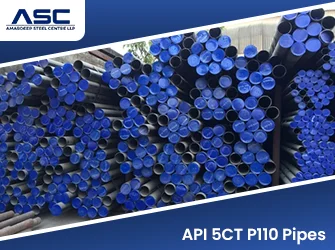
API 5CT P110 pipes are high strength casing and tubing products used in deep oil and gas wells where elevated mechanical loads and pressure conditions require higher strength. Amardeep Steel supplies P110 casing and tubing for demanding oilfield applications, including production casing in deep and extended reach wells. As an API 5CT Group 3 grade, P110 has a higher specified minimum yield strength than API 5CT N80 tubing, supporting applications where greater load carrying capacity is required. For sour service, see our API 5CT T95 pipes. Our range of seamless pipes and tubes includes additional grades for oilfield and industrial requirements.
Each shipment is supported by mill test certificates, relevant inspection records and dimensional verification to confirm compliance with the specified API 5CT requirements.
What Are API 5CT P110 Pipes?
API 5CT P110 is the only grade in Group 3 of the specification. It has a yield strength of 758 to 965 MPa and a minimum tensile strength of 862 MPa, which lets designers run thinner or lighter strings in deep wells where weight and pressure are high.
P110 is supplied as both casing and tubing. Its most common use is production casing, which has to hold the full pressure of the well during fracturing and production.
Why P110 Is Not Used in Sour Wells
P110 has no maximum hardness limit, and steel at this strength level is prone to sulphide stress cracking when hydrogen sulphide is present. For that reason P110 is kept for sweet wells. Sour wells at similar depths normally use T95 or another restricted yield grade.
API 5CT P110 Pipe Specifications
Parameter | Details |
|---|---|
Specification | API 5CT / ISO 11960 |
Grade | P110 |
API Group | Group 3 (high strength) |
Product Form | Casing and tubing |
Manufacturing Process | Seamless (electric welded casing allowed under extra controls) |
Casing Outside Diameter | 4 1/2 inch to 20 inch (114.3 mm to 508 mm) |
Tubing Outside Diameter | 1.050 inch to 4 1/2 inch (26.67 mm to 114.3 mm) |
Casing Length | Range 1: 4.88 to 7.62 m, Range 2: 7.62 to 10.36 m, Range 3: 10.36 to 14.63 m |
Tubing Length | Range 1: 6.10 to 7.32 m, Range 2: 8.53 to 9.75 m, Range 3: 11.58 to 12.80 m |
Casing Connections | STC, LTC and BC (buttress) |
Tubing Connections | NU (non upset) and EU (external upset) |
Premium Connections | Available on request |
Heat Treatment | Quenched and tempered |
Product Specification Level | PSL 1, PSL 2 and PSL 3 |
Test Certificate | EN 10204 3.1, with 3.2 on request |
API 5CT P110 Chemical Composition
Element | Content (%) |
|---|---|
Phosphorus (P) | 0.030 max |
Sulphur (S) | 0.030 max |
Carbon, Manganese and Alloying Elements | Not specified, chosen by the mill to reach the required strength |
API 5CT only limits phosphorus and sulphur for seamless P110. Mills normally use a chromium molybdenum or manganese boron steel so the pipe hardens fully when quenched. Electric welded P110 casing has extra chemistry limits set in the standard.
API 5CT P110 Mechanical Properties
Property | Requirement |
|---|---|
Yield Strength | 758 to 965 MPa (110 to 140 ksi) |
Tensile Strength, min | 862 MPa (125 ksi) |
Maximum Hardness | Not specified |
Total Elongation Under Load | 0.6% |
Impact Testing on P110 Pipe
Charpy V-notch impact testing is required for P110. The minimum absorbed energy depends on the wall thickness and the specified yield strength, which keeps the pipe tough enough to resist brittle failure under high load.
API 5CT N80 vs T95 vs P110 vs Q125
Property | N80 | T95 | P110 | Q125 |
|---|---|---|---|---|
API Group | Group 1 | Group 2 | Group 3 | Group 4 |
Yield Strength | 552 to 758 MPa | 655 to 758 MPa | 758 to 965 MPa | 862 to 1034 MPa |
Tensile Strength, min | 689 MPa | 724 MPa | 862 MPa | 931 MPa |
Maximum Hardness | Not specified | 25.4 HRC | Not specified | Not specified |
Sour Service (H2S) | Not recommended | Yes, SSC tested | Not recommended | Not recommended |
When P110 is not strong enough for very deep casing strings, API 5CT Q125 casing is the next step up. For sour wells, choose T95 pipe or C90 pipe.
API 5CT P110 Colour Code
P110 pipe is marked with one white band, and the grade is stencilled on every length with size, weight and heat number.
Heat Treatment of API 5CT P110 Pipes
All P110 pipe is quenched and tempered along its full length. Quenching hardens the steel and tempering brings it back into the required yield range while restoring toughness.
Applications of API 5CT P110 Casing and Tubing
- Production casing in deep and high pressure sweet wells
- Horizontal and shale wells that see high fracturing pressure
- Production tubing in high pressure gas wells
- Intermediate casing in deep wells
Testing and Documentation
Every order of API 5CT P110 pipe goes through the checks below at our testing facility or approved third party labs.
- Heat and product chemical analysis
- Tensile test for yield, tensile strength and elongation
- Charpy V-notch impact test
- Hydrostatic test on every length
- Full length drift test
- Ultrasonic or electromagnetic inspection of the pipe body
- Thread gauging, visual and dimensional inspection
- Third party inspection on request
Mill test certificates are issued to EN 10204 3.1, with 3.2 available on request. You can view our approvals on the certificates page.
Packing and Marking
Each length is stencilled with the manufacturer name, API 5CT, size, weight, grade, connection and heat number, and carries the API colour band for its grade. Threads are protected with steel or plastic thread protectors, and pipes are bundled or loaded loose with spacers depending on size. Read more about our packing and despatch process.
Request a Quote for API 5CT P110 Pipes
Send us the outside diameter, weight, connection, range length and quantity, and our team will reply with price and delivery. Use the enquiry form or reach us through the contact page.
Frequently Asked Questions
What is API 5CT P110 pipe used for?
API 5CT P110 pipe is used as casing and tubing in deep, high pressure sweet oil and gas wells. It is a common choice for production casing in horizontal and shale wells that face high fracturing pressure.
What is the yield strength of API 5CT P110?
API 5CT P110 has a yield strength of 758 to 965 MPa (110 to 140 ksi) and a minimum tensile strength of 862 MPa (125 ksi).
Can API 5CT P110 be used in sour wells?
P110 is not recommended for sour wells. It has no maximum hardness limit and its high strength makes it prone to sulphide stress cracking in the presence of hydrogen sulphide. Sour wells normally use T95, C90 or L80.
What is the colour code for API 5CT P110?
API 5CT P110 pipe is identified by one white colour band. The grade, size, weight and heat number are also stencilled on each length.
