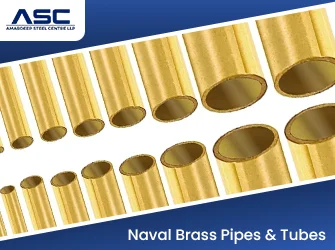
Naval Brass Pipes & Tubes Manufacturer, Supplier & Exporter in India
C46400 • C48200 • CZ112 • CZ134 • CW719R • CuZn37Pb1Sn1
Ordinary 60/40 brass does not last long in seawater. Salt water pulls zinc out of the metal and leaves a weak, porous copper shell, a failure called dezincification. Naval brass solves this with one small change. Replacing just under 1% of the zinc with tin makes the alloy far more resistant to seawater, while keeping the strength and hot-working ability of Muntz metal.
The result is the brass that shipbuilders, offshore fabricators and valve makers have trusted for more than a century. It goes into propeller shafts, marine fasteners, condenser tube plates, valve stems and pump parts. Amardeep Steel supplies naval brass pipes and tubes in the main UNS, BS and EN grades. Tubes run from 6 mm to 219 mm OD with walls from 0.5 mm to 10 mm, and every order ships with an EN 10204 3.1 mill test certificate.
Naval Brass Grades We Supply
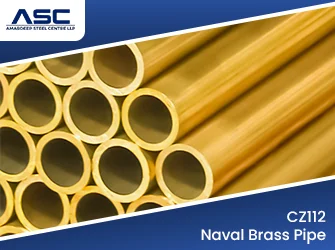
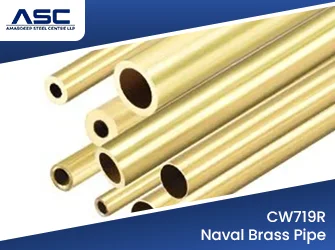
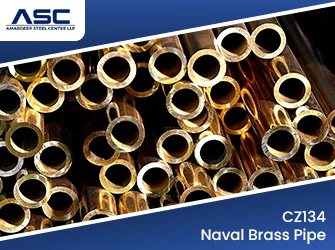
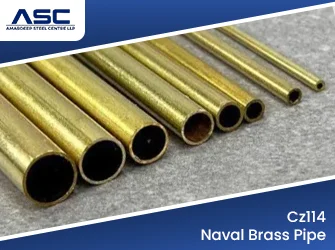
Naval Brass Specifications
| Parameter | Details |
|---|---|
Forms | Seamless pipes and tubes |
Tube outside diameter | 6–219 mm |
Wall thickness | 0.5–10 mm |
Length | Single random, double random, cut length |
Temper | Annealed (O), half hard, hard |
Finish | Mill, bright, polished |
Standards | ASTM B21 (rod and bar), ASTM B171 (plate), BS 2871, BS 2874, EN 12163–12165 (rod), EN 1652 (plate) |
Testing | Eddy current, hydrostatic, flattening and flaring tests |
Certification | EN 10204 3.1 MTC; third-party inspection (TUV, BV, SGS, Lloyd’s) on request |
Chemical Composition of Naval Brass (%)
| Grade | Cu | Sn | Pb | Fe max | Zn |
|---|---|---|---|---|---|
C46400 (naval brass, uninhibited) | 59.0–62.0 | 0.5–1.0 | 0.20 max | 0.10 | Rem. |
C48200 (medium-leaded naval brass) | 59.0–62.0 | 0.5–1.0 | 0.40–1.0 | 0.10 | Rem. |
C48500 (high-leaded naval brass) | 59.0–62.0 | 0.5–1.0 | 1.3–2.2 | 0.10 | Rem. |
BS and EN grades (CZ112, CZ134, CW719R, CuZn37Pb1Sn1) are supplied to the limits of their own standard, shown on the mill certificate.
Naval Brass Grade Equivalents
| Type | UNS | EN | BS |
|---|---|---|---|
Naval brass | C46400 | CuZn39Sn1 (CW719R) | CZ112 |
Medium-leaded naval brass | C48200 | CuZn37Pb1Sn1 (CW714R) | – |
High-leaded naval brass | C48500 | – | CZ134 |
Physical Properties of Naval Brass (C46400)
| Property | Value |
|---|---|
Density | 8.41 g/cm³ |
Melting range | 885–900 °C |
Electrical conductivity | 26% IACS |
Thermal conductivity | 116 W/m·K |
Modulus of elasticity | 103 GPa |
Coefficient of thermal expansion | 21.2 × 10⁻⁶ /°C (20–300 °C) |
Fabrication Properties
| Process | C46400 | C48200 | C48500 |
|---|---|---|---|
Hot forming and forging | Excellent | Excellent | Excellent |
Cold working | Fair | Fair | Poor |
Machinability rating (free-cutting brass = 100) | 30 | 50 | 70 |
Soldering and brazing | Excellent | Excellent | Good |
Welding | Fair (oxyacetylene, butt) | Not recommended | Not recommended |
Choose C46400 when the part is formed or welded, and the leaded grades when it is mainly machined.
Applications of Naval Brass Pipes & Tubes
- Marine hardware, propeller shafts and turnbuckles
- Condenser tube sheets, baffles and heat-exchanger plates
- Seawater valve stems, pump shafts and fittings
- Bolts, nuts, rivets and marine fasteners
- Bushings, bearings and wear parts
- Offshore, shipbuilding and naval equipment
- Desalination and seawater cooling systems
For seawater condenser tubes, see aluminium brass tubes and admiralty brass tubes. For harsher seawater duty, see our copper-nickel products.
FAQs – Naval Brass Pipes & Tubes
1. Why is it called naval brass?
It was developed for ships. The small tin addition protects it from seawater, so navies used it for fittings, shafts and hardware.
2. What is the difference between naval brass and admiralty brass?
Naval brass is about 60/40 copper-zinc with tin and is used for rods, plates and hardware. Admiralty brass is about 70/30 with tin and arsenic and is used mainly for condenser tubes.
3. Is naval brass easy to machine?
Plain naval brass (C46400) machines only fairly. The leaded grades, C48200 and C48500, cut much more easily.
4. Can naval brass be welded?
C46400 can be oxyacetylene or butt welded. The leaded grades should be soldered or brazed instead.
Our Products

- CuZn30 Brass Tubes
- CuZn37 Brass Tubes
- CZ121 Brass Tubes
- C28000 60/40 Muntz Metal Tubes
- C37000 Muntz Metal Pipes
- C330 / C33000 Brass Pipes
- C33000 Brass Tubes
- C36300 Brass Tubes
- C36500 Brass Tubes
- C27450 Brass Tubes
- CuZn40 Brass Pipes
- CW705R Brass Pipes
- CZ112 Naval Brass Pipe
- CW719R Naval Brass Pipe
- CZ134 Naval Brass Pipe
- CZ114 Naval Brass Pipe
- CuZn37Pb1Sn1 (C48200) Naval Brass Rods
- Naval Brass Plates & Sheets
- C44300 Admiralty Brass Tubes
- BS 2871 CZ111 Admiralty Brass Tubes
- EN 12451 CW706R Admiralty Brass Pipe
- CuZn29Sn1 Admiralty Brass Pipe
- JIS H3300 C4430 Admiralty Brass Pipe
- NFA 51-102 Admiralty Brass Pipe