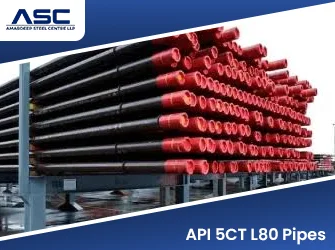
API 5CT L80 pipes are used as casing and tubing in oil and gas wells where controlled yield strength and hardness are required. The grade includes L80 Type 1, L80 9Cr and L80 13Cr variants for different service conditions. Amardeep Steel supplies L80 casing and tubing for oilfield applications. Compared with API 5CT N80 tubing, L80 has controlled yield strength and hardness requirements that can support applications where sulphide stress cracking resistance is required. For shallow wells and general service, see our API 5CT J55 tubing, while our range of seamless pipes and tubes covers other grades and specifications.
Each shipment includes mill test certificates, hardness results and grade colour banding for material identification and traceability.
What Are API 5CT L80 Pipes?
API 5CT, also published as ISO 11960, is the specification for steel casing and tubing used in oil and gas wells. It sorts grades into four groups. L80 belongs to Group 2, the restricted yield grades, where the standard sets both a minimum and a maximum yield strength along with a maximum hardness.
Casing lines the drilled hole and holds back the surrounding rock, while tubing runs inside the casing and carries oil and gas to the surface. L80 is used for both. It should not be confused with API 5L line pipe, which is meant for pipelines on the surface rather than inside the well.
Why Restricted Yield Matters in Sour Wells
Hydrogen sulphide in a well can cause sulphide stress cracking in steel that is too hard or too strong. By capping yield at 655 MPa and hardness at 23 HRC, L80 Type 1 stays within the range accepted for sour service under NACE MR0175 / ISO 15156. That is the main reason operators choose L80 over N80, even though both start at the same minimum yield.
Types of API 5CT L80: L80-1, L80 9Cr and L80 13Cr
L80 Type 1 (L80-1)
A carbon manganese steel that is quenched and tempered. It is the standard choice for sour wells and can be made as seamless or electric welded pipe.
L80 9Cr
Contains about 9 percent chromium and 1 percent molybdenum. The chromium gives better resistance to carbon dioxide corrosion. It is made as seamless pipe only.
L80 13Cr
A martensitic 13 percent chromium steel widely used in sweet wells with high carbon dioxide content. It handles CO2 corrosion well but has limited tolerance for hydrogen sulphide, so it is not the first choice for sour service. It is made as seamless pipe only.
API 5CT L80 Pipe Specifications
Parameter | Details |
|---|---|
Specification | API 5CT / ISO 11960 |
Grade | L80 Type 1, L80 9Cr, L80 13Cr |
API Group | Group 2 (restricted yield) |
Product Form | Casing and tubing |
Manufacturing Process | Seamless (L80 Type 1 also available electric welded) |
Casing Outside Diameter | 4 1/2 inch to 20 inch (114.3 mm to 508 mm) |
Tubing Outside Diameter | 1.050 inch to 4 1/2 inch (26.67 mm to 114.3 mm) |
Casing Length | Range 1: 4.88 to 7.62 m, Range 2: 7.62 to 10.36 m, Range 3: 10.36 to 14.63 m |
Tubing Length | Range 1: 6.10 to 7.32 m, Range 2: 8.53 to 9.75 m, Range 3: 11.58 to 12.80 m |
Casing Connections | STC, LTC and BC (buttress) |
Tubing Connections | NU (non upset) and EU (external upset) |
Premium Connections | Available on request |
Heat Treatment | Quenched and tempered |
Product Specification Level | PSL 1, PSL 2 and PSL 3 |
Test Certificate | EN 10204 3.1, with 3.2 on request |
API 5CT L80 Chemical Composition
Element (%) | L80 Type 1 | L80 9Cr | L80 13Cr |
|---|---|---|---|
Carbon (C) | 0.43 max | 0.15 max | 0.15 to 0.22 |
Manganese (Mn) | 1.90 max | 0.30 to 0.60 | 0.25 to 1.00 |
Chromium (Cr) | Not specified | 8.00 to 10.00 | 12.0 to 14.0 |
Molybdenum (Mo) | Not specified | 0.90 to 1.10 | Not specified |
Nickel (Ni) | 0.25 max | 0.50 max | 0.50 max |
Copper (Cu) | 0.35 max | 0.25 max | 0.25 max |
Phosphorus (P) | 0.030 max | 0.020 max | 0.020 max |
Sulphur (S) | 0.030 max | 0.010 max | 0.010 max |
Silicon (Si) | 0.45 max | 1.00 max | 1.00 max |
API 5CT L80 Mechanical Properties
Property | Requirement |
|---|---|
Yield Strength | 552 to 655 MPa (80 to 95 ksi) |
Tensile Strength, min | 655 MPa (95 ksi) |
Maximum Hardness | 23 HRC (241 HBW) |
Total Elongation Under Load | 0.5% |
Hardness Testing on L80 Pipe
Hardness readings are taken across the wall section and none may exceed 23 HRC. This check matters as much as the tensile test, because hardness is the property most closely linked to sulphide stress cracking.
API 5CT L80 Colour Code and Marking
L80 Type | Colour Band on Pipe | Grade Marking |
|---|---|---|
L80 Type 1 | One red band and one brown band | L |
L80 9Cr | One red band and two yellow bands | L9 |
L80 13Cr | One red band and one yellow band | L13 |
API 5CT L80 vs N80 vs C90
Property | N80 | L80 Type 1 | C90 |
|---|---|---|---|
API Group | Group 1 | Group 2 | Group 2 |
Yield Strength | 552 to 758 MPa | 552 to 655 MPa | 621 to 724 MPa |
Tensile Strength, min | 689 MPa | 655 MPa | 689 MPa |
Maximum Hardness | Not specified | 23 HRC | 25.4 HRC |
Sour Service (H2S) | Not recommended | Yes | Yes, SSC tested |
If the well is sweet and you only need strength, N80 tubing can be the cheaper option. For higher pressure sour wells, step up to API 5CT C90 pipes or API 5CT T95 pipes.
Heat Treatment of API 5CT L80 Pipes
All L80 pipe is quenched and tempered. The standard also sets a minimum tempering temperature so the steel cannot be left too hard.
- L80 Type 1: tempered at 566 degrees Celsius or higher
- L80 9Cr and L80 13Cr: tempered at 593 degrees Celsius or higher
Applications of API 5CT L80 Casing and Tubing
- Production tubing in sour oil and gas wells
- Intermediate and production casing strings
- Sweet gas wells with high carbon dioxide content (L80 13Cr)
- CO2 injection and enhanced oil recovery wells (L80 9Cr and 13Cr)
- Geothermal wells
Testing and Documentation
Every order of API 5CT L80 pipe goes through the checks below at our testing facility or approved third party labs.
- Heat and product chemical analysis
- Tensile test for yield, tensile strength and elongation
- Hardness test across the wall section
- Charpy V-notch impact test
- Hydrostatic test on every length
- Full length drift test
- Ultrasonic or electromagnetic inspection of the pipe body
- Thread gauging, visual and dimensional inspection
- Third party inspection on request
Mill test certificates are issued to EN 10204 3.1, with 3.2 available on request. You can view our approvals on the certificates page.
Packing and Marking
Each length is stencilled with the manufacturer name, API 5CT, size, weight, grade, connection and heat number, and carries the API colour band for its grade. Threads are protected with steel or plastic thread protectors, and pipes are bundled or loaded loose with spacers depending on size. Read more about our packing and despatch process.
Request a Quote for API 5CT L80 Pipes
Send us the L80 type, outside diameter, weight, connection, range length and quantity, and our team will reply with price and delivery. Use the enquiry form or reach us through the contact page.
Frequently Asked Questions
What is API 5CT L80 pipe?
API 5CT L80 pipe is casing or tubing made to the API 5CT specification in grade L80. It is a Group 2 restricted yield grade with a yield strength of 552 to 655 MPa and a maximum hardness of 23 HRC, and it is widely used in sour oil and gas wells.
What is the difference between L80-1, L80 9Cr and L80 13Cr?
L80-1 is a carbon manganese steel suited to sour service. L80 9Cr adds about 9 percent chromium and 1 percent molybdenum for carbon dioxide corrosion resistance. L80 13Cr is a 13 percent chromium steel for sweet wells with high CO2. All three share the same strength range.
Is API 5CT L80 suitable for sour service?
L80 Type 1 is suitable for sour service because its yield strength and hardness are capped at levels accepted by NACE MR0175 / ISO 15156. L80 13Cr has limited tolerance for hydrogen sulphide and is normally chosen for sweet wells with high carbon dioxide instead.
What is the colour code for API 5CT L80 pipe?
L80 Type 1 carries one red band and one brown band. L80 9Cr carries one red band and two yellow bands, and L80 13Cr carries one red band and one yellow band. The grade is also stencilled on each length as L, L9 or L13.
