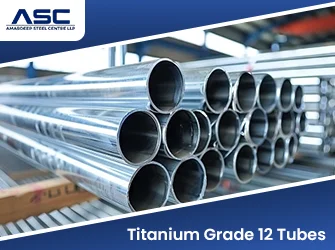
Titanium Grade 12 tubes (UNS R53400) conform to ASTM B338, coming in either seamless or welded form. Grade 12 serves applications that require enhanced corrosion resistance and strength above what Titanium Grade 2 can provide. Grade 12 contains 0.2% to 0.4% molybdenum and 0.6% to 0.9% nickel, which improve resistance to crevice corrosion in hot brines and mildly reducing acids without involving palladium. That makes it a lower cost alternative to the palladium grades. Amardeep Steel supplies Titanium Grade 12 tubes with EN 10204 3.1 mill test certificates and complete heat traceability. Compare our ASTM B338 Grade 7 titanium tubes, or browse our titanium pipes and tubes.
What Are Titanium Grade 12 Tubes?
Grade 12, often written Ti-0.3Mo-0.8Ni, adds small amounts of molybdenum and nickel to titanium. These additions improve resistance to crevice corrosion in hot chloride brines and to mildly reducing acids, and raise minimum tensile strength to 483 MPa. It is widely used where Grade 2 is close to its limit but palladium grades cost too much.
Grade 12 or a Palladium Grade?
Grade 7 and Grade 16 use palladium to give the highest crevice corrosion resistance. Grade 12 sits between Grade 2 and the palladium grades in corrosion resistance, with higher strength and lower cost. For the most aggressive hot reducing service, specify Grade 7 or 16.
Titanium Grade 12 Tube Specifications
Parameter | Details |
|---|---|
Grade | Titanium Grade 12 (Ti-0.3Mo-0.8Ni) |
UNS | R53400 |
Tube standard | ASTM B338 / ASME SB338 (seamless and welded tubes for condensers and heat exchangers) |
Pipe standards | ASTM B861 (seamless pipe), ASTM B862 (welded pipe) |
Type | Seamless and welded |
Tube sizes | 6.35 mm to 50.8 mm OD as standard, 0.5 mm to 3 mm wall; other sizes on request |
Forms | Straight lengths, U-bend tubes, coils |
Condition | Annealed; welded tubes stress relieved after welding |
Length | Random, fixed and cut lengths |
Test Certificate | EN 10204 3.1, with 3.2 available on request |
Titanium Grade 12 Chemical Composition
Element | Content (%) |
|---|---|
Nitrogen (N) | 0.03 max |
Carbon (C) | 0.08 max |
Hydrogen (H) | 0.015 max |
Iron (Fe) | 0.30 max |
Oxygen (O) | 0.25 max |
Molybdenum (Mo) | 0.2 to 0.4 |
Nickel (Ni) | 0.6 to 0.9 |
Residual elements, each | 0.1 max |
Residual elements, total | 0.4 max |
Titanium (Ti) | Balance |
Titanium Grade 12 Mechanical Properties
Property (ASTM B338) | Value |
|---|---|
Tensile Strength, min | 483 MPa (70 ksi) |
Yield Strength (0.2% offset), min | 345 MPa (50 ksi) |
Elongation in 50 mm, min | 18% |
Titanium Grade 12 Physical Properties
Property | Typical value |
|---|---|
Density | 4.51 g/cm³ |
Melting point | About 1660°C |
Modulus of elasticity | About 103 to 107 GPa |
Mean thermal expansion (20°C to 100°C) | About 8.6 µm/m·°C |
Magnetic | Non-magnetic |
Typical values for commercially pure and low alloy titanium. Values for each heat are on the mill certificate.
Titanium Grade 12 Equivalent Grades
Standard | Designation |
|---|---|
UNS | R53400 |
Common names | Titanium Grade 12, Ti-0.3Mo-0.8Ni |
GB (China) | TA10 |
ASTM tube / pipe | B338 / B861 / B862 |
Titanium Grade 7 vs Grade 16 vs Grade 12
Property (ASTM B338) | Grade 7 | Grade 16 | Grade 12 |
|---|---|---|---|
Alloying addition | Pd 0.12 to 0.25% | Pd 0.04 to 0.08% | Mo 0.2 to 0.4%, Ni 0.6 to 0.9% |
Oxygen, max | 0.25% | 0.25% | 0.25% |
Tensile strength, min | 345 MPa (50 ksi) | 345 MPa (50 ksi) | 483 MPa (70 ksi) |
Yield strength, min | 275 MPa (40 ksi) | 275 MPa (40 ksi) | 345 MPa (50 ksi) |
Crevice corrosion resistance | Highest | Close to Grade 7 | Better than Grade 2 |
Relative cost | Highest | Lower than Grade 7 | Lower, no precious metal |
For the highest crevice corrosion resistance, see our ASTM B338 Grade 7 titanium tubes or Titanium Grade 16 tubes.
Titanium Grade 12 Tube Size and Weight Chart
Tube OD, in (mm) | 22 BWG (0.71 mm) | 20 BWG (0.89 mm) | 18 BWG (1.24 mm) | 16 BWG (1.65 mm) | 14 BWG (2.11 mm) |
|---|---|---|---|---|---|
1/2" (12.70) | 0.12 | 0.15 | 0.20 | 0.26 | 0.32 |
5/8" (15.88) | 0.15 | 0.19 | 0.26 | 0.33 | 0.41 |
3/4" (19.05) | 0.18 | 0.23 | 0.31 | 0.41 | 0.51 |
7/8" (22.23) | 0.22 | 0.27 | 0.37 | 0.48 | 0.60 |
1" (25.40) | 0.25 | 0.31 | 0.42 | 0.56 | 0.70 |
1 1/4" (31.75) | 0.31 | 0.39 | 0.54 | 0.70 | 0.89 |
1 1/2" (38.10) | 0.38 | 0.47 | 0.65 | 0.85 | 1.08 |
2" (50.80) | 0.50 | 0.63 | 0.87 | 1.15 | 1.46 |
Weights are in kg/m, calculated as (OD minus wall) x wall x π x 4.51 / 1000. Condenser tubes are most often 20 to 22 BWG; heavier walls on request.
Need Titanium Grade 12 tubes in a size or BWG not listed, or as U-bends? Send the OD, wall, length and quantity for a quote.
Applications of Titanium Grade 12 Tubes
- Heat exchangers in hot chloride brines and salt evaporators
- Chlor-alkali and chlorate plant tubing
- Hydrometallurgy and leaching circuits
- Geothermal and hot seawater service
- Chemical process tubing in mildly reducing acids
Testing and Documentation
Every order of Titanium Grade 12 tube goes through the checks below at our testing facility or approved third party labs.
- Chemical analysis, including hydrogen, oxygen and nitrogen
- Tension test
- Flattening and flaring tests; reverse flattening on welded tube
- Eddy current or ultrasonic test
- Hydrostatic or pneumatic test on each tube
- Visual and dimensional inspection
Mill test certificates are issued to EN 10204 3.1, with 3.2 available on request. You can view our approvals on the certificates page.
Packing and Marking
Each tube is marked with ASTM B338, Titanium Grade 12, size, heat number and manufacturer name. Tubes are capped, sleeved in polythene and packed in wooden boxes so they never touch carbon steel. Read more about our packing and despatch process.
Request a Quote for Titanium Grade 12 Tubes
Send us the OD, wall or BWG, seamless or welded, length or U-bend details and quantity, and our team will reply with price and delivery. Use the enquiry form or reach us through the contact page.
Frequently Asked Questions
What is Titanium Grade 12?
Titanium Grade 12 (UNS R53400) is a titanium alloy with 0.2% to 0.4% molybdenum and 0.6% to 0.9% nickel, often written Ti-0.3Mo-0.8Ni.
What are the mechanical properties of Grade 12 titanium tube?
ASTM B338 sets 483 MPa (70 ksi) minimum tensile strength, 345 MPa (50 ksi) minimum yield strength and 18% minimum elongation for Grade 12.
Is Grade 12 better than Grade 2 for corrosion?
Yes. Grade 12 has better resistance to crevice corrosion in hot chloride brines and to mildly reducing acids than Grade 2, and higher strength.
What is the difference between Titanium Grade 12 and Grade 7?
Grade 7 uses 0.12% to 0.25% palladium for the highest crevice corrosion resistance. Grade 12 uses molybdenum and nickel instead, giving somewhat lower corrosion resistance at lower cost and higher strength.
