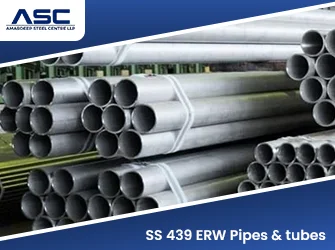
The Stainless Steel 439 ERW pipes and tubing are titanium stabilizing ferritic tubes with 17% - 19% chromium, which are used in environments where heat, corrosion, and continuous exposure to heat and cool environments are present. The grade 439, UNS S43035 and EN 1.4510 has good resistance to sensitization due to welding. ASTM A268 notes that TP439 is used mainly for hot water tank service. Amardeep Steel Centre supplies these tubes in India for automotive, heat transfer and export orders. See our SS 439 tubes and our SS welded pipes and tubes.
Technical Data
Specifications of Stainless Steel 439 ERW Pipes and Tubes
Specification Parameter | Technical Detail |
|---|---|
Material Grade | SS 439 / TP 439 / Type 439 |
UNS Designation | UNS S43035 |
EN / Werkstoff Equivalent | 1.4510 |
JIS Equivalent | SUS 430LX (closest) |
Applicable Standards | ASTM A268 / ASME SA268 |
Manufacturing Type | Electric Resistance Welded (ERW) / High-Frequency Induction Welded |
Form Factor | Round Pipes, Square/Rectangular Tubing, Custom Tubular Profiles |
Surface Finishes | Mill Finish (2B), Bright Annealed (BA), Polished (180/320/600 Grit) |
Certification & Testing | EN 10204 3.1 / 3.2 MTC, PMI, Hydrostatic, NDT, Flaring, Flattening |
Chemical Compositions of Stainless Steel 439 ERW Pipes & Tubes
Chemical Element | Specification Limit (% Mass) |
|---|---|
Carbon (C) | 0.07 Max |
Manganese (Mn) | 1.00 Max |
Silicon (Si) | 1.00 Max |
Phosphorus (P) | 0.040 Max |
Sulfur (S) | 0.030 Max |
Chromium (Cr) | 17.00 to 19.00 |
Nickel (Ni) | 0.50 Max |
Titanium (Ti) | 0.20 + 4 x (C+N) min to 1.10 max |
Aluminium (Al) | 0.15 Max |
Nitrogen (N) | 0.04 Max |
Iron (Fe) | Balance |
SS 439 ERW Pipes and Tubes Mechanical Properties
Mechanical Property | ASTM A268 Minimum Requirement | Typical Value (Reference only, based on production test results) |
|---|---|---|
Tensile Strength (Ultimate) | 415 MPa (60,000 psi) | 440 to 480 MPa |
Yield Strength (0.2% Offset) | 205 MPa (30,000 psi) | 260 to 290 MPa |
Elongation in 2 inches (50 mm) | 22.0% min | 28% to 32% |
Hardness (Rockwell B) | 89 HRB max | 78 to 84 HRB |
Hardness (Brinell) | 183 HBW max | 150 to 165 HBW |
Physical Properties of Stainless Steel 439 ERW Pipes & Tubes
Physical Property | Value | Units (SI / Imperial) |
|---|---|---|
Density | 7.70 | g/cm³ (0.278 lb/in³) |
Melting Range | 1480 to 1530 | °C (2696 to 2786 °F) |
Specific Heat(0 to 100 °C) | 460 | J/kg·K (0.11 Btu/lb·°F) |
Thermal Conductivity(100 °C) | 25.0 | W/m·K (14.4 Btu/ft·h·°F) |
Modulus of Elasticity (E) | 200 | GPa (29,000 ksi) |
Electrical Resistivity | 0.60 | µΩ·m |
Mean Coeff. of Thermal Expansion(0 to 100 °C) | 10.4 | µm/m·K (5.8 µin/in·°F) |
Dimensions and Schedule Range of SS 439 ERW Pipes and Tubes
Dimensional Parameter | Manufacturing Capabilities |
|---|---|
Outside Diameter (OD) - Round | 6.00 mm to 114.30 mm |
Wall Thickness (WT) | 0.50 mm to 4.50 mm (custom wall in mm or SWG) |
Square Tubing Sizes | 12.7 x 12.7 mm to 75 x 75 mm |
Rectangular Tubing Sizes | 20 x 10 mm to 100 x 50 mm |
Standard Lengths | 6.0 Meters, 12.0 Meters, or Cut-to-Length Precision Parts |
Dimensional Tolerances | Per ASTM A268 (tighter tolerances available) |
Surface Conditions | Mill Finish, Bright Annealed (BA), Satin (180 Grit), Mirror (600 Grit) |
Applications and Industrial Uses of SS 439 ERW Pipes and Tubes
- Automotive Exhaust Systems
- Exhaust Manifolds
- Catalytic Converter Components
- Heat Exchanger Tubes
- Industrial Heating Equipment
- Furnace Components
- Hot Water and Heat-Transfer Systems
- Thermal Processing Equipment
Frequently Asked Questions
What are SS 439 ERW Pipes and Tubes?
SS 439 ERW Pipes and Tubes are ferritic stainless steel products made by electric resistance welding, offering good corrosion resistance, weldability, and heat resistance.
What is Stainless Steel 439 used for?
Stainless Steel 439 is commonly used for automotive exhaust systems, heat exchangers, furnace components, and other high-temperature applications.
What is the difference between Stainless Steel 439 and 409?
SS 439 generally has higher chromium content than SS 409, providing better corrosion and oxidation resistance, especially in demanding exhaust and heat-related applications.
Can Stainless Steel 439 ERW Tubes withstand high temperatures?
Yes, SS 439 ERW Tubes have good oxidation and corrosion resistance at elevated temperatures and are widely used in automotive and heat-transfer applications.
Is Stainless Steel 439 resistant to corrosion after welding?
Yes, its titanium stabilization helps reduce sensitization during welding and supports good corrosion resistance in welded areas when properly fabricated.
Is Stainless Steel 439 suitable for heat exchanger tubes?
Yes, SS 439 is suitable for heat exchanger tubes where good heat resistance, corrosion resistance, and weldability are required.
What is the difference between SS 439 and SS 304?
SS 439 is a ferritic, titanium-stabilized stainless steel, while SS 304 is an austenitic stainless steel with nickel. SS 304 generally offers broader corrosion resistance, while SS 439 provides good high-temperature performance at a lower alloy cost.
Can Stainless Steel 439 be used in chloride environments?
Yes, SS 439 can handle some chloride exposure, but it is not the preferred choice for severe chloride environments where higher pitting resistance is required.
