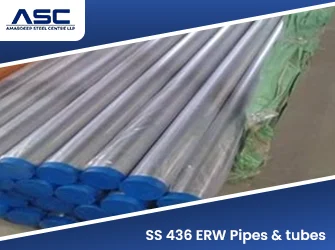
SS 436 ERW Pipes and Tubes are Nb stabilized Cr Mo ferritic tubes that are in accordance with UNS S43600. In SS 436, 16% to 18% chromium and 0.75% to 1.25% molybdenum are present, offering higher resistance to pitting and condensate corrosion than SS 430. Tubes are formed from strip with a continuous longitudinal ERW seam. Typical uses are automotive exhaust, EGR and condensate lines, and heat exchanger components. Amardeep Steel Centre supplies them in India for domestic and export orders. See our SS 436 tubes and our SS welded pipes and tubes.
Technical Data
Specifications of Stainless Steel 436 ERW Pipes & Tubes
Attribute | Specification Value |
|---|---|
Material Grade | Stainless Steel 436 (AISI 436 / UNS S43600) |
Alloy Family | Ferritic Stainless Steel (Niobium-Stabilized + Molybdenum-Bearing) |
Manufacturing Process | High-Frequency Electric Resistance Welded (ERW) |
Primary Governing Standard | ASTM A268 / ASME SA268 (Seamless & Welded Ferritic Tubing) |
Base Material Standard | ASTM A240 / ASME SA240 (Plate, Sheet, Strip) |
Equivalent Standards | Closest EN 1.4513 (X2CrMoTi17-1), JIS SUS436L (Note: Close matches, not exact equivalents) |
Min. Tensile Strength | 415 MPa (60,000 psi) |
Min. Yield Strength (0.2%) | 240 MPa (35,000 psi) |
Min. Elongation (A5) | 20.0% |
Surface Finish Options | Mill Finish, Annealed & Pickled, Bright Annealed (BA), 180/240/320 Grit Polish |
Chemical Compositions of Stainless Steel 436 ERW Pipes & Tubes
Element | Chromium (Cr) | Molybdenum (Mo) | Niobium (Nb) | Carbon (C) | Manganese (Mn) | Silicon (Si) | Phosphorus (P) | Sulfur (S) | Nickel (Ni) | Iron (Fe) |
|---|---|---|---|---|---|---|---|---|---|---|
Min Value | 16.00% | 0.75% | 5C | — | — | — | — | — | — | Balance |
Max Value | 18.00% | 1.25% | 0.80% | 0.12% | 1.00% | 1.00% | 0.040% | 0.030% | 0.50% | Balance |
Function | Passive oxide layer | Pitting resistance | Weld seam stabilizer | Maximize ductility | Deoxidizer | Oxidation resistance | Trace limit | Trace limit | Ferritic stabilizer | Base metal |
SS 436 ERW Pipes & Tubes Mechanical Properties
Property | Tensile Strength (Rm) | Yield Strength (Rp0.2) | Elongation (A5 in 50 mm) | Hardness (Rockwell B) | Hardness (Brinell) |
|---|---|---|---|---|---|
ASTM Minimum | 415MPa (60ksi) | 240MPa (35ksi) | 20.0% | — | — |
ASTM Maximum | — | — | — | 89HRB | 190HBW |
Typical Production | 450-520MPa | 270-330MPa | 24.0 - 30.0% | 75-84HRB | 145-175HBW |
Physical Properties of Stainless Steel 436 ERW Pipes & Tubes
Property | Metric Value | Imperial Value |
|---|---|---|
Density | 7.70 g/cm³ (7.74 g/cm³) | 0.278 lb/in³ (0.280 lb/in³) |
Modulus of Elasticity | 200 GPa | 29,000 ksi (29,106 psi) |
Thermal Expansion(0 to 100 °C) | 10.4 × 10⁻⁶/K / 9.3 µm/m·K | 5.78 × 10⁻⁶/°F / 5.2 µin/in·°F |
Thermal Conductivity(100 °C) | 24.0 W/m·K (26.1 W/m·K) | 13.9 Btu/h·ft·°F (15.1 Btu/h·ft·°F) |
Specific Heat(0 to 100 °C) | 460 J/kg·K | 0.11 Btu/lb·°F |
Electrical Resistivity | 0.60 µΩ·m | 23.6 µΩ·in (23.7 µΩ·in) |
Magnetic State | Ferromagnetic | Annealed & Cold-Worked Ferromagnetic |
Equivalent Grades of SS 436 ERW Pipes & Tubes
Region / System | Standard / Standardizing Body | Numeric / Werkstoff Grade | Chemical / Alphanumeric Designation |
|---|---|---|---|
USA / International | ASTM A268 / ASME SA268 | UNS S43600 | AISI 436 |
European Union | EN 10088 | 1.4513 | X2CrMoTi17-1 |
Japan | JIS G4305 / JIS G4303 | — | SUS436L |
Applications and Industrial Uses of SS 436 ERW Pipes & Tubes
- Automotive Exhaust Gas Recirculation (EGR) Tubes
- Exhaust Gas Condensate Lines
- Automotive Muffler and Silencer Components
- Catalytic Converter Tubing
- Automotive Heat Shields and Thermal Tubing
- Industrial Heat Exchanger Components
- Furnace and Thermal Processing Equipment
- High-Temperature Condensate Piping
Frequently Asked Questions
What are SS 436 ERW Pipes and Tubes?
SS 436 ERW Pipes and Tubes are ferritic stainless steel products made by electric resistance welding, offering good corrosion resistance and performance under elevated temperatures.
What is Stainless Steel 436 used for?
Stainless Steel 436 is used for automotive exhaust components, heat exchangers, thermal equipment, and industrial applications exposed to heat and condensation.
What is the UNS number of Stainless Steel 436?
The UNS number of Stainless Steel 436 is UNS S43600.
What is the difference between Stainless Steel 436 and 430?
SS 436 contains molybdenum and stabilizing elements, giving it better resistance to localized corrosion and improved performance in certain thermal environments than SS 430.
What is the difference between Stainless Steel 436 and 434?
Both are molybdenum-bearing ferritic grades, but SS 436 is niobium-stabilized, while SS 434 is generally stabilized through its alloy composition without niobium.
Why is molybdenum added to Stainless Steel 436?
Molybdenum improves resistance to pitting and localized corrosion, particularly in environments containing moisture and chlorides.
Why is niobium added to Stainless Steel 436?
Niobium helps stabilize the steel and improves resistance to sensitization and intergranular corrosion in welded areas.
Is Stainless Steel 436 suitable for high-temperature applications?
Yes, SS 436 provides good oxidation resistance and thermal stability for applications such as exhaust components and thermal equipment.
Is Stainless Steel 436 resistant to pitting corrosion?
Yes, its molybdenum content provides improved pitting resistance compared with standard ferritic grades such as SS 430.
