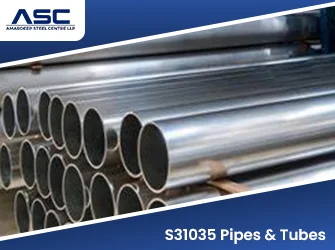
S31035 Pipes and Tubes are special austenitic stainless steel materials used in very tough conditions in ultra-supercritical power stations. UNS S31035 has 22% chromium and 25% nickel content, together with tungsten, copper, cobalt, niobium, and nitrogen for enhanced creep-rupture properties and increased protection from steam corrosion at elevated temperatures. The material is designed for tube-metal temperatures up to 700°C. It performs well under conditions of superheaters and reheaters where they undergo tough thermal stress and coal ash corrosion. Seamless pipes conform to ASTM A213 / ASME SA213, while pipe conforms to ASTM A312 / ASME SA312. They are available with solution-annealed and white pickled surfaces with EN 10204 3.1 MTCs. We at Amardeep Steel provide you with S31035 Pipes and Tubes. Amardeep Steel supplies S31035 Pipes and Tubes for critical power-generation applications
Specifications of S31035 Pipes and Tubes
Technical Parameter | Specification / Detail |
|---|---|
UNS Grade | UNS S31035 (Nominal 22Cr-25Ni-3.6W-3Cu-1.5Co-Nb-N) |
EN Designation | EN 1.4990 / X7NiCrWCuCoNb25-23-3-3-2 |
Product Standards | ASTM A213 / ASME SA-213 (Seamless Boiler Tubes); ASTM A312 / ASME SA-312 (Seamless Pipes) |
Manufacturing Process | Seamless, cold-pilgered, solution annealed, and white pickled |
Primary Applications | Ultra-supercritical (USC) boiler superheater and reheater tubing |
Maximum Service Temperature | 700°C metal temperature (Design allowable stress tabulated up to 750°C per ASME Code Cases) |
Density | 8.32 g/cm³ (0.29 lb/in³) |
Mill Certification | EN 10204 3.1 MTC supplied with all heats; Third-Party Inspection (TPI) on request |
Chemical Compositions of S31035 Pipes and Tubes
Element | ASTM A213 Specification Limit (wt %) | Nominal Mill Target (wt %) |
|---|---|---|
Carbon (C) | 0.04 – 0.10 | 0.07 |
Chromium (Cr) | 21.5 – 23.5 | 22.5 |
Nickel (Ni) | 23.5 – 26.5 | 25.0 |
Tungsten (W) | 3.0 – 4.0 | 3.6 |
Copper (Cu) | 2.5 – 3.5 | 3.0 |
Cobalt (Co) | 1.0 – 2.0 | 1.5 |
Niobium (Nb) | 0.30 – 0.70 | 0.50 |
Nitrogen (N) | 0.15 – 0.30 | 0.23 |
Boron (B) | 0.002 – 0.008 | 0.005 |
Manganese (Mn) | 0.60 max | 0.50 |
Silicon (Si) | 0.40 max | 0.20 |
Phosphorus (P) | 0.030 max | 0.025 |
Sulfur (S) | 0.015 max | 0.015 |
Iron (Fe) | Balance | Balance |
Mechanical Properties of S31035 Pipes and Tubes
Property | ASTM A213 Minimum | Typical Producer Values |
|---|---|---|
Yield Strength, 0.2% Offset (Rp0.2) | 310 MPa (45 ksi) | 340 MPa (49.3 ksi) |
Yield Strength, 1.0% Proof (Rp1.0) | — | 355 MPa (51.5 ksi) |
Tensile Strength (Rm) | 655 MPa (95 ksi) | 680 MPa (98.6 ksi) |
Elongation (A in 2 inches / 50 mm) | 40 % | 45 % |
Hardness (Approximate) | 220 HBW / 96 HRB | ~185 HV |
Temperature Rating Chart of S31035 Pipes and Tubes
Temperature (°C) | 100 | 200 | 300 | 400 | 500 | 600 | 700 | 800 |
|---|---|---|---|---|---|---|---|---|
Rp0.2 Min (MPa) | 250 | 225 | 210 | 200 | 195 | 180 | 180 | 180 |
Rp1.0 Min (MPa) | 315 | 255 | 240 | 225 | 215 | 205 | 195 | 195 |
Rm Min (MPa) | 625 | 575 | 560 | 550 | 535 | 500 | 455 | 355 |
Physical Properties of
Property | 20°C | 100°C | 200°C | 300°C | 400°C | 500°C | 600°C | 700°C | 800°C |
|---|---|---|---|---|---|---|---|---|---|
Density (g/cm³) | 8.32 | — | — | — | — | — | — | — | — |
Thermal Conductivity (W/m⋅K) | 12 | 13 | 15 | 16 | 18 | 20 | 22 | 23 | 25 |
Specific Heat Capacity J/kg.K | 470 | 485 | 500 | 520 | 535 | 555 | 570 | 585 | 605 |
Mean Thermal Expansion (10-6/K from 30°C) | — | 14.5 | 15.0 | 16.0 | 16.0 | 16.5 | 16.5 | 17.0 | 17.0 |
Modulus of Elasticity (GPa) | 197 | 191 | 183 | 175 | 168 | 160 | 153 | 145 | 137 |
Electrical Resistivity | 0.98 μΩ⋅m at 20°C | — | — | — | — | — | — | — | — |
Weight Chart of S31035 Pipes and Tubes
Outer Diameter (mm) | 4.5 mm WT | 5.0 mm WT | 6.3 mm WT | 8.0 mm WT | 10.0 mm WT | 12.5 mm WT |
|---|---|---|---|---|---|---|
25.4 | 2.46 | 2.67 | 3.15 | — | — | — |
31.8 | 3.21 | 3.50 | 4.20 | 4.98 | — | — |
38.1 | 3.95 | 4.33 | 5.24 | 6.29 | 7.34 | — |
44.5 | 4.70 | 5.16 | 6.29 | 7.63 | 9.02 | 10.46 |
50.8 | 5.45 | 5.99 | 7.33 | 8.95 | 10.66 | 12.51 |
57.2 | 6.20 | 6.82 | 8.38 | 10.29 | 12.34 | 14.60 |
63.5 | 6.94 | 7.65 | 9.42 | 11.61 | 13.98 | 16.66 |
76.1 | 8.42 | 9.29 | 11.49 | 14.24 | 17.28 | 20.78 |
88.9 | 9.93 | 10.96 | 13.60 | 16.92 | 20.62 | 24.96 |
101.6 | 11.42 | 12.62 | 15.69 | 19.57 | 23.94 | 29.11 |
114.3 | 12.91 | 14.28 | 17.78 | 22.23 | 27.26 | 33.26 |
S31035 Pipes and Tubes Dimensions Chart
Nominal Pipe Size (NPS) | Outer Diameter (mm) | Sch 10S Wall (mm) | Sch 10S Weight (kg/m) | Sch 40S Wall (mm) | Sch 40S Weight (kg/m) | Sch 80S Wall (mm) | Sch 80S Weight (kg/m) |
|---|---|---|---|---|---|---|---|
1/2" | 21.3 | 2.11 | 1.06 | 2.77 | 1.34 | 3.73 | 1.71 |
3/4" | 26.7 | 2.11 | 1.36 | 2.87 | 1.79 | 3.91 | 2.33 |
1" | 33.4 | 2.77 | 2.22 | 3.38 | 2.65 | 4.55 | 3.43 |
1-1/4" | 42.2 | 2.77 | 2.85 | 3.56 | 3.60 | 4.85 | 4.73 |
1-1/2" | 48.3 | 2.77 | 3.30 | 3.68 | 4.29 | 5.08 | 5.74 |
2" | 60.3 | 2.77 | 4.17 | 3.91 | 5.76 | 5.54 | 7.93 |
2-1/2" | 73.0 | 3.05 | 5.58 | 5.16 | 9.15 | 7.01 | 12.09 |
3" | 88.9 | 3.05 | 6.84 | 5.49 | 11.97 | 7.62 | 16.19 |
4" | 114.3 | 3.05 | 8.87 | 6.02 | 17.04 | 8.56 | 23.66 |
5" | 141.3 | 3.40 | 12.26 | 6.55 | 23.07 | 9.53 | 32.82 |
6" | 168.3 | 3.40 | 14.65 | 7.11 | 29.96 | 10.97 | 45.11 |
8" | 219.1 | 3.76 | 21.16 | 8.18 | 45.10 | 12.70 | 68.52 |
Applications and Industrial Uses of S31035 Pipes and Tubes
- Ultra-Supercritical Boiler Superheaters
- Ultra-Supercritical Boiler Reheaters
- Power Plant Steam Piping
- High-Temperature Boiler Tubing
- Coal-Fired Power Generation Systems
- Steam Generation Equipment
- High-Temperature Heat Recovery Systems
- Boiler Furnace and Heat Transfer Components
Frequently Asked Questions
What are S31035 Pipes and Tubes?
S31035 Pipes and Tubes are austenitic stainless steel products designed for high-temperature boiler and power-generation applications.
What is UNS S31035 also known as?
UNS S31035 is commercially known as Sanicro 25.
What ASTM standards cover S31035 Pipes and Tubes?
S31035 Pipes and Tubes are commonly supplied to ASTM A213 / ASME SA213 and ASTM A312 / ASME SA312.
Can S31035 withstand temperatures up to 700°C?
Yes. S31035 is designed for high-temperature service and can operate at tube-metal temperatures approaching 700°C, depending on service conditions.
What is the difference between S31035 and 310H stainless steel?
S31035 has a specialized alloy composition with additions such as tungsten, copper, cobalt, niobium, and nitrogen for improved high-temperature creep strength.
Is UNS S31035 resistant to steam oxidation and hot corrosion?
Yes. S31035 offers strong resistance to steam oxidation and coal-ash hot corrosion at elevated temperatures.
Is S31035 suitable for high-temperature steam piping?
Yes. It can be used for selected high-temperature steam piping and boiler components where creep strength and oxidation resistance are required.
