Facts to Know About Niobium: Properties, Grades, Uses and Availability
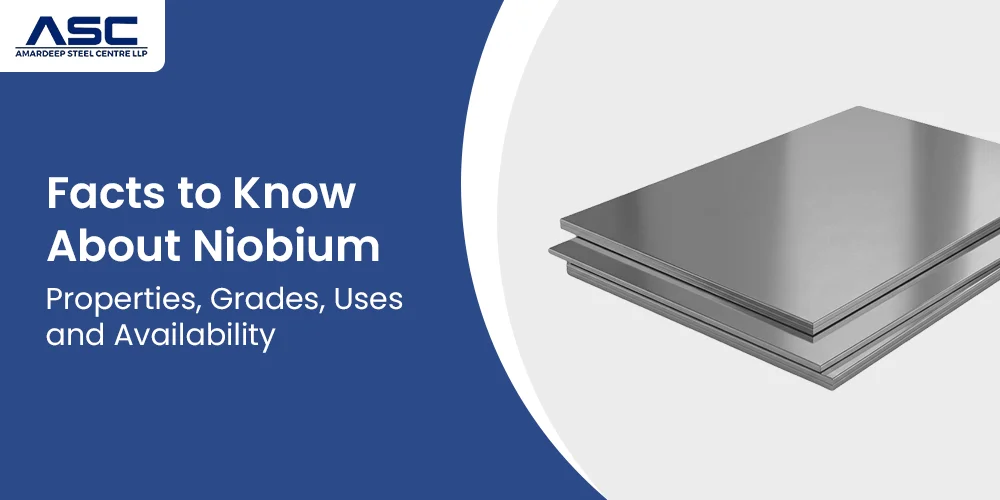
Niobium (Nb) is element 41, a soft, grey, ductile refractory metal that almost nobody outside the metals trade can name, yet roughly 80% of it ends up inside the high strength steel used for pipelines, bridges, car bodies and railway track. Add as little as 0.02% niobium to steel and you get a measurable jump in yield strength and toughness without extra weight. Below the alloying story sits a second one: niobium titanium and niobium tin wire make the superconducting magnets inside every MRI scanner and inside the Large Hadron Collider.
This guide covers the physical and chemical facts, how niobium is mined and refined, the commercial grades and alloys you can actually buy, where it is used, how it compares with tantalum, and what governs niobium prices. Amardeep Steel Centre stocks niobium sheet, foil, wire, tube, pipe, ingot and sputtering targets.
On this page
- Physical and chemical properties
- Discovery and the columbium name
- Mining, extraction and refining
- Commercial grades and alloys
- Key niobium compounds
- Industrial applications
- Niobium vs tantalum vs titanium
- Fabrication and welding notes
- Supply, reserves and price drivers
- Product forms available
- Frequently asked questions
Physical and chemical properties of niobium
Niobium sits in group 5 of the periodic table, directly above tantalum and beside zirconium and molybdenum. It is one of the five refractory metals, along with tantalum, tungsten, molybdenum and rhenium, all of which resist heat and wear far beyond ordinary steel. Freshly machined niobium is bright silver grey. Exposed to air it grows a thin oxide film that turns blue, green or yellow depending on thickness, which is exactly the effect jewellers exploit when they anodise it.
| Chemical symbol | Nb (formerly Cb, columbium) |
|---|---|
| Atomic number | 41 |
| Standard atomic weight | 92.90638 g/mol |
| Element category | Transition metal (refractory metal) |
| Density | 8.57 g/cm³ (0.31 lb/in³) |
| Crystal structure | Body centred cubic (BCC) |
| Melting point | 2477 °C / 4491 °F / 2750 K |
| Boiling point | 4744 °C / 8571 °F / 5017 K |
| Electrical resistivity (0 °C) | 152 nΩ·m |
| Thermal conductivity (300 K) | 53.7 W/(m·K) |
| Thermal expansion | 7.3 µm/(m·K) |
| Superconducting transition | 9.2 K, the highest of any elemental metal |
| Common valences | +2, +3, +4, +5 (+5 most stable) |
| Natural isotope | Nb-93 (100% abundance) |
| Crustal abundance | approx. 8 ppm |
Mechanical behaviour
Annealed commercial purity niobium typically shows around 200 to 275 MPa tensile strength, 105 to 170 MPa yield strength and 30 to 40% elongation, with a hardness near 80 HV. It is genuinely soft, comparable to pure titanium, and cold works readily into foil, deep drawn cups and fine wire without intermediate cracking. That combination of low strength but exceptional formability, corrosion resistance and a very high melting point is what makes niobium a lining and cladding material rather than a structural one.
Corrosion resistance
The Nb₂O₅ passive film resists most mineral acids at room temperature, including hydrochloric, nitric, sulphuric and phosphoric, plus many organic acids and liquid metals. It is not resistant to hydrofluoric acid, hot concentrated alkalis, or fluoride bearing media, and it absorbs hydrogen, oxygen and nitrogen rapidly above roughly 200 to 400 °C, which is why hot work and welding must be done under vacuum or inert gas. Tantalum outperforms it in aggressive chemical service, so niobium is chosen when tantalum cost cannot be justified.
Discovery, and why Americans said columbium for a century
In 1734 the Connecticut governor John Winthrop the Younger sent a mineral sample from Massachusetts to the British Museum, where it sat unexamined for decades. In 1801 the English chemist Charles Hatchett analysed it, found an unknown element and named it columbium after Columbia, the poetic name for America. Eight years later William Hyde Wollaston compared columbite with tantalite and concluded, wrongly but understandably, that columbium and tantalum were the same element.
The confusion lasted until 1844, when Heinrich Rose separated two distinct acids from columbite and renamed the element niobium after Niobe, daughter of Tantalus, a neat mythological nod to how closely the two metals travel together. Jean Charles Galissard de Marignac isolated the metal in 1864 by reducing the chloride in hydrogen. IUPAC settled the naming dispute in 1949 and 1950, adopting niobium in deference to European usage while accepting tungsten over wolfram in deference to American usage. Many metallurgists, mills and US specifications still write columbium or Cb. If you see Cb on a mill certificate, it means niobium.
Where niobium comes from and how it is refined
Niobium never occurs as a free metal. It is won from pyrochlore ((Na,Ca)₂Nb₂O₆(OH,F)), the dominant commercial ore, and from columbite tantalite (coltan), euxenite and loparite. Pyrochlore deposits sit in carbonatite intrusions, which is why the supply map is so concentrated.
The supply map
- Brazil supplies roughly 90% of world output. The Araxá deposit in Minas Gerais is the largest working mine, with reserves in excess of 460 million tonnes averaging around 2.5% Nb₂O₅. Catalão in Goiás is the second Brazilian source.
- Canada is the main producer outside Brazil. The Niobec mine in Quebec, hosted in the Saint Honoré carbonatite complex, is the world's principal underground niobium mine.
- Smaller or intermittent output comes from Nigeria, Rwanda, DR Congo, Russia and Australia.
- There has been no significant US mine production since 1959. The US Department of the Interior listed niobium among its 35 critical minerals in 2018 and it has remained on the critical minerals list since.
- Global production runs above 50,000 tonnes of contained niobium oxide per year. Known reserves are widely estimated to cover several centuries of demand at current rates, so scarcity is not the constraint. Geographic concentration is.
From ore to metal, step by step
- Concentration. Crushed ore is upgraded by gravity separation, magnetic separation and froth flotation.
- Digestion. The concentrate is dissolved in hydrofluoric acid, often with sulphuric acid.
- Separation. Liquid liquid solvent extraction splits niobium from tantalum. This is the hardest step, because their chemistry is nearly identical.
- Precipitation and calcining. Ammonia precipitates niobium hydroxide, which is calcined to niobium pentoxide (Nb₂O₅).
- Reduction. Aluminothermic reduction of Nb₂O₅ with aluminium powder yields metal. For the steel industry, Nb₂O₅ is instead reduced with iron oxide to make ferroniobium (typically 63 to 67% Nb), which is the form in which most niobium is actually consumed.
- Purification. Electron beam (EB) melting under high vacuum removes gases and volatile impurities, producing ingot. Repeated EB passes give RRR 300 superconductor grade metal.
- Mill processing. Ingot is forged, rolled and drawn into plate, sheet, foil, strip, rod, wire and tube.
What RRR means. RRR is the Residual Resistivity Ratio, or resistivity at room temperature divided by resistivity just above the superconducting transition. Higher RRR means fewer interstitial impurities and better thermal conduction at cryogenic temperature. RRR 300 niobium is the specification for superconducting RF cavities in particle accelerators. Commercial grade material is typically RRR 40 or below.
Commercial grades and niobium alloys
Pure niobium grades
| Grade | UNS | Typical purity | Typical use |
|---|---|---|---|
| Commercial / Type 1 | R04200 | 99.8% Nb min | Chemical process linings, anodes, lighting, jewellery |
| Reactor grade | R04210 | 99.9% Nb, controlled Ta | Nuclear components, cladding, control rods |
| Superconductor grade | n/a | RRR 300, very low O, N, H, C | SRF cavities, accelerators, colliders |
Niobium alloys
| Alloy | Composition | Why it is used |
|---|---|---|
| Nb-1Zr | Nb + 1% Zr | Higher strength and creep resistance than pure Nb. Sodium vapour lamp bodies, nuclear service |
| Nb-47Ti | Nb + 47% Ti | The workhorse superconductor wire for MRI, NMR and research magnets |
| Nb-50Ti / Nb-55Ti | Nb + 50 to 55% Ti | Superconducting and structural variants |
| C-103 (Nb-10Hf-1Ti) | Nb + 10% Hf + 1% Ti | Rocket nozzles, thrusters, high temperature aerospace hardware |
| Nb₃Sn (intermetallic) | Niobium tin | Higher field strength than Nb-Ti. High field magnets, fusion, LHC upgrades |
| Ferroniobium | 63 to 67% Nb, balance Fe | The alloying addition for HSLA steel, the largest single use of niobium |
| Ta-Nb alloys | Variable | Chemical plant where tantalum performance is needed at lower cost |
Key niobium compounds
Niobium pentoxide (Nb₂O₅) is the intermediate for all metal production, and is also used in high refractive index optical glass, camera lenses and optical coatings. Supplied in ceramic, optical and crystal grades.
Niobium carbide (NbC) is extremely hard with a high melting point. It acts as a grain refiner in HSLA steel and as a component of cemented carbide cutting tools.
Niobium nitride (NbN) superconducts below about 16 K and is used in infrared detectors, single photon detectors and thin film devices.
Lithium niobate (LiNbO₃) is piezoelectric and electro optic, forming the backbone of optical modulators, SAW filters in mobile phones and telecom waveguides.
Where niobium is actually used
High strength low alloy (HSLA) steel, about 80% of demand
This is the volume application, and it is the reason niobium matters economically. Additions of roughly 0.02 to 0.10% niobium, delivered as ferroniobium, form fine NbC and Nb(C,N) precipitates that pin austenite grain boundaries during hot rolling. The result is a finer grain, higher yield strength, better toughness at low temperature and improved weldability, all without added weight. It shows up in:
- Automotive body in white and truck chassis, where weight reduction drives fuel economy
- Bridges, offshore structures, pressure vessels and building frames
- Railway track and rolling stock
- Stabilised stainless grades such as 347 and 347H, where niobium ties up carbon and prevents intergranular corrosion after welding
API 5L line pipe grades X60 through X80 for oil and gas transmission. See our API 5L pipe range
Superalloys and aerospace
Nickel, cobalt and iron based superalloys rely on niobium for high temperature strength. Inconel 718, one of the most used aerospace alloys in existence, contains roughly 5% niobium, which forms the strengthening gamma double prime phase. Applications include jet engine turbine discs and blades, rocket subassemblies, turbocharger wheels, land based gas turbines and combustion hardware. See our Inconel 718 and Inconel product ranges. Nb-10Hf-1Ti (C-103) is used for rocket nozzle extensions that run red hot in vacuum.
Superconducting magnets
Niobium titanium wire is the reason MRI is a routine hospital service. It superconducts below about 9 to 10 K, carries enormous current density with zero resistance, and can be drawn into fine multifilament wire embedded in copper. Nb₃Sn goes further, supporting much higher magnetic fields at the cost of brittleness and a difficult reaction heat treatment. Together they build:
- MRI and NMR spectroscopy magnets
- Particle accelerators and colliders, including the Large Hadron Collider
- Fusion research magnets, including ITER
- Research magnets reaching 30 tesla and above. For scale, the Earth's surface field is only 30 to 60 microtesla
Chemical process and nuclear
Niobium linings, heat exchanger tubes, thermowells and anodes serve acid duties where stainless steel fails and tantalum is uneconomic. In nuclear plant, the low thermal neutron absorption cross section, high melting point and corrosion resistance suit niobium to control rod and cladding roles. Zr-2.5Nb is a standard pressure tube alloy in CANDU reactors.
Electronics, optics and everything else
- Niobium electrolytic capacitors, a partial substitute for tantalum capacitors
- Sputtering targets for thin film coating, in flat and tubular form. See niobium targets
- LCD backlighting and sodium vapour lamp bodies
- Optical coatings and high index camera lens glass
- Thin film solar cells and lithium niobate waveguides
- Crucibles for synthetic diamond manufacture
- Body jewellery and implants. Niobium is hypoallergenic, nickel free, biocompatible, and anodises to a full spectrum of colours with no dyes or coatings
- Commemorative bi metallic coins, which use anodised niobium cores for their colour
Niobium vs tantalum vs titanium, how to choose
| Property | Niobium | Tantalum | Titanium (Gr 2) |
|---|---|---|---|
| Density (g/cm³) | 8.57 | 16.6 | 4.51 |
| Melting point (°C) | 2477 | 3017 | 1668 |
| Corrosion resistance | Very good | Outstanding | Good, excellent in chlorides |
| Relative cost | Moderate | High | Low |
| Superconducting | Yes, 9.2 K | Yes, 4.5 K | Marginal |
| Typical role | Steel alloying, magnets, mid tier acid service | Severe acid service, capacitors, implants | Seawater, chloride and general corrosion service |
In short: specify titanium first for chlorides and seawater, niobium when you need acid resistance plus high temperature capability at roughly half the density and a fraction of the cost of tantalum, and tantalum when the medium is hot concentrated acid and failure is unacceptable. Compare our tantalum, titanium and tantalum niobium alloy ranges.
Fabrication, welding and handling notes
Forming. Excellent cold formability. Deep drawing, spinning, bending and stamping are all straightforward at room temperature, and annealing between passes is rarely needed.
Machining. Niobium is gummy and galls easily. Use sharp tools with generous positive rake, slow speeds, heavy feeds and flood coolant. Treat it like annealed copper rather than steel.
Welding. GTAW in a purged glovebox or with full trailing and backing shields of high purity argon, or electron beam welding in vacuum. Any oxygen, nitrogen or hydrogen pickup above roughly 200 to 400 °C causes rapid embrittlement. A discoloured weld is a rejected weld.
Annealing. Vacuum anneal, typically 1100 to 1300 °C, never in air.
Cleaning. Pickle in HF nitric mixtures under controlled conditions. Note that HF attacks niobium, so this is a controlled etch, not a general purpose cleaner.
Health and safety. Niobium metal and most of its compounds are not classed as hazardous in bulk form and there are no documented cases of serious occupational harm from working with it. Fine dust and fume can irritate eyes and skin, and powder is a fire risk, so use local extraction, eye protection and standard metal dust housekeeping. No known adverse environmental effects.
Supply security, reserves and what drives niobium prices
Niobium is not scarce, but its supply is unusually concentrated. One country accounts for around nine tenths of production and a single Brazilian producer for the majority of that. This is why niobium appears on the critical minerals lists of the United States, the European Union, Japan and India despite comfortable long term reserves.
The main price drivers are:
- Steel demand. Ferroniobium pricing tracks global HSLA and line pipe demand more than anything else
- Purity and grade. RRR 300 superconductor material can cost many multiples of commercial grade
- Product form. Foil, fine wire and seamless tube carry substantial conversion cost over ingot
- Freight, export policy and currency. Concentrated supply makes logistics and trade policy unusually influential
- Energy transition demand. Niobium in lithium ion anode materials, fusion magnets and grid equipment is a growing, if still small, pull on supply
Because niobium is not exchange traded like copper or nickel, there is no public spot price. Pricing is negotiated per specification, form and quantity, so request a current quotation with your grade, dimensions and tonnage.
Niobium product forms from Amardeep Steel Centre
| Form | Typical range | Product page |
|---|---|---|
| Sheet and plate | 0.5 to 25 mm thickness | Niobium sheet |
| Foil and strip | 0.025 to 0.5 mm | Niobium foil |
| Rod, bar and wire | 0.1 to 100 mm diameter | Niobium wire |
| Tube and pipe | Seamless and welded | Tube / Pipe |
| Ingot and billet | EB melted | Niobium ingot |
| Sputtering targets | Flat and tubular | Niobium targets |
| Alloys | Nb-1Zr, Nb-47Ti, Nb-50Ti, Nb-55Ti, C-103 | All niobium products |
Material is supplied with EN 10204 3.1 mill test certificates, full chemical and mechanical test reports, and third party inspection on request.
Frequently asked questions
Is niobium the same as columbium?
Yes. Columbium (Cb) was the original 1801 name and remained standard in the United States until IUPAC adopted niobium in 1949 and 1950. American steel and aerospace specifications still use Cb, and the two terms are interchangeable.
Is niobium magnetic?
Niobium is paramagnetic, meaning it is very weakly attracted to a magnetic field and not magnetic in any practical sense. Below 9.2 K it becomes superconducting and expels magnetic fields entirely.
Does niobium rust?
No. It forms a thin, tenacious, self healing oxide film that protects the metal against most acids and the atmosphere indefinitely. The film thickens on heating, producing the blue, purple, green and gold colours used in jewellery.
Why is niobium added to steel?
Even 0.02 to 0.10% forms niobium carbides and carbonitrides that refine grain size during rolling. That raises yield strength and low temperature toughness while improving weldability, letting designers use thinner, lighter sections for the same load.
What is the difference between niobium and ferroniobium?
Ferroniobium is a niobium iron master alloy, typically 63 to 67% Nb, made specifically for adding niobium to molten steel. Pure niobium metal is a separate product route used for mill products, superconductors and chemical equipment.
Is niobium safe to wear against the skin?
Yes. It is nickel free, hypoallergenic and biocompatible, which is why it is widely used for body jewellery and some implants.
Is niobium expensive?
Ferroniobium is inexpensive relative to its effect on steel, which is why it dominates the market. Pure mill products cost considerably more, and RRR 300 superconductor grade is at the top of the range. There is no public spot price, so quotations are issued per specification.
Can niobium replace tantalum?
Partially. Niobium substitutes for tantalum in some capacitor and chemical equipment applications at roughly half the density and lower cost, but tantalum remains superior in hot concentrated acids and in high reliability capacitors.
Related reading
- What is niobium? Properties, uses and industrial applications
- A brief guide to niobium bars and sheets
- How is tantalum mined?
- Inconel properties, composition and grades
- What is alloy steel? Characteristics and applications
Stainless Steel Metal Fabrication — Processes, Grades, Welding & Surface Finishing Guide
Stainless Steel Metal Fabrication is a very specialised process and is very different from carbon steel, as it has a very different metallurgical behaviour.