Seamless vs Welded Pipe – Which is Better for Industrial Applications?
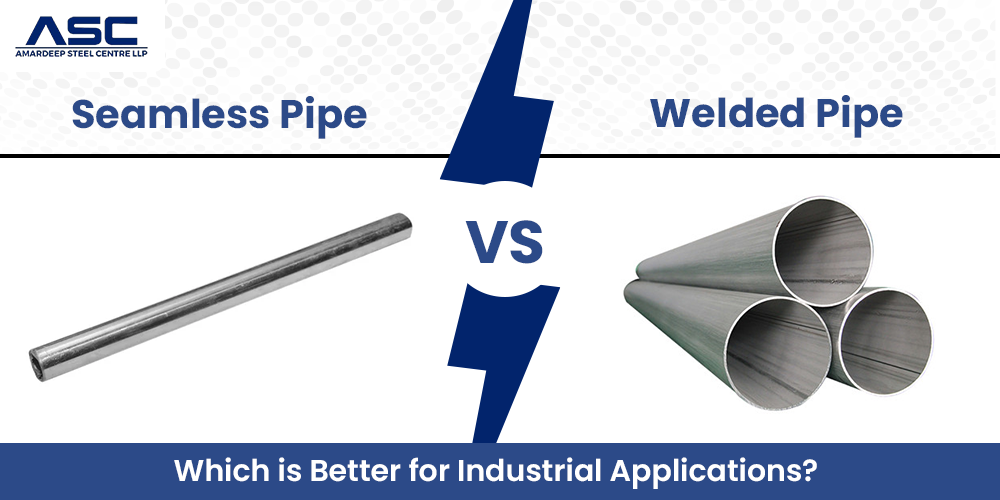
The incorrect type of pipe in a high-pressure or high temperature system can have a premature life cycle, leakage routes, and fatigue of the weld line when the cyclic loads are more than 150 bar or the temperature is higher than 400 °C. The decision between seamless and welded pipe is thus influenced by the pressure grades, operating temperature, corrosive substances and adherence to standards like ASTM A53, ASTM A179 and ASTM A214 standards. To know what is meant by seamless and welded pipe, we have to analyse the manufacturing process of both seamless pipes and welded pipes, their mechanical properties, maximum stresses, and the effects which these properties have on the long-term reliability of demanding industrial piping systems.
How Seamless and Welded Pipes Are Manufactured
The process of manufacturing has a direct influence on the performance of a seamless pipe or welded pipe under pressure, temperature and cyclic loading. A seamless pipe is created by either piercing or extruding a heated piece of steel through a mandrel, making it a hollow tube, with no longitudinal weld seam. Since the material moves continuously to the location of forming, the pipe wall attains a continuous grain structure, which enhances resistance to internal pressure and fatigue stress.
The welded pipe is manufactured by rolling the steel plate or coil and turning it into a cylindrical form, and then sealing the edges with the help of welding, such as electric resistance welding (ERW), electric fusion welding (EFW), or submerged arc welding (SAW). This form of welded pipes comes in large sizes that are mostly used in places where cost sensitivity is very important. It's commonly used by many industries in large-diameter seamless pipe structures or systems.
Key Differences: Seamless vs Welded Pipe Properties
To know the difference between seamless and welded pipe, it is necessary to consider the mechanical and economic factors that shape the specification of pipes in industrial systems. The most significant selection criteria are pressure capacity, cyclic loads under fatigue and economic viability at a larger diameter.
Pressure Rating and Uniformity of the Wall
A continuous pipe usually offers an approximate 20 percent greater bursting pressure than a similar ERW welded pipe of the same wall-thickness and diameter. This benefit is due to the fact that there is no weld seam and therefore, the wall of the pipes has a uniform grain structure and has an even thickness all the way around the circumference. The localized thermal effects in the seam area of a welded pipe during the welding process produce a metallurgical zone that can slightly lower pressure capacity relative to a completely homogeneous wall of a pipe.
Fatigue and Cyclic Load Resistance
The weld seam in an ERW welded pipe may concentrate stress when under cyclic pressure, vibration or thermal expansion. With long operation cycles, repeated stress cycles might trigger micro-cracks along the seam. Since longitudinal weld of any seamless pipe is nonexistent, it spreads out stresses more evenly and is often required to be used in fatigue-sensitive service such as piping system design under any ASME Boiler Code requirements and service at a pressure greater than 100 bar.
Diameter cost and Availability
The choice of pipes highly depends on cost and manufacturability. The cost of welded pipe would typically be 20-30% less than that of seamless pipe of similar size since it is made using plate or coil instead of solid billet. Besides this, over 24 inches OD the pipe diameter, seamless production becomes technically and economically impractical. To these large diameters, the standard production path and in reality the only viable path is SAW welded pipe or EFW welded pipe.
ASTM Standards for Seamless and Welded Tubes: A53, A179, A214
The selection of the right types of steel pipes for industries requires understanding the proper chemical composition, manufacturing process, and service limits. The ASTM standards provide clear guidance for carbon steel pipes, predicting the performance under pressure, temperature, and other properties. The most commonly used grades of steel pipes are A53, A179, and A214, which cover a range of seamless and welded applications in process, structural, and heat exchanger systems.
ASTM A53 Tube
ASTM A53 tubes are made up of Grade A carbon steel, which has a maximum content of 0.25% Carbon, and Grade B, which has a maximum content of 0.30% Carbon. They come in a different form, like seamless (Type S) and welded ERW (Type E) to offer flexibility in terms of pressure and structural applications. These tubes have service ratings up to 370 °C (700°F) in pressure service, and Grade B has a higher tensile strength, should higher requirements be needed. ASTM A53 finds its main application in the general industrial piping such as black and hot-dipped galvanized piping, where mechanical and pressure performance is very important.
ASTM A179 Tube
ASTM A179 tubes are made of low-carbon seamless steel, 0.06 -0.18 C and 0.27 -0.63 Mn, with 0.06 -0.18 C being the predominant alloy, and are made in seamless form only, by cold drawing to achieve uniform wall thickness. The temperature limit of these tubes is up to 400 °C, and thus, they can be used in heat exchangers and condensers where high quality of surfaces is required and high rate of heat transfer. A179 tubes have a minimum tensile strength that is 325 Mpa and this guarantees good operation at thermal and pressure cycles.
ASTM A214 Tube
ASTM A214 tubes are carbon steel ERW welded pipes with a maximum carbon content of 0.18%, designed as a welded (ERW) only alternative to seamless heat exchanger tubing. These tubes are rated for service up to 370°C in heat exchanger applications and offer a lower-cost solution where seam-free construction is not strictly required. The weld seam must be inspected to ensure integrity, as it can be a potential stress concentration point. A214 tubes are commonly used in industrial condensers and heat exchangers where A179 seamless is not mandatory.
Explore our full range of carbon steel tubes by ASTM standard: ASTM A53 Tube | ASTM A179 Tube | ASTM A214 Tube
Industrial Applications by Pipe Type
To choose the best pipes according to your requirements is a difficult task. For that you need to know different types, its standard and in which types suit your industry. So to know all those things refer to the table given below.
|
Pipe / Tube Type & ASTM Standard |
Key Industries |
Typical Equipment / Service |
|
Seamless Pipe (ASTM A53 Type S) |
Oil & gas, petrochemical, power generation |
High-pressure hydraulic lines, boiler headers, reactor outlet piping |
|
Welded Pipe — ERW (ASTM A53 Type E) |
Construction, water distribution, low-pressure process |
Structural columns, fire suppression systems, general process lines below 370°C |
|
Seamless Tube (ASTM A179) |
Heat exchange, condensers, refineries |
Heat exchanger tubes, condenser bundles, cooler tubes in chemical plants |
|
Welded Tube (ASTM A214) |
Heat exchange, low-pressure service |
Low-pressure condenser tubes, economizer tubes, non-critical heat transfer service |
How to Choose Between Seamless and Welded Pipe
To choose the correct type of pipe, one will have to consider the service conditions, mechanical requirements, and financial limitations. The following table gives a very brief and real-world guide on seamless pipe vs welded pipe choices upon operating pressure, temperature, cyclic loading, and diameter, with relevant ASTM standards.
|
Service Condition |
Recommended Pipe Type |
Applicable ASTM Standard |
|
High pressure (>100 bar) or cyclic/fatigue-critical service |
Seamless pipe – uniform wall, superior fatigue resistance |
ASTM A53 Type S, ASTM A179 |
|
Moderate pressure (≤100 bar), large diameter (>24" OD), cost-sensitive |
Welded pipe (ERW/SAW/EFW) – economical for large sizes |
ASTM A53 Type E, ASTM A214 |
|
Heat exchanger or condenser service, seamless preferred for efficiency |
Cold-drawn seamless tube – high surface quality, uniform wall |
ASTM A179 |
|
Heat exchanger/condenser where seamless not required, welded acceptable |
ERW welded tube – cost-effective, inspected weld seam |
ASTM A214 |
|
General structural or pressure service at ambient-to-moderate temperature |
Either seamless or welded depending on budget |
ASTM A53 Type S or E |
Conclusion: Matching Pipe Type to Application Requirements
In high-pressure service over 100 bar, fatigue-critical systems, and ASME Boiler Code pressure type, seamless pipe to ASTM A53 Type S gives the necessary strength and uniformity. Amardeep Steel provides high-quality seamless and welded pipes in the case where the integrity of the weld seam may be confirmed and pressures are moderate, ERW welded pipe to Type E ASTM A53 may provide the answer to a cost-effective solution in structural or general industrial use. ASTM A179 seamless tube is employed in the heat exchanger and condenser service in situations where seamless construction is required, and ASTM A214 ERW tube is used where a seamless construction is not as important but a seam in the construction is acceptable. The pressure, fatigue, temperature, and code requirements are used to select, and the diameter and budget determine the type of exact pipe used.
Frequently Asked Questions About Alloy vs Aluminum
What is the main difference between seamless and welded pipe?
Seamless pipe has no weld seam and uniform mechanical properties, while welded pipe is formed from rolled plate or coil with a longitudinal weld. Seamless handles higher pressure and fatigue; welded is cheaper for large diameters.
Which is stronger, seamless or welded pipe?
Seamless pipe is stronger under high pressure and cyclic loading, carrying up to 20% higher burst pressure than ERW welded pipe. Welded pipe can approach seamless performance if fully inspected and heat-treated.
What is ASTM A53 and does it cover seamless and welded pipe?
ASTM A53 covers both seamless (Type S) and welded ERW (Type E) carbon steel pipes, Grades A and B, rated up to 370°C for pressure service. Grade B has higher strength.
What is the difference between ASTM A179 and ASTM A214 tubes?
A179 is seamless cold-drawn for heat exchangers, offering uniform wall thickness; A214 is ERW welded, lower-cost alternative where seam-free construction isn’t required.
When should seamless pipe be specified over welded pipe?
Use seamless for high-pressure (>100 bar), fatigue-critical, high-temperature (>315°C), or ASME code–governed systems. Welded is fine for structural, low-pressure, and cost-sensitive applications.