Forged vs Buttweld Pipe Fittings – Key Differences and Selection Guide
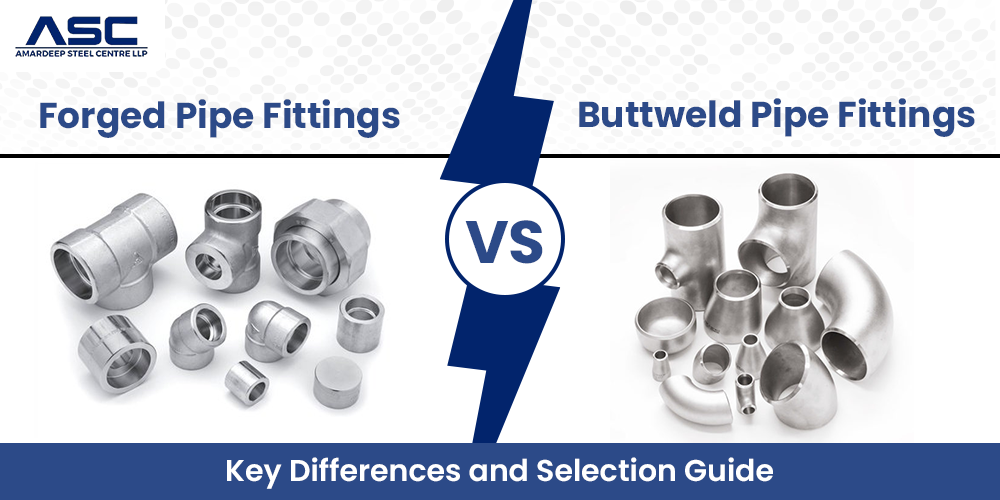
Specifying forged fittings where buttweld fittings are required or vice versa leads to pressure rating mismatches, failed inspections, and costly rework on high-pressure piping systems. The ASME B16.11 produced forged fittings are generally used in small bore piping networks to NPS 4 with pressure rating of Class 3000, 6000 and 9000, normally installed as socket weld fittings or threaded fittings. On the other hand, buttweld fittings designed to ASME B16.9 are used where the diameter of the pipes are greater and full-penetration joints are necessary to be used in the welded pipeline system. The piping design requires proper selection based on the size of the pipes, the pressure category and the mode of installation.
What Are Forged and Buttweld Pipe Fittings?
Forged fittings are made by pressing high-force billets of solid steel into dense components that are defined by the ASME B16.11 and provided in pressure classes of 2000, 3000, and 6000. Such fittings are typically designed to fit piping systems with small bore of up to NPS 2-4 inches, either threaded or a socket weld fitting. Buttweld fittings are ASME B16.9-controlled manufactured either out of seamless or welded pipe and have elbows, reducers, tees, and caps, which are designed for buttweld fittings.Forged fittings prevail in small bore lines whereas buttwelds are used as the standard selection in bigger process and utility piping systems where larger pipelines need welded joints.
How They Are Manufactured: Forging vs Forming
Forged Fitting Manufacturing
Forged fittings are made by heating solid steel billets and clamping them in closed-die forging presses or open-die forging presses, in which the pressure is regulated to induce the billet to the necessary shape. The direction of the flow is directed by the shape of the fitting instead of being random, as with cut or machined components. This directional grain structure enhances cyclic pressure and mechanical stress structural integrity. The process produces solid components that have a high density without any voids with close dimensional limits specified in ASME B16.11. Common examples of forged material grades are ASTM A105 in the case of carbon steel service and ASTM A182 F304/F316 in the case of stainless steel installations in corrosive or high-temperature process systems.
Buttweld Fitting Manufacturing
Buttweld fittings are produced by bending or pressing or extrusion of pieces of seamless or welded pipe into elbows, tees, reducers, and caps in a hot or cold forming process. Components are formed and then usually subjected to heat treatment to relieve the stresses of forming and eliminate the non-uniform metallurgical characteristics before being subjected to final machining and inspection. Dimensional requirements and tolerances are in compliance with the standard of ASME B16.9, which deals with welded pipeline fittings. Popular grades of material are ASTM A403 WP304/WP316, used with stainless steel buttweld fittings, and ASTM A234, used with carbon steel service, both of which are commonly used in larger-diameter process piping systems.
Types of Forged Fittings: Socket Weld and Threaded
The forged fittings are mainly manufactured in socket weld and threaded types and the detailed information of these two are given below.
Socket Weld Fittings
Socket weld fittings are used to connect to piping by inserting the end of the pipe into a hole in the socket and welding around the outer joint with the fillet. They are the fittings that are compliant with ASME B16.11 pressure classes such as Class 3000, Class 6000, and Class 9000, and are normally used in piping of small bore sizes such as NPS 1/2 to NPS 2 inches in the event that a high-pressure rating is needed without butt welding full penetration. Prior to welding, a gap of 1.6 mm should be kept between the end of the pipe and socket shoulder to allow expansion of the thermal during service. ASTM A182 F304 and F316 are some of the common stainless grades that are used in chemical processes, pharmaceutical systems and high-purity piping installations. In these pressure classes, engineers tend to use Stainless Steel Forged Fittings.
Threaded Fittings
Threaded Fittings are joined without welding with the geometry of NPT (National Pipe Thread). These are manufactured under the ASME B16.11 in Class 2000, 3000, and 6000 ratings and are usually used in instrument lines, small utility piping, and in connections that are accessible and need regular removal. Use of PTFE or recommended thread tape is required to seal the thread so that the thread is leak-tight. Threaded designs tend not to be used in high temperature cyclic service or corrosive process streams, where stress concentration at the thread root would enhance the potential of fatigue or stress corrosion cracking.
Types of Buttweld Fittings and Their Configurations
The butt weld pipe fittings are manufactured in various types to maintain flow direction, to join branches or alter pipe diameter in a welded pipeline system. These are ASME B16.9 fittings that are most often ordered to fit pipelines larger than NPS 2 inches, in which full-penetration weld joints must be used. Elbows come in 45° and 90° radius, and are fabricated in long (LR 1.5D) or short (SR 1D) radius depending on the space available. Reducers become either concentric (with the piping centerline aligned) or eccentric (with the pipe bottom in horizontal lines). Tees deal with connections of branches and the caps seal the end of any pipeline. In the case of corrosion resistant installations, the engineers often make their choice on Stainless Steel Buttweld Fittings.
Forged vs Buttweld Fittings: Key Differences
The biggest difference in forged fittings and buttweld fittings when it comes to operations is the internal flow route developed due to the connection method. The buttweld joints are created with a bore of smooth continuous flow with minimal turbulence and no crevices to trap process fluids. This feature is significant in stainless steel piping systems that receive chloride-containing or corrosive media and in which stagnant areas may promote localized corrosion. In many forged fittings, socket weld connections place a small crevice at the interface between the pipes and the socket. Due to this reason, some classes of corrosive service piping will require buttweld fittings even where the pressure rating of a socket weld fitting otherwise would be sufficient.
|
Property |
Forged Fittings |
Buttweld Fittings |
|---|---|---|
|
Manufacturing |
Closed-die or open-die forging from solid steel billet |
Hot or cold forming from seamless or welded pipe |
|
Governing Standard |
ASME B16.11 |
ASME B16.9 |
|
Pipe Size Range |
NPS 1/2" – 4" (Commonly for small-bore piping) |
NPS 1/2" and above (Dominant above NPS 2") |
|
Pressure Class |
Class 2000 / 3000 / 6000 / 9000 |
Determined by pipe schedule and material grade |
|
Connection Method |
Socket weld (fillet weld) or threaded (NPT) |
Full-penetration butt weld |
|
Flow Path |
Creates a small internal crevice at the pipe/socket interface |
Continuous internal bore with no crevice |
|
Relative Cost |
Higher per unit (billet forging & small-bore) |
Lower per unit on larger diameters |
Browse the full range of stainless steel pipe fittings by type:
Stainless Steel Forged Fittings | Stainless Steel Buttweld Fittings | SS 304/316 Fittings
How to Select the Right Fitting for Your Piping System
The pipe size is the most important thing in the selection of the right fitting. Socket weld fittings are popular in small-bore high-pressure systems, buttweld fittings gain popularity with increasing pipe diameter. The eventual fitting configuration in the applicable ASME standard is dictated by the service conditions at that time and the corrosive media, cyclic loading, or access to maintenance. Some of the common sizes and conditions of the fittings are listed below to choose the right fitting according to your requirements.
|
Pipe Size |
Service Condition |
Recommended Type |
Standard |
|---|---|---|---|
|
NPS ½ – 2” |
High-pressure, non-corrosive, permanent joint |
Socket Weld (Forged) |
ASME B16.11 Class 3000/6000 |
|
NPS ½ – 2” |
Low-pressure, maintenance access required |
Threaded (Forged) |
ASME B16.11 Class 2000/3000 |
|
NPS ½ – 2” |
Corrosive fluid / chloride service |
Buttweld (no crevice) |
ASME B16.9 |
|
NPS 2” and above |
All process piping, high pressure/temp |
Buttweld |
ASME B16.9 |
|
NPS 2” and above |
Stainless steel corrosive service |
Buttweld SS 304/316 |
ASME B16.9 + ASTM A403 |
|
Any size |
Cyclic service / fatigue-critical |
Buttweld (full penetration preferred) |
ASME B16.9 |
Conclusion: Matching Fitting Type to Application
In small-bore piping up to NPS 2 inches, the socket weld forged fittings produced to ASME B16.11 are typical high-pressure systems where compact connections are necessary and a high-pressure classification such as Class 3000 or 6000 is needed. NPS 2 inches or larger Pipe size or when smooth crevice-free internal bore is required buttweld fittings constructed to ASME B16.9 are a practical specification. This is particularly applicable to the stainless steel pipelines that carry corrosive or chloride containing fluids, and internal crevices in such pipelines may enhance localized corrosion. For projects requiring certified materials and standards-compliant fittings, Amardeep Steel is a trusted brand that manufactures and supplies a complete range of forged and buttweld pipe fittings manufactured to ASTM and ASME specifications.
Frequently Asked Questions
1. What is the difference between forged fittings and buttweld fittings?
The common difference between forged fitting and buttweld fitting is that they are made from different metals. Forged fittings are made by forging solid metal and usually connect with socket weld or threaded ends (as per ASME B16.11).Buttweld fittings are formed from pipe or plate and are butt-welded directly to pipes (as per ASME B16.9).Forged fittings are typically used for smaller pipe sizes, while buttweld fittings are used for larger piping systems.
2. When should I use socket weld fittings instead of buttweld fittings?
Use socket weld fittings for small-bore piping (≤NPS 2”) operating at high pressure where a fillet weld joint is acceptable. Use buttweld fittings when the piping system requires a smooth internal bore, full-penetration weld, or crevice-free flow path, especially in corrosive service.
3. What ASME standard applies to forged fittings?
The ASME B16.11 governs forged socket weld and threaded fittings, defining their dimensions, tolerances, and pressure classes such as 2000#, 3000#, and 6000# for threaded fittings and 3000#, 6000#, and 9000# for socket weld fittings.
4. What are buttweld fittings made of?
Buttweld fittings are commonly manufactured from carbon steel (ASTM A234), stainless steel 304/316 (ASTM A403 WP304/WP316), and various alloy steel grades. The material grade is generally selected to match the specification of the connected pipe.
5. Can forged fittings be used in stainless steel piping systems?
Yes, stainless steel forged fittings are produced to ASTM A182 in grades such as F304, F304L, F316, and F316L, following ASME B16.11 standards. In systems handling corrosive or chloride-containing fluids, buttweld fittings are often preferred because socket weld connections create a small crevice where corrosion can initiate.