Stainless Steel Pipe Fittings for High Temperature Industrial Applications
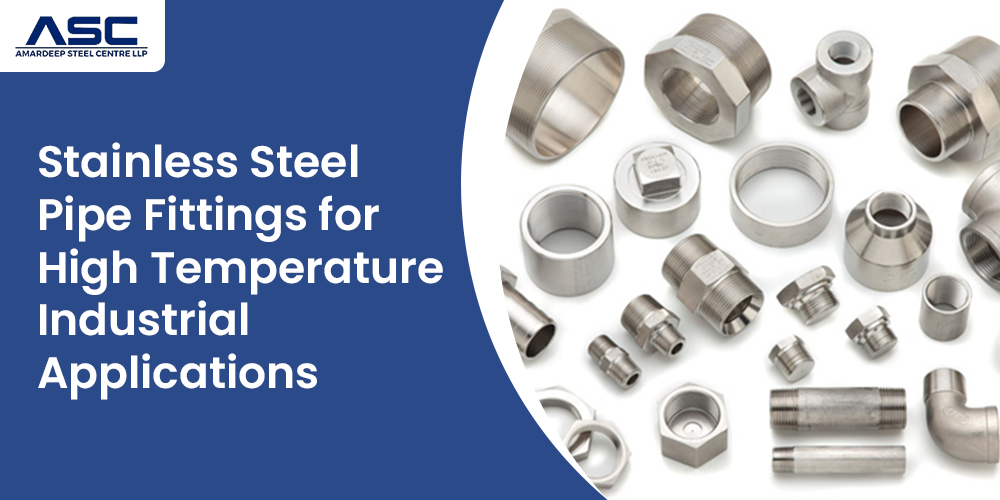
Pipe fittings that work under temperatures upto 500 °C do not last long when using standard SS 304 or SS 316 grade, because carbide precipitation at grain boundaries can result in intergranular corrosions and reduce the mechanical strength of the material when subjected to continuous thermal loads. The use of stabilized or high-alloy stainless steel pipe fittings include SS 310/310S (ASTM A182 / A403), SS 321 (ASTM A182 F321), or SS 347H (ASTM A182 F347H) in industrial systems working in furnaces, heat exchangers, and thermal processing lines is therefore necessary. These industrial pipe fittings are designed to have oxidation resistance and structural integrity in temperatures ranging between 900-1100 °C with service conditions and grade composition based on the grade composition.
Why Standard Grades Fail in High Temperature Piping Systems
In unstabilized austenitic grades, chromium carbide precipitation starts at 425-860 °C and initiates sensitization and dire loss of intergranular corrosion resistance. In stainless steel pipe fittings (ASTM A403 WP304 / WP316) chromium is added at the grain boundary, leaving other areas to be chromium-depleted and susceptible to intergranular corrosion and decreased ductility. Service temperatures above 650 °C, with long-term exposure, may cause sigma phase embrittlement, which leads to a sudden decrease in toughness and crack resistance. On the other hand oxidation scaling increases at temperatures above 800 °C since these grades do not contain enough chromium-nickel. To this end, high temperature pipe fittings should be used to stabilize or high alloy grades like SS 321, SS 321H, SS 347H, or SS 310/310S in order to achieve structural stability.
What Makes a Stainless Steel Grade Suitable for High Temperature Service?
When choosing stainless steel pipe fittings in high-temperature piping, there are 3 characteristics on which the choice is based: oxidation resistance, creep strength, and sensitization resistance. The industrial systems running within the temperatures of 427-1100 °C subject the fittings to continuous heat, oxidation scaled, and structural stress. The grades employed in furnace piping and in the superheater lines should be strong and corrosion-resistant so that service cycles can be long. There are many grades like SS 310/310S (ASTM A182 / A403) and stabilised alloys SS 321H and SS 347H, aimed at working in these environments with increased chromium content, lower carbon levels, and stabilising elements.
Oxidation Resistance
The oxidation resistance is mainly dependent on the chromium content present in the material. Similar to SS 310 and SS0310S, which have 24-26% of chromium that forms a stable layer of oxide that shields the metal against the heat up to 1100 °C. Conversely, low-chromium grades like SS 304 (~ 18 % Cr) begin to scale at temperatures above 870 °C.
Creep Resistance
The creep resistance is a slow deformation process that happens when the material is under continuous stress or at high temperatures. There are many H-grade alloys like SS 321H and SS 347H that contain 0.04 - 0.10% carbon, which increases the creep strength and helps the piping system to operate smoothly above 550 °C temperature.
Stabilization Against Sensitization
Stabilized grades prevent chromium carbide formation on the metal boundaries. Many grades, such as SS 321/321H, use titanium, while other grades, such as SS 347/347H, use niobium as a stabilizer. These elements protect the steel from getting sensitized in the temperature range between 427- 816 °C.
High Temperature Stainless Steel Pipe Fitting Grades: Properties and Ratings
Stainless steel pipe fittings applicable in high-temperature systems in the industrial setting should be able to retain their oxidation resistance, creep strength, and structural stability through constant exposure to heat. The most commonly used grades in furnace piping, boilers, and chemical processing lines are 310, 310S, 321, 321H, and 347H, which range between 538 °C and 1100 °C. Their oxidation resistance, creep strength, and sensitization resistance depends on their chromium, nickel, carbon and stabilizing elements.
Stainless Steel 310 Fittings
A typical SS 310 stainless steel pipe fitting comprises chromium 25 %, nickel 20 %, with a maximum of 0.25 % carbon, which offers a great oxidation resistance in continuous use to 1100 °C. Due to such a high chromium-nickel content, they find a wide range of applications in furnace parts and high temperature process piping. These fittings are made to meet the standards of ASTM A403 WP310 (buttweld) and ASTM A182 F310 (forged), and are typically sold as Stainless Steel 310 Fittings to high temperature industrial piping systems.
Stainless Steel 310S Fittings
Stainless Steel 310S steel pipe fittings are made with 25 % chromium, nickel 20%, and with a maximum of 0.25% and up to 0.08% carbon. The low carbon level present in it minimizes the danger occurring while assembling it or welding together and also has an oxidation resistance up to 1000 °C. These fittings are commonly used in welded furnace piping and thermal processing lines, with most being produced to ASTM A403 WP310S and ASTM A182 F310S as Stainless Steel 310S Fittings.
Stainless Steel 321 Fittings
SS 321 stainless steel pipe fittings have approximately 18% chromium and 10% nickel and they are stabilized with titanium that inhibits sensitization in the 427-816 °C temperature range. The grade allows service to a maximum of 870 °C, thus it is applicable in boiler parts, exhaust mains, and chemical processing piping. Those are manufactured in compliance with ASTM A403 WP321 and ASTM A182 F321 standards and are mainly designed to be Stainless Steel 321 Fittings in welded high-temperature assemblies.
Stainless Steel 321H Fittings
This stainless steel 321H fitting, made with approximately 18 % chromium, 10 % nickel, and 0.04-0.10 % of carbon are used to make SS 321H fittings of stainless steel pipe, which are titanium-stabilized. The greater the carbon increases creep strength above 550 °C, the more it can depend on service to approximately 925 °C. Owing to this enhanced creep, they are typically ordered to superheater headers and high temperature steam pipe, to ASTM A403 WP321H and ASTM A182 F321H standards as Stainless Steel 321H Fittings.
Stainless Steel 347H Fittings
Stainless Steel 347H fitting is a type of stainless steel pipe fittings, composed of approximately 18 % chromium, 11 % nickel and 0.04 or 0.10 % carbon, stabilized with niobium (columbium) and tantalum. This stabilization enhances sensitization resistance and supplements creep strength up to 538 °C to service temperatures up to 925 °C. It finds application in petroleum refining units and high-temperature reactor piping, which is made to the requirements of ASTM A403 WP347H and ASTM A182 F347H as SS 347H Fittings.
Explore the full range of high temperature stainless steel pipe fittings by grade:
SS 310 Fittings | SS 310S Fittings | SS 321 Fittings | SS 321H Fittings | SS 347H Fittings
Industrial Applications by Grade
The stainless steel pipe fitting is manufactured in different grades according to different temperatures and industrial application and the detailed information of these grades are given below.
|
Grade |
Key Industries |
Typical Equipment / Service |
|
SS 310 Fittings |
Heat treatment, ceramics, furnace manufacturing |
Burner manifolds, radiant tubes, furnace piping above $1000^\circ\text{C}$ |
|
SS 310S Fittings |
Petrochemical, power generation, cement |
Welded high-temperature piping systems, thermal cycling service |
|
SS 321 Fittings |
Aerospace, chemical processing, boiler systems |
Exhaust manifolds, boiler pressure parts, moderate temp process piping |
|
SS 321H Fittings |
Power generation, refineries, ASME pressure vessels |
Superheater headers, high-temp steam lines, creep-critical components |
|
SS 347H Fittings |
Petroleum refining, nuclear, high-temp heat exchangers |
FCC units, polythionic acid service, boiler superheaters above $538^\circ\text{C}$ |
How to Select the Right Grade for Your High Temperature Application
Selection of the right grades according to your application temperature is a difficult process. So refer to the below table to find the best stainless steel pipe fitting according to your requirements.
|
Temp Range |
Service Condition |
Recommended Grade |
ASTM Standard |
|
Up to 870°C |
General high-temp, welded assembly, sensitization risk |
SS 321 |
A403 WP321 / A182 F321 |
|
550–925°C |
Creep-critical pressure components, ASME code service |
SS 321H |
A403 WP321H / A182 F321H |
|
538–925°C |
Petroleum refining, polythionic acid, strong oxidizing |
SS 347H |
A403 WP347H / A182 F347H |
|
Up to 1100°C |
Furnaces, welded HT piping, carburizing atmosphere |
SS 310S |
A403 WP310S / A182 F310S |
|
Up to 1100°C |
Non-welded components, max oxidation resistance |
SS 310 |
A403 WP310 / A182 F310 |
Conclusion: Matching SS Grade to Operating Temperature
For high-temperature piping up to 870°C where welded assemblies pass through the sensitization range, SS 321 pipe fittings are the standard specification. Amardeep Steel supplies these fittings for industrial applications where consistent material performance is required. Where creep strength above 550°C is required by ASME code, SS 321H and SS 347H are the correct grades, with 347H preferred in petroleum refining service due to niobium stabilization and polythionic acid resistance. For the most extreme temperatures up to 1100°C, SS 310S covers welded systems, and SS 310 covers non-welded components requiring maximum oxidation resistance. Operating temperature defines the grade family; service environment, welded or not, creep-loaded or not, determines which variant within that family.
Frequently Asked Questions
What are high-temperature pipe fittings made of?
The high-temperature pipe fittings are made from stabilized or high-alloy austenitic stainless steels such as SS 310/310S, SS 321/321H, and SS 347H. These grades resist heat, oxidation, and sensitization at elevated temperatures, while SS 304 and SS 316 are not suitable for sustained service above 425°C.
What is the difference between SS 321 and SS 347H for high temperature service?
SS 321 is stabilized with titanium, while SS 347H uses niobium (columbium). SS 347H offers better creep strength above 538°C and improved resistance in oxidizing and petroleum refining environments.
What temperature can SS 310S pipe fittings withstand?
The carbon steel boiler tube temperature limits depend on the grade, like ASTM A179 and ASTM A214, which are generally used up to about 370°C, while ASTM A192 and ASTM A210 Grade A1 can operate reliably up to around 450°C. For temperatures above 450°C, alloy steel grades are required because carbon steel begins to lose creep resistance.
What is ASTM A179 used for?
SS 310S pipe fittings can handle continuous temperatures up to 1000°C. Its low carbon content (max 0.08%) helps reduce sensitization in welded systems.
What does the ‘H’ designation mean in SS 321H and SS 347H?
The “H” grade indicates higher carbon content (0.04–0.10%), which improves creep strength above 550°C. These grades are commonly used in high-temperature pressure systems.
What ASTM standards apply to high-temperature stainless steel pipe fittings?
The ASTM standards high temperature is used in different fittings like ASTM A403 (WP310, WP310S, WP321, WP321H, WP347H) in buttweld fitting and ASTM A182 (F310, F310S, F321, F321H, F347H) in forged fittings. On the other hand ASME equivalents are SA403 and SA182 for pressure vessel and boiler systems.