Cold Rolled Steel vs Hot Rolled Steel: Key Differences, Uses & Benefits
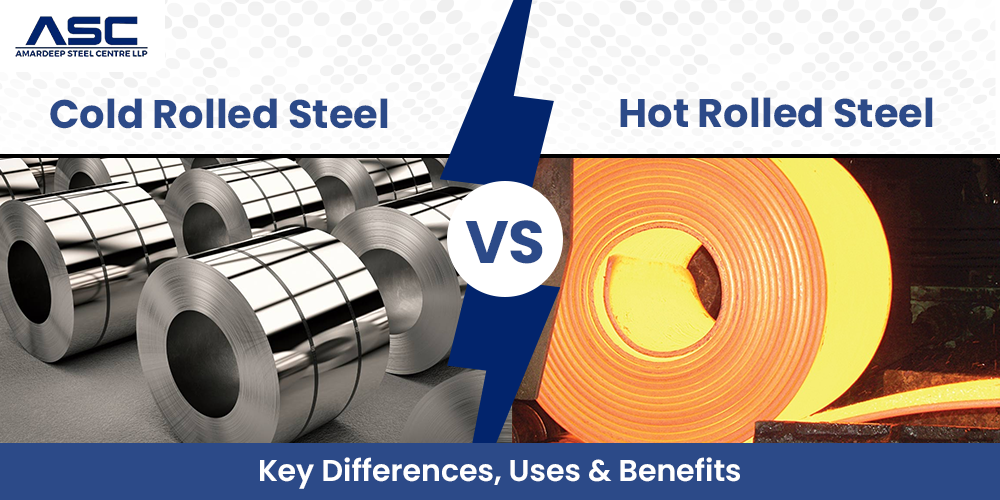
The right steel does not only lie in the grade but it also lies in how that steel was formed. The main distinction between hot rolled and cold rolled steel is the extent of the temperature in which they are handled. Hot rolled steel refers to those processed at high temperatures whereas cold rolled steel further undergoes processing at room temperature in order to obtain accurate dimensions and high quality of the surfaces.
We shall divide the manufacturing processes in this guide, compare their mechanical properties and a selection check list to make sure you select the most cost effective material to use in your project.
Quick Answer: What's the Difference Between Hot Rolled and Cold Rolled Steel?
The processing temperature is the basic difference. Hot rolled steel is rolled at elevated temperatures (usually more than 1,700 F), that is above the recrystallization temperature of the steel. Cold rolled steel is actually much hot rolled steel that has undergone additional processing at room temperature, called cold reduction, to obtain tighter tolerances, a smoother finish and greater strength by work hardening.
How Hot Rolled Steel Is Made
The Hot Rolling Process
Hot rolling occurs at temperatures exceeding the steel's recrystallization point.
- Heating: Large steel slabs or billets are heated in a furnace.
- Rolling: The glowing-hot steel is passed through rollers to reach the desired dimensions.
- Cooling: As the steel cools, it shrinks slightly. Because the cooling is non-uniform, the final shape has less precision than cold-processed alternatives.
Typical Characteristics of Hot Rolled Steel
- Mill Scale: A bluish-gray, oxidized finish caused by cooling at high temperatures.
- Rounded Edges: Due to shrinkage, corners and edges are less defined.
- Wider Tolerances: Slight distortions occur during the cooling process.
- Cost-Efficiency: Requires significantly less processing time and labor than cold rolling.
How Cold Rolled Steel Is Made
The Cold Rolling Process
Cold rolling doesn't actually begin at the furnace; it begins with hot rolled steel.
- Pickling: The hot rolled steel is "pickled" in an acid bath to remove mill scale.
- Cold Reduction: The steel is passed through rollers at room temperature.
- Annealing & Tempering: To prevent the steel from becoming too brittle, it is often heated (annealed) in a controlled manner and then "temper rolled" to achieve the final desired hardness and smoothness.
Typical Characteristics of Cold Rolled Steel
- Oily or Smooth Finish: The surface is clean, often appearing oily, and is ready for paint or plating.
- Tight Tolerances: Dimensions are extremely precise because no shrinkage occurs after rolling.
- Increased Strength: The "work hardening" process can increase the yield strength by up to 20%.
Cold Rolled Steel vs Hot Rolled Steel: Side-by-Side Differences
|
Parameter |
Hot Rolled Steel (HR) |
Cold Rolled Steel (CR) |
Best Choice When... |
|---|---|---|---|
|
Surface Finish |
Rough, scaled, non-reflective |
Smooth, shiny, often oily |
CR for aesthetics; HR for industrial |
|
Dimensional Accuracy |
Lower (not for precision) |
High (tighter tolerances) |
CR for precision machining |
|
Strength/Hardness |
Standard |
Higher (due to work hardening) |
CR for higher stress parts |
|
Formability |
High (easy to shape) |
Lower (more brittle) |
HR for complex structural bends |
|
Internal Stress |
Low (stable) |
Higher (may warp if cut) |
HR for large structural beams |
|
Cost |
Lower |
Higher (approx. 30–50% more) |
HR for budget-sensitive projects |
Uses and Applications
Best Applications for Hot Rolled Steel
Because HR steel is affordable and easy to work with in large formats, it is the backbone of heavy industry.
- Structural Components: I-beams, channel iron, and railroad tracks.
- Heavy Fabrication: Base plates, brackets, and truck frames.
- Agriculture: Silos, farm equipment, and heavy piping.
Explore our Hot Rolled Steel Products and Carbon Steel Plates.
Best Applications for Cold Rolled Steel
When precision and visual appeal are the priorities, CR steel is the standard.
- Consumer Goods: Home appliances (fridges/washers), metal furniture, and filing cabinets.
- Automotive: Car body panels, exhaust tubes, and precision shafts.
- Electronics: Computer enclosures and precision hardware.
Does This Difference Apply to Stainless Steel Too?
Yes. While the metallurgical properties of stainless steel differ from carbon steel, the mechanical processing remains the same.
- Hot Rolled Stainless: Often used for heavy industrial tanks, structural supports, and chemical processing equipment where the "industrial" look is acceptable.
- Cold Rolled Stainless: This is the standard for kitchen appliances, medical tools, and architectural trim. It provides that iconic bright, reflective finish.
See our full range of Stainless Steel Sheets & Plates.
Frequently Asked Questions
Is cold rolled steel stronger than hot rolled steel?
Yes. Through a process called work hardening, cold rolling increases the yield and tensile strength of the metal, making it physically harder than its hot-rolled counterpart.
Why is cold rolled steel more expensive?
It requires more processing steps (cleaning, cold reduction, annealing) and more energy to roll metal at room temperature.
Which is better for welding?
Hot rolled steel is generally preferred for heavy welding because it has fewer internal stresses, reducing the risk of warping during the heating and cooling of the weld.
Conclusion
Choosing between hot rolled and cold rolled steel depends on balancing precision, strength, and budget. Hot rolled steel is the go-to for structural projects and heavy fabrication where cost-efficiency and ease of forming are the primary drivers. However, when your application demands tight dimensional tolerances, a superior surface finish for coating, or enhanced mechanical hardness, cold rolled steel is the essential choice. Understanding these technical nuances ensures you select a material that meets your specifications while optimizing production costs. At Amardeep Steel, we specialize in providing premium steel solutions tailored to your specific industrial needs. Whether you require heavy-duty structural plates or precision-engineered cold-finished sheets, we ensure you receive the right material with the reliability your business deserves. Partner with Amardeep Steel for your next project to experience expert guidance and high-performance steel.