Types of Stainless Steel Pipe Fittings: A Complete Guide
by AMC
Posted on March 10, 2025 at 05:01 PM
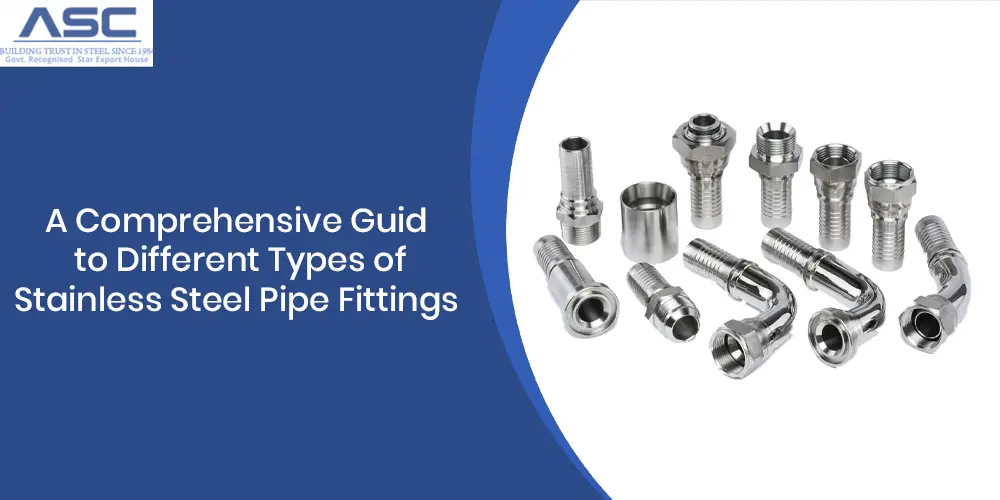
Industrial piping systems depend on dozens of small components to keep fluids and gases moving safely and efficiently. Among these, stainless steel pipe fittings are some of the most critical — they connect pipes, change direction, control flow, and allow for maintenance access. But not all fittings work the same way, and choosing the wrong type for an application can lead to leaks, pressure failures, or costly shutdowns.
This guide breaks down every major type of stainless steel pipe fitting, explains how each works, and helps you match the right fitting to the right job. If you already know what you need and want to check grades, specifications, or request a quote, visit our stainless steel fittings product page.
1. Buttweld Pipe Fittings
Buttweld fittings are the most widely used type in industrial piping. The fitting is welded directly to the pipe end, creating a continuous, seamless joint with no mechanical threads or sockets. This makes them the top choice for high-pressure and high-temperature systems where zero leakage is non-negotiable.
Types of Buttweld Fittings
| Fitting Type | How It Works | Best For |
|---|---|---|
| Elbow (45° / 90°) | Changes pipe direction at 45° or 90° angles | Oil & gas, refineries, tight spaces |
| Long Radius Elbow | 90° turn over a longer arc, reduces turbulence | High-flow systems, chemical plants |
| Reducer (Concentric) | Connects pipes of different diameters, centred | Horizontal pipelines, pumps |
| Reducer (Eccentric) | Connects unequal diameters, offset bottom | Suction lines, preventing air pockets |
| Equal Tee | Splits or merges flow into three equal branches | General distribution systems |
| Reducing Tee | Branch is smaller than the main run | Selective flow control systems |
| Cap | Seals the open end of a pipe permanently | Pipeline terminations, testing |
| Stub End | Used with lap joint flanges for easy dismantling | Systems needing frequent inspection |
| Cross | Four-way junction for splitting flow | Complex manifold systems |
Standards: ASME B16.9, MSS SP-43. For full specifications and available grades, see our SS buttweld fittings page.
2. Forged (Socket Weld & Threaded) Fittings
Forged fittings are manufactured by applying extreme pressure to solid steel, producing a denser, stronger fitting than cast alternatives. They are used in smaller pipe sizes — typically ½" to 4" NB — and are divided into two connection types:
Socket Weld Fittings
The pipe end is inserted into a recessed socket in the fitting, then fillet-welded on the outside. This creates a strong, leak-resistant joint without requiring pipe-end preparation. Socket weld fittings are ideal for non-corrosive service and applications where radiographic inspection is not required.
- Common types: elbows, tees, reducers, couplings, caps, crosses
- Size range: ½" to 4" NB
- Standard: ASME B16.11
Threaded (Screwed) Fittings
Threaded fittings use NPT (National Pipe Thread) or BSP threads to connect pipes mechanically — no welding required. This makes them fast to install and remove, ideal for low-pressure utility systems and maintenance-intensive environments.
- Common types: elbows, tees, unions, couplings, nipples, plugs, bushings
- Size range: ½" to 4" NB
- Standard: ASME B16.11
View our complete range of stainless steel forged fittings including socket weld and threaded types.
3. Flanges
While not always classified as pipe fittings, flanges are integral to piping assemblies. They are flat disc-shaped components that bolt two pipe sections or pipe-to-equipment connections together. Unlike welded joints, flanged connections can be fully disassembled, making them critical in systems requiring regular inspection, maintenance, or component replacement.
Common Flange Types
- Weld Neck Flange – High-pressure, high-temperature pipelines
- Slip-On Flange – Easy installation, moderate pressure service
- Blind Flange – Seals the end of a pipeline or vessel opening
- Socket Weld Flange – Small bore, high-pressure piping
- Threaded Flange – Low-pressure, non-welded connections
- Lap Joint Flange – Used with stub ends, ideal for frequent dismantling
Standard: ASME B16.5. Browse our stainless steel flanges range for grades, pressure classes, and face types.
4. Nipples and Adapters
Nipples are short lengths of pipe — typically with male threads on both ends — used to extend piping or connect two female-threaded fittings. Adapters allow transition between different pipe sizes, thread types, or end connections (e.g., from threaded to socket weld).
- Close nipple: threads run the full length, no exposed pipe between
- Hex nipple: hex body for easier wrench grip
- Reducing nipple / adapter: transitions between two different sizes
- Union: allows complete disconnection of two pipe sections without rotating
5. Pipe Bends
Bends differ from elbows in that the radius of curvature is larger — typically 3D, 5D, or 10D (where D = nominal pipe diameter). This gentler arc reduces turbulence and pressure drop compared to standard elbows, making bends preferable in high-flow and slurry systems where erosion is a concern.
- 3D Bend: tighter curve, used in space-constrained systems
- 5D Bend: standard sweep, balances space and flow efficiency
- 10D Bend: gentle curve, maximum flow retention, used in transfer lines
6. Olets (Branch Fittings)
Olets are self-reinforcing fittings used to create branch connections on existing pipelines without the need for a tee fitting. They are welded directly onto the main pipe, making them ideal when adding branches to an already-installed system.
| Olet Type | Use Case |
|---|---|
| Weldolet | Buttweld branch connection — most common for high-pressure systems |
| Sockolet | Socket weld branch for smaller bore pipes |
| Thredolet | Threaded branch connection, no weld required |
| Elbolet | Branch at an elbow junction, changes direction while branching |
| Nipolet | Combines nipple and olet — branch + extension in one fitting |
| Sweepolet | Large-radius branch, minimal flow disruption — used in erosion-prone systems |
How to Choose the Right Type of Stainless Steel Pipe Fitting
Selecting the right fitting type depends on four main factors:
- Pressure & Temperature Rating: Buttweld fittings handle the highest pressures (Class 150–2500). Threaded fittings suit lower-pressure utility lines.
- Pipe Size: Forged fittings (socket weld / threaded) are typically used for ½" to 4" NB. Buttweld fittings cover ½" to 48" NB.
- Maintenance Frequency: If the connection needs to be opened regularly, use flanges or unions. Welded joints are permanent.
- Flow Requirements: For systems where pressure drop and turbulence matter, use long-radius elbows or pipe bends instead of short-radius elbows.
For grade selection, size ranges, pressure ratings, and end connection options, refer to our complete SS pipe fittings specifications.
Stainless Steel Grades Used in Pipe Fittings
The grade of stainless steel determines corrosion resistance, temperature performance, and mechanical properties. Here is a quick reference:
| Grade | Key Applications | Standard | Composition |
|---|---|---|---|
| 304 | Food & beverage, water treatment, general purpose | ASTM A403 | 18% Cr, 8% Ni |
| 316 / 316L | Marine, pharmaceuticals, chemical processing | ASTM A403 | 16% Cr, 10% Ni, 2% Mo |
| 321 | Heat exchangers, aerospace, power plants | ASTM A403 | 17% Cr, 9% Ni + Ti stabilized |
| 310 | High-heat furnaces, kilns (up to 1150°C) | ASTM A403 | 25% Cr, 20% Ni |
| 317L | Sulfuric acid exposure, chemical plants | ASTM A182 | 18% Cr, 11% Ni, 3% Mo |
| 904L | Seawater, aggressive acid environments | ASTM A403 | 20% Cr, 25% Ni, 4.5% Mo |
Industry-Wise Applications
Different industries rely on specific fitting types based on their operating conditions:
- Oil & Gas / Refineries: Buttweld elbows, reducers, and tees in 316L or 321 grades for corrosive, high-pressure service.
- Pharmaceutical & Food Processing: Sanitary tube fittings and 316L buttweld fittings with polished, passivated surfaces for hygiene compliance.
- Chemical Plants: 904L and 317L fittings for resistance to sulfuric acid and chloride-rich media.
- Power Generation: 310 and 321 stainless fittings for high-temperature steam lines and heat exchanger connections.
- Marine & Shipbuilding: 316 grade fittings with passivated surfaces for seawater resistance.
- Water Treatment: 304 and 316 buttweld or flanged fittings in desalination and wastewater processing plants.
Frequently Asked Questions
What is the difference between buttweld and socket weld fittings?
Buttweld fittings are welded end-to-end with the pipe and are used in larger sizes and higher-pressure applications. Socket weld fittings have a recessed socket that the pipe inserts into before being fillet-welded — they are used in smaller pipe sizes (½" to 4") where full radiographic inspection is not required.
Which is better — 304 or 316 stainless steel for pipe fittings?
SS 304 offers excellent general-purpose corrosion resistance and is more cost-effective. SS 316 adds 2% molybdenum, which significantly improves resistance to chlorides, saltwater, and acidic chemicals. For marine, pharmaceutical, or chemical environments, 316 is the better choice. For food & beverage and general plumbing, 304 is usually sufficient.
What are olets used for?
Olets (weldolets, sockolets, thredolets, etc.) create branch connections on existing pipelines without cutting out a tee section. They are self-reinforcing, meaning no additional reinforcement pad is required, and are commonly used when adding branch lines to in-service pipelines.
Can stainless steel pipe fittings be used in high-temperature applications?
Yes. Grade 310 handles temperatures up to 1150°C. Grade 321 (titanium-stabilised) and 347 (niobium-stabilised) are designed to resist carbide precipitation at elevated temperatures, making them suitable for heat exchangers, power plants, and aerospace piping.
What standards apply to stainless steel pipe fittings?
The primary standards are ASME B16.9 (buttweld fittings), ASME B16.11 (forged socket weld and threaded fittings), ASME B16.5 (flanges), MSS SP-43, and ASTM A403 / A182 for material certification. International standards including DIN, EN, and ISO also apply.
Conclusion
Choosing the right type of stainless steel pipe fitting — whether buttweld, forged, flanged, or a specialty olet — depends on your operating pressure, pipe size, fluid type, and maintenance requirements. Understanding the differences between each type prevents costly errors at the specification stage.
For detailed specifications, grade availability, pressure ratings, and enquiries on stainless steel pipe fittings and SS tube fittings with ASME, ASTM, and ISO certification, visit Amardeep Steel Centre — one of India's leading stainless steel fittings manufacturers and exporters.
Understanding Stainless Steel Precision Tubes: Benefits and Applications
Stainless steel precision tubes are widely used in various industries for their structural integrity, corrosion resistance, and dimensional accuracy. These tubes are manufactured