Carbon Steel Flanges: Grades, Types and ASTM Specifications Complete Technical Guide
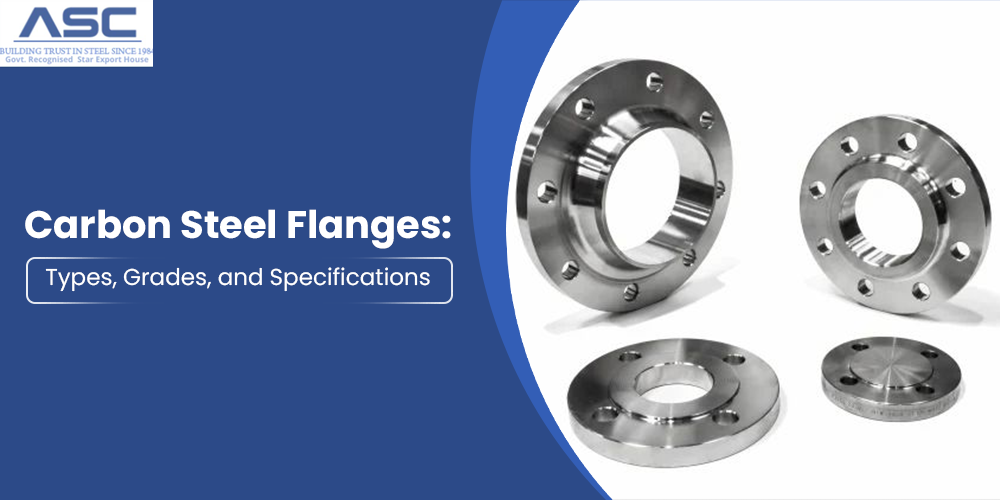
Carbon steel flanges are foundational components in industrial piping systems. They form the bolted joints that connect pipes, valves, pumps, and vessels into a sealed, pressure rated assembly. Used across oil and gas, petrochemical, power generation, shipbuilding, and water treatment industries, they are valued for their high strength, wide temperature tolerance, and cost effectiveness compared to stainless or alloy steel alternatives.
This guide covers everything engineers, procurement professionals, and project specifiers need to know about carbon steel flanges: the ASTM material grades, standard types, chemical and mechanical properties, applicable codes, and the key factors that determine which grade and type to specify for a given service condition.
What Is a Carbon Steel Flange?
A carbon steel flange is a forged or cast disc with bolt holes around its circumference, used to create a removable, bolted connection between two sections of a piping system or between a pipe and a piece of equipment. The flange faces are sealed with a gasket (flat, raised face, ring type joint, or spiral wound) and held together with bolts and nuts to a specified torque.
Carbon steel, as defined by the AISI/SAE standard, is steel in which carbon is the principal alloying element, containing up to 2.1% carbon by weight. For flange applications, low to medium carbon steels (0.10 to 0.35% C) are most common, offering a practical balance of strength, weldability, toughness, and machinability.
The term “CS flanges” or “carbon flanges” is widely used in procurement and refers specifically to flanges made from carbon or carbon manganese steel, as distinct from stainless steel flanges, alloy steel flanges, or duplex flanges.
Carbon Steel vs Other Flange Materials
|
Property |
|||
|
Cost |
Low |
High |
Medium to High |
|
Corrosion Resistance |
Moderate (coating required) |
Excellent |
Good (service dependent) |
|
Strength at Ambient Temp |
Good |
Good |
Excellent |
|
High Temp Performance |
Good (up to 800°F) |
Very Good |
Excellent (up to 1200°F+) |
|
Low Temp Performance |
Limited (A350 LF2 needed) |
Good |
Good (with correct grade) |
|
Weldability |
Excellent |
Good |
Moderate |
|
Best For |
General industrial service |
Corrosive environments |
High temp or high pressure |
Carbon Steel Flange Grades and ASTM Standards
The American Society for Testing and Materials (ASTM) publishes the primary material specifications used globally for carbon steel flanges. The grade determines the alloy composition, heat treatment, mechanical properties, and the service conditions the flange can safely handle.
ASTM A105 and A105N: The Standard Grade
ASTM A105 is the most widely specified grade for forged carbon steel flanges, fittings, and valves used in pressure systems at ambient to high temperatures. A105N indicates normalized heat treatment (heated above the transformation range and air cooled), which refines the grain structure and improves toughness. Normalization is required for flanges above 2 inch in ASME B16.5 Class 600 and above.
Service range: −20°F to 800°F (−29°C to 427°C). Used in refineries, chemical plants, steam systems, and general industrial piping.
ASTM A350 LF2: Low Temperature Service
When piping systems operate below −20°F (−29°C), standard A105 flanges cannot be specified. The steel’s ductile to brittle transition means it may fail without warning in cold conditions. ASTM A350 LF2 is formulated for low temperature service down to −50°F (−45°C), with mandatory Charpy V notch impact testing at −50°F to verify notch toughness.
Applications include LNG processing plants, cryogenic storage, refrigeration systems, cold climate pipeline installations, and offshore platforms in Arctic regions.
ASTM A694 F52 to F80: High Yield Transmission
These grades are specified for high pressure oil and gas pipeline flanges where elevated yield strength is required. The designation (F52, F60, F65, F70, F80) indicates the minimum yield strength in ksi. Unlike A105, which is a composition based specification, A694 grades are property based. The manufacturer has flexibility in alloy additions to achieve the required yield.
Applications include high pressure natural gas transmission (ANSI 600# and above), subsea pipelines, offshore topsides, and large bore pipeline systems.
ASTM A182 F11 and F22: Alloy Steel for High Temperature Service
Technically alloy steel rather than pure carbon steel, A182 F11 (1.25% Cr, 0.5% Mo) and F22 (2.25% Cr, 1% Mo) flanges are specified for high temperature service in power generation and refinery applications where carbon steel’s creep resistance is insufficient. They are commonly procured alongside carbon steel flanges and follow the same fitting standards.
Service range: up to 1100°F (593°C). Used in steam turbine piping, boiler headers, and catalytic reformer units.
Chemical Composition of A105 Carbon Steel Pipe Flanges
| Element | Composition,% |
|---|---|
| Carbon (C) | 0.35max |
| Manganese (Mn) | 0.60–1.05 |
| Phosphorus (P) | 0.035max |
| Sulfur (S) | 0.040max |
| Silicon (Si) | 0.10–0.35 |
| Copper (Cu) | 0.40max |
| Nickel (Ni) | 0.40max |
| Chromium (Cr) | 0.30max |
| Molybdenum (Mo) | 0.12max |
| Vanadium (V) | 0.08max |
Mechanical Properties of ASTM A105
| Mechanical Properties | Requirements |
|---|---|
| Tensile strength,min,psi [MPa] | 70000 [485] |
| Yield strength,min,psi [MPa] | 36000 [250] |
| Elongation, min, % | 30 |
| Reductionofarea,min,% | 30 |
| Hardness,HB,max | 187 |
Flange Types and Connection Methods
The flange type determines how the flange connects to the pipe and the structural characteristics of the joint. ASME B16.5 defines the following standard types:
Weld Neck Flange (WNRF)
Characterized by a long tapered hub that transitions to the pipe wall thickness. The hub is butt welded to the pipe, creating a smooth bore for unrestricted flow and distributing mechanical and thermal stress across the weld area. The best choice for critical, high pressure, high temperature, or cyclic loading services.
Slip On Flange (SORF)
Slips over the pipe and is fillet welded on both the inside and outside faces. Easier to install than weld neck since no bore machining is needed, but slightly weaker under bending loads. Common in utility piping, water systems, and low to medium pressure service.
Blind Flange (BLRF)
A solid disc with no bore, bolted to the end of a pipe, vessel nozzle, or valve to seal off the end of a system. The most highly stressed flange type under internal pressure because the entire face is loaded, which is why blind flanges are typically the thickest flanges in a given pressure class.
Socket Weld Flange (SWRF)
The pipe end inserts into a counter bore socket in the flange and is held by a single fillet weld on the outside. Used for small bore piping (typically 2 inches and below) in high pressure service. Not recommended for cryogenic, elevated temperature cyclic service, or applications with crevice corrosion concerns.
Threaded Flange
Connected to the pipe by pipe threads with no welding required. The internal thread matches standard pipe threads (NPT or BSP). Suitable for low pressure, non hazardous, non cyclic service. The threaded joint’s susceptibility to leakage under thermal cycling restricts its use in critical applications.
Lap Joint Flange
Used in conjunction with a stub end fitting. The flange itself is loose and free to rotate, making bolt hole alignment straightforward. Common in systems requiring frequent disassembly for inspection, and in carbon steel systems connected to stainless or alloy stub ends to reduce cost.
Ring Type Joint Flange (RTJ)
Features a machined groove on the face that accepts a metal ring gasket (oval or octagonal cross section). The ring deforms under bolt load to create a metal to metal seal that is superior to spiral wound or flat gaskets. Specified for high pressure, high temperature, and sour service (H2S containing) applications, and is standard in oil and gas wellhead and Christmas tree assemblies.
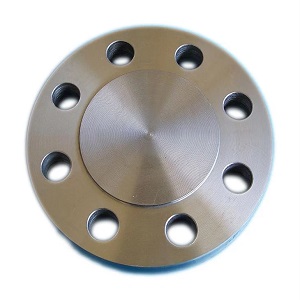
Blind Flange
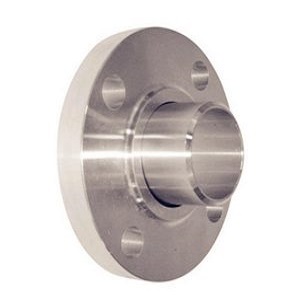
Lap Joint Flange
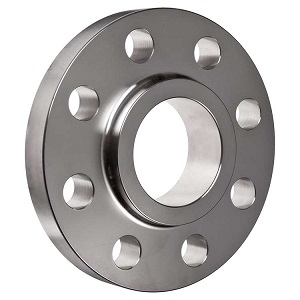
Slip On Flange
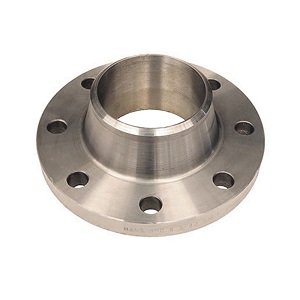
Weld Neck Flange
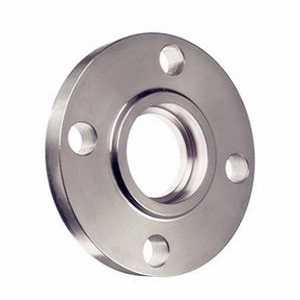
Socket Weld Flange
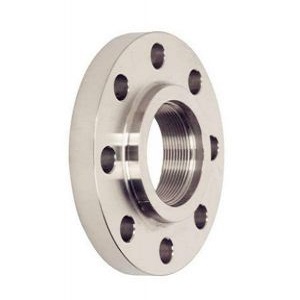
Threaded Flange
Forged vs Cast Carbon Steel Flanges
Most carbon steel flanges used in pressure piping are forged, not cast. Forging aligns the grain structure of the steel with the shape of the flange, producing superior mechanical properties compared to casting. The differences are significant in practice:
| Characteristic | Forged Carbon Steel | Cast Carbon Steel (Cast Iron) |
|---|---|---|
| Grain Structure | Oriented, refined by forging process | Random, may contain voids or inclusions |
| Tensile Strength | Higher: typically 70,000+ psi | Lower: typically 30,000 to 40,000 psi |
| Pressure Rating | Suitable for Class 150 to 2500 | Typically Class 125 or 250 only |
| Weldability | Good (low carbon content, A105) | Poor: cast iron is not weldable |
| Cost | Higher unit cost, lower lifecycle cost | Lower unit cost |
| Applications | All pressure piping: oil, gas, chemical, power | Low pressure non critical service, drainage |
ASME B31.3 (Process Piping) and B31.1 (Power Piping) require forged flanges for pressure systems. Cast iron flanges are not permitted in hydrocarbon or steam service.
Applicable Standards and Codes
Dimensional Standards
- ASME B16.5: Pipe flanges and fittings, NPS 1/2 inch to 24 inch, Classes 150 to 2500
- ASME B16.47: Large diameter steel flanges, NPS 26 inch to 60 inch, Series A (MSS SP 44) and Series B (API 605)
- ASME B16.48: Line blanks, NPS 1/2 inch to 24 inch
- MSS SP 44: Steel pipeline flanges
- DIN 2527, 2566, 2573, 2576, 2631 to 2638: German dimensional standards
- EN 1092-1: European flange standard (PN6 to PN100)
- BS 4504 and BS 10: British standards
- JIS B2220: Japanese Industrial Standard
- GOST 12820 and 33259: Russian standard
Material Standards
- ASTM A105 / ASME SA-105: Carbon steel forgings for piping
- ASTM A350 LF2: Low temperature carbon steel forgings
- ASTM A694: High strength carbon steel forgings for pipeline flanges
- ASTM A182: Alloy and stainless steel pipe flanges and fittings
- ASTM A516: Carbon steel plates for pressure vessels (used in plate flanges)
Corrosion Protection and Coatings
Carbon steel corrodes in the presence of moisture, oxygen, and corrosive process fluids. The following coatings are commonly applied to protect flanges during storage, transport, and in certain service environments:
- Anti-rust oil or VCI (Vapour Corrosion Inhibitor) oil: Standard for storage and shipping
- Yellow passivation: Light chromate coating for improved atmospheric corrosion resistance
- Electric zinc coating (galvanizing): White or yellow zinc for moderate corrosion environments
- Hot dip galvanizing: Heavier zinc coating for outdoor or wet service
- Epoxy or polyurethane coating: For buried pipelines or chemical exposure
- Alloy cladding or lining: Used where process fluid corrosion requires noble material contact surfaces
In process piping containing corrosive hydrocarbons, acids, or H2S, carbon steel flanges are often used with internal lining or are replaced with stainless steel depending on the corrosion allowance in the design.
How to Specify a Carbon Steel Flange: Quick Reference
When raising a material requisition (MR) or purchase order for carbon steel flanges, the following information should be specified:
- Type: Weld Neck, Slip On, Blind, Socket Weld, Threaded, Lap Joint, or RTJ
- Size: NPS or DN (for example 4 inch or DN100)
- Pressure Class: ANSI 150# / 300# / 600# / 900# / 1500# / 2500#, or DIN PN rating
- Standard: ASME B16.5 or B16.47 Series A or B
- Material Grade: ASTM A105N, A350 LF2, A694 F65, or equivalent
- Face Type: Raised Face (RF), Ring Type Joint (RTJ), or Flat Face (FF)
- Bore: Full bore or reduced bore (confirm to match pipe schedule)
- Heat Treatment: Normalized (N) for A105N; impact tested for A350
- Inspection and Testing: PMI, hydrostatic, radiography, third party inspection
- Certifications required: EN 10204/3.1, NACE, PED, ATEX, and others as applicable
Summary: Choosing the Right Carbon Steel Flange Grade
| Service Condition | Recommended Grade | Key Standard |
|---|---|---|
| General industrial, ambient to high temp | ASTM A105N | ASME B16.5 |
| Low temperature (−50°F to −20°F) | ASTM A350 LF2 | ASME B16.5 |
| High pressure oil and gas transmission | ASTM A694 F52 to F80 | ASME B16.47 / API 605 |
| High temperature power generation | ASTM A182 F11 / F22 | ASME B16.5 |
| Very high temperature (above 1100°F) | ASTM A182 F91 (CrMo) | ASME B16.5 |
This guide was prepared by Amardeep Steel, a leading carbon steel flanges manufacturer and supplier in India. For technical inquiries, custom specifications, or bulk supply requirements, contact our engineering team.
304 Stainless Steel: Everything You Need to Know – Simple Guide
Ever found yourself wondering what gives your kitchen sink that lasting shine, or what tough material keeps those big industrial pipes from turning into rust buckets?